The debt avalanche method directs every extra dollar you can spare toward the debt carrying the highest annual percentage rate (APR), while paying only the minimum on everything else. Once that balance is gone, you roll its entire payment into the next-highest APR debt and repeat. When you can stay disciplined and cover all your minimums reliably, this approach typically saves more interest and cuts payoff time more than any other debt repayment strategy. For a side-by-side comparison with the snowball method, jump to the numeric example below; to model your own numbers, the interactive calculator section walks you through it step by step.
Key Takeaways
The debt avalanche method saves more interest than any other common repayment strategy, but its real advantage only materializes if you automate minimums and stay consistent through the slow early months.
| Point | Details |
|---|---|
| Rank debts by APR | List every balance and sort highest to lowest APR — that order is your payoff sequence. |
| Automate all minimums | Autopay every minimum before directing extras anywhere; one missed payment can erase weeks of interest savings. |
| Roll payments forward | When a debt closes, immediately add its full payment to the next debt on your list. |
| Model before you commit | Run avalanche and snowball scenarios in a calculator to see actual interest and timeline differences for your specific balances. |
| Apexapro calculator | Use Apexapro's free browser tool to compare methods, test extra-payment amounts, and export your payoff plan. |
Table of Contents
- How does the debt avalanche method work?
- Avalanche vs. snowball: what the numbers actually show
- Who benefits from the avalanche method, and who should think twice?
- Your startup checklist for this week and this month
- How to accelerate payoff and the risks to weigh
- How to use a debt-payoff calculator to model your own scenarios
- What practitioners have learned about sticking with the avalanche
- Apexapro's free debt-payoff calculator makes this easier
- Sources
How does the debt avalanche method work?
Chase's debt education guide defines the process cleanly: make minimum payments on all accounts, then send every extra dollar to the highest-APR balance until it's gone, and roll that freed-up payment forward to the next debt in line.
Here is the exact sequence to follow:
- List every debt with its current balance, minimum payment, and APR.
- Rank debts from highest to lowest APR — this is your payoff order.
- Confirm you can cover all minimums each month without exception.
- Choose a fixed extra payment amount you can sustain (even $50 counts).
- Apply that extra amount to the top-ranked debt every month until it reaches zero.
- Roll the freed payment forward — add the full payment you were making on the paid-off debt to the minimum of the next debt on your list.
Wells Fargo's debt paydown guidance reinforces this sequence and emphasizes that automating minimum payments is the single most important safeguard against late fees erasing your interest savings.
A few bookkeeping habits make the process easier:
- Set autopay for every minimum payment so you never miss one.
- Track balances monthly in a spreadsheet or free app.
- Update your debt table whenever a balance closes or a rate changes.
Pro Tip: For variable-rate debts like credit cards or HELOCs, use the current APR to rank your list, but re-evaluate the order whenever rates shift materially. A card that was third on your list can jump to first after a rate hike.
Avalanche vs. snowball: what the numbers actually show
To see the difference concretely, consider three debts with fixed rates:
Assumptions: $400 total monthly payment, with minimums and extra payment amounts; rates are fixed. No new charges.
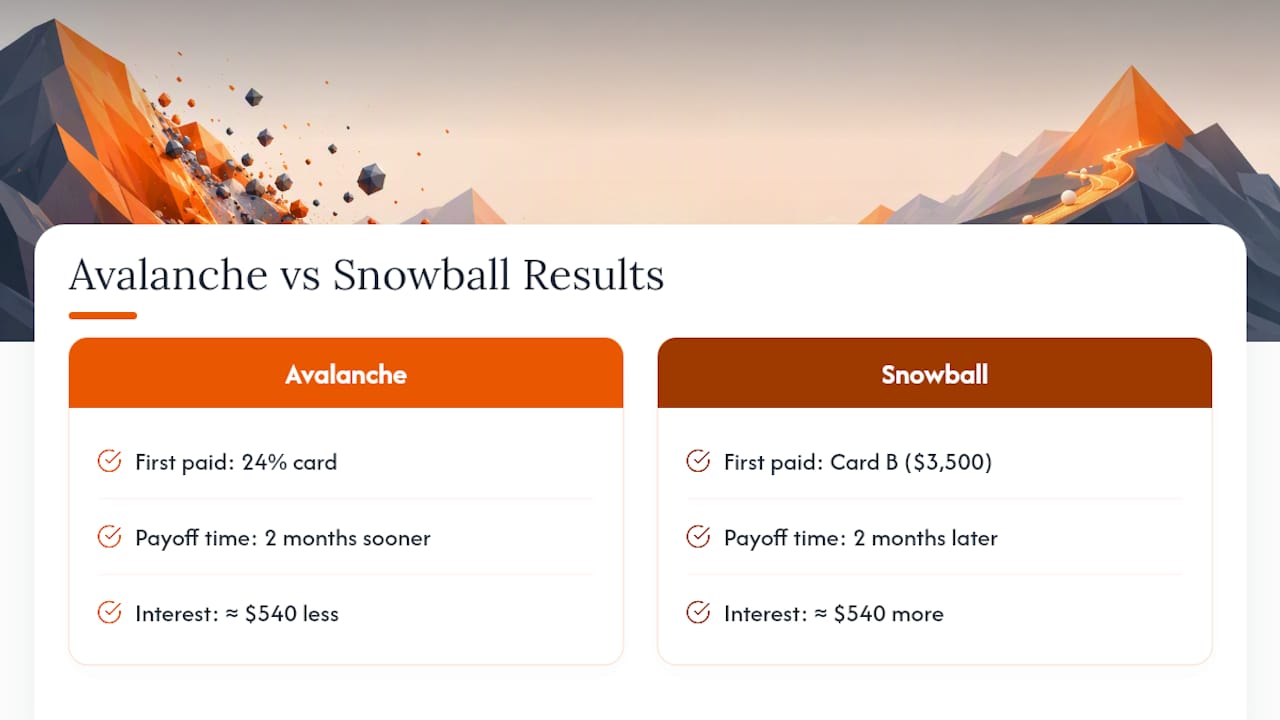
Snowball order: Card B ($3,500 smallest) → Personal Loan ($4,000) → Card A ($6,000 largest).
Running both schedules through a payoff calculator produces the following results:
The core insight: Targeting the 24% card first reduces the principal that compounds at the highest rate. Experian's analysis describes this as "earning back" the interest you would otherwise pay — a useful frame for understanding why the order of payoff matters so much.
The snowball finishes only two months later in this scenario, but costs roughly $540 more in interest. On larger balances or higher APRs, that gap widens considerably. Your own numbers will differ, which is exactly why running them through a calculator before committing to a strategy is worth the 10 minutes it takes.
Who benefits from the avalanche method, and who should think twice?
Advantages worth knowing:
- Mathematically optimal for total interest savings across nearly all debt profiles.
- Shortens overall payoff time when followed consistently.
- Works especially well when the highest-APR debt also carries a significant balance.
Real limitations:
- Progress can feel invisible for months if the top-ranked debt is large. Investopedia notes that this is the primary reason borrowers abandon the plan before it pays off.
- Requires an emergency fund buffer; one unexpected expense can derail the extra payment.
- Variable-rate debts add reranking complexity.
Who fits the avalanche best: analytical borrowers who track numbers, respond to data rather than emotion, and can sustain a plan without needing to see a balance hit zero quickly. If that description fits you, the avalanche is likely your best debt repayment plan.
Who should consider the snowball instead: borrowers who have struggled to stick with financial plans before, or who have several small balances that could be eliminated quickly for a motivational boost. Fidelity's comparison puts it plainly: there is no single best method, and the right choice depends on your temperament as much as your math. You can also read the full debt snowball method breakdown to weigh both approaches side by side.
Pro Tip: A hybrid approach works well when one small balance sits just below your highest-APR debt. Knock out the small one first for a quick win, then pivot to pure avalanche order. The interest cost of that detour is usually minor, and the motivational payoff can keep you on track for the longer haul.
Three warnings to keep visible:
- Never skip a minimum payment to fund your extra payment. Late fees and penalty APRs can cost more than the interest you were trying to avoid.
- Long payoff timelines can wear on motivation. Build in small milestones — a dinner out when a balance hits 50% — to maintain momentum.
- Don't drain your emergency fund to accelerate payoff. One car repair without a cushion can send you back to the credit card you just paid off.
Your startup checklist for this week and this month
This week:
- Pull statements for every debt and note the balance, APR, and minimum payment.
- Rank debts from highest to lowest APR.
- Enroll every account in autopay for at least the minimum payment.
- Open a free payoff calculator or build a simple spreadsheet with your debt table.
Within 30–90 days:
- Set a fixed extra payment amount and add it to your monthly budget as a non-negotiable line item.
- Schedule a monthly calendar reminder to update balances and confirm your APR ranking is still current.
- When a debt closes, immediately redirect its full payment to the next debt on your list — don't let that money disappear into discretionary spending.
- Keep at least one month of minimum payments in a separate savings buffer so a cash-flow hiccup doesn't break your autopay chain.
Pro Tip: Treat your extra payment like a bill, not a surplus. Naming it "Debt Avalanche Payment" in your budget app makes it psychologically harder to skip than a vague "savings" line.
How to accelerate payoff and the risks to weigh
Three tactics can meaningfully speed up your timeline, but each carries tradeoffs.
SoFi's debt avalanche guide cautions that one-time fees can eliminate expected interest savings if you don't account for them upfront. Model the total cost, not just the promotional rate.
Debt consolidation loans combine multiple balances into a single fixed-rate loan, which simplifies tracking and can lower your weighted average APR. Use a refinance calculator to compare the all-in cost before signing.
Negotiating directly with creditors costs nothing and is underused. Credit card issuers sometimes reduce APRs for customers with good payment history, especially if you mention a competing offer. A single call can shave 2–5 percentage points off a rate and accelerate your avalanche without any fees.
- Calculate the all-in cost of any acceleration tactic (fees plus remaining interest).
- Compare that total to the interest you'd pay staying on your current avalanche schedule.
- Verify any lender or consolidation firm using FINRA BrokerCheck or NMLS Consumer Access before sharing financial information.
- Keep minimums automated throughout any transition to avoid penalty APRs.
Pro Tip: Windfalls — tax refunds, bonuses, side-income payments — are the fastest legal way to accelerate an avalanche. Apply them directly to your top-ranked balance the day they arrive, before they get absorbed into everyday spending.
How to use a debt-payoff calculator to model your own scenarios
A good payoff calculator asks for five inputs per debt: balance, APR, minimum payment, extra monthly payment, and payment frequency. Getting APR vs. APY terminology right before you enter numbers matters — use APR, not APY, to avoid overstating your interest cost.
Three scenarios worth running:
- Credit-card-heavy profile: Three cards with APRs of 22%, 19%, and 15%, balances of $5,000, $2,500, and $1,800. Set extra payment to $150. Look for total interest paid and the month each card closes.
- Mixed-loans profile: One credit card at 20%, one auto loan at 7%, one student loan at 5%. The avalanche concentrates everything on the card; watch how quickly the other two resolve on minimums alone.
- High-balance/high-APR profile: A single card at 26% with a $12,000 balance alongside two smaller debts. This is the scenario where avalanche saves the most and where motivation is hardest — note the payoff date and set a halfway milestone.
When reading outputs, focus on three numbers: total interest paid, full payoff date, and the month each individual debt closes. Change the extra payment by $50 in either direction to see how sensitive your timeline is — that sensitivity check often reveals that a modest increase in extra payment cuts months off the schedule.
Pro Tip: Save or export your scenario before changing inputs. Comparing a saved baseline against a revised scenario is the clearest way to see whether a balance transfer or extra payment actually improves your position.
What practitioners have learned about sticking with the avalanche
The avalanche method works on paper for almost everyone who tries it. Where it breaks down is almost always behavioral, not mathematical.
The most common failure pattern: a borrower sets up the plan correctly, automates minimums, and directs extras to the highest-APR card — then, three months in, sees no visible progress on that large balance and quietly stops making the extra payment. The minimums keep running, the balance barely moves, and the plan dissolves without a formal decision to quit. Investopedia's analysis identifies this abandonment risk as the central reason the avalanche's mathematical advantage doesn't always translate to real-world results.

The fix is simple but requires deliberate setup. Mark it on a calendar. Acknowledge it when you hit it. That structure converts an abstract number into a series of short-term targets, which is what keeps the plan alive through the slow middle months.
A few practical reminders from people who've run this process successfully: re-evaluate your APR ranking every quarter, especially if you carry variable-rate balances. Don't interpret a closed account as permission to stop the extra payment — that's the moment the rollover does its most powerful work. And consider a hybrid approach without guilt if your highest-rate debt is also your largest; the interest cost of clearing one small balance first is usually modest, and the motivational return can be worth it.
Apexapro's free debt-payoff calculator makes this easier
Apexapro's free, browser-based debt-payoff calculator lets you run avalanche and snowball scenarios side by side in under five minutes, with no account required and nothing to download. Enter your balances, APRs, minimums, and extra payment amount, and the tool shows you total interest paid, full payoff date, and a month-by-month breakdown for each method. Adjust the extra payment slider to see how an additional $50 or $100 changes your timeline. You can export or save your scenario summary to compare options before committing to a plan.
Head to Apexapro to run your numbers now and see exactly how much the avalanche method could save you.
Sources
- What is the debt avalanche method and how to apply it
- Debt snowball method vs. debt avalanche method: Which is right for you? | Fidelity
- The Debt Avalanche Method: How it Works and When to Use It
- Debt avalanche definition and explanation | Investopedia
- What to know about the debt snowball vs avalanche method
- Using the Debt Avalanche Method of Paying Off Debt | SoFi
This article is general information, not a substitute for advice from a qualified financial advisor. Consult a qualified financial professional about your own circumstances before acting on anything here.