
What are the best refinance calculators available right now?
The strongest mortgage refinance calculators on the market today come from three institutions that homeowners and financial professionals consistently trust: Bankrate, Fannie Mae, and Bank of America. Each one goes beyond a simple monthly payment comparison to show you closing costs, break-even timing, and the long-term interest picture that actually determines whether refinancing makes sense for your situation.
Here is what these tools offer at a glance:
- Bankrate Refinance Calculator: Pulls live rate data, lets you enter your credit score range for a personalized rate estimate, and flags whether your break-even point falls under the three-year benchmark experts recommend.
- Fannie Mae Mortgage Refinance Calculator: Walks through current loan details and new loan terms side by side, with a clear emphasis on closing cost accuracy and how location-specific fees affect your real numbers.
- Bank of America Mortgage Refinance Calculator: Integrates with Bank of America's lending products, making it useful for homeowners who want to compare a lender-specific offer against their current mortgage in one place.
All three include inputs for taxes, homeowners insurance, and mortgage insurance premiums, which matters because a calculator that omits those figures will overstate your monthly savings. The best refinance calculators also show total interest paid over the life of the loan, not just the monthly payment difference.
How to use a refinance calculator effectively

Getting useful results starts with accurate inputs. Pull out your most recent mortgage statement before you open any calculator.
What to enter for your current mortgage:
- Remaining loan balance (not the original amount)
- Current interest rate, to three decimal places if possible
- Current monthly principal and interest payment
- Years remaining on the loan
What to enter for the new loan:
- New interest rate from a lender quote or the calculator's live rate feed
- Proposed loan term (10, 15, 20, or 30 years)
- Estimated closing costs typically range from 2% to 6% of the loan amount
- Any cash-out amount if you plan to tap equity
Optional fields for taxes, homeowners insurance, and PMI sharpen the estimate considerably. If your refinance would eliminate PMI, add that monthly savings to your current payment input so the calculator captures the full benefit.
Pro Tip: Run at least three scenarios before drawing any conclusions: one with your current loan term, one with a shorter term, and one where you roll closing costs into the loan balance versus paying them out of pocket. The differences in lifetime interest can be striking.

Comparing loan estimates from at least three lenders before committing is one of the most effective ways to avoid overpaying on fees and rates. A calculator gives you the framework; real Loan Estimates give you the numbers worth comparing.
How to read your refinance calculator results
The output from a well-built refinance savings calculator tells three distinct stories, and you need all three to make a sound decision.
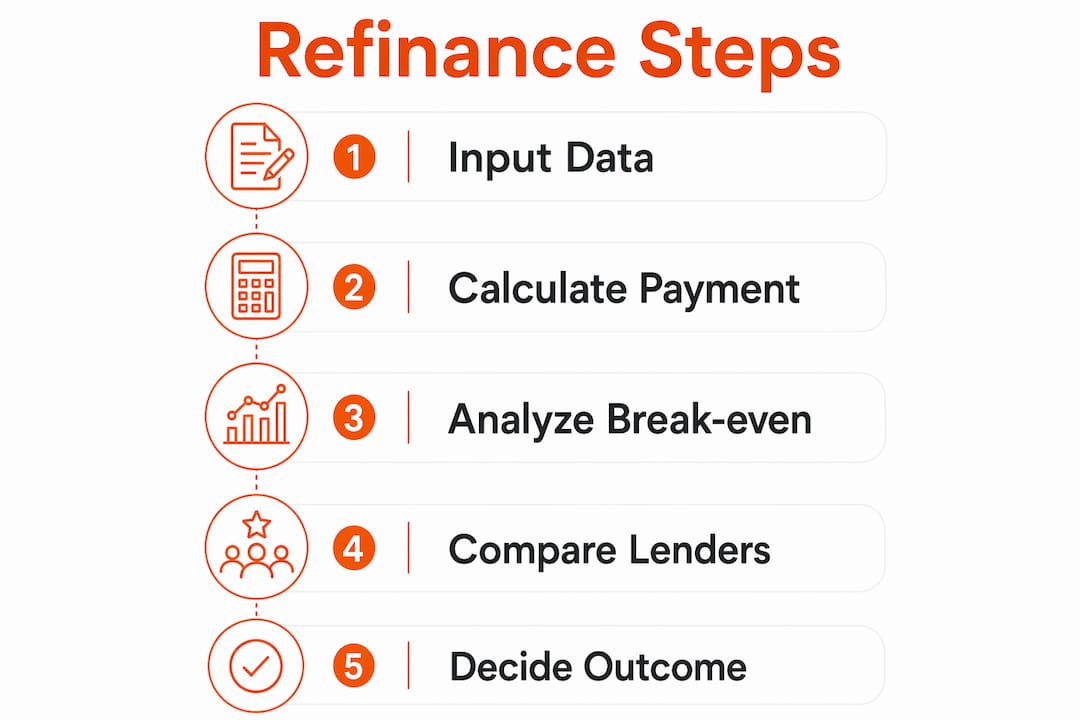
Monthly payment comparison shows the difference between what you pay now and what you would pay after refinancing. A lower number feels good, but it is only part of the picture.
Break-even point is where the real analysis begins. The formula is straightforward: divide your total closing costs by monthly savings to get the number of months until the refinance pays for itself. If closing costs are $6,000 and monthly savings are $200, the break-even is 30 months. Refinancing only makes financial sense if you plan to stay in the home past that point.
Lifetime interest comparison is the figure most homeowners overlook. Resetting a loan with many years remaining to a new longer term extends your payoff date and can add significantly to total interest paid, even when the monthly payment drops. A calculator that shows only monthly savings but omits total interest effects gives you an incomplete picture.
| Output | What It Measures | Why It Matters |
|---|---|---|
| New monthly payment | Principal and interest on the refinanced loan | Shows immediate cash flow impact |
| Monthly savings | Difference between old and new P&I | Starting point for break-even math |
| Break-even point | Closing costs ÷ monthly savings (in months) | Tells you how long you must stay to profit |
| Lifetime interest saved or added | Total interest on new loan vs. remaining interest on current loan | Reveals hidden cost of term extension |
| Total closing costs | Fees to complete the refinance | Determines upfront cash needed |
Closing costs typically range from 2% to 6% of the loan amount. On a typical loan balance, this represents several thousand dollars in upfront costs before you see savings.
Key factors that shape your refinance decision
The monthly payment drop is the number that gets attention, but several other factors determine whether a refinance actually improves your financial position.
How long you plan to stay in the home. Refinancing is only financially advisable when your break-even period is shorter than the time you expect to keep the loan. If you plan to sell in two years and the break-even is 30 months, the math does not work regardless of how attractive the new rate looks.
The three-year benchmark. Financial experts generally treat a break-even point under 36 months as the threshold where refinancing is worth pursuing, assuming you plan to stay that long. That is a guideline, not a guarantee, and your personal timeline is what actually matters.
Term reset and amortization. Extending your remaining term when you refinance is one of the most common ways homeowners end up paying more over time despite lower monthly payments. A 15-year remaining balance reset to 30 years adds a decade of interest payments. The Loan Estimate you receive from a lender will show this clearly.
- Avoid the "2% rate drop" rule as a universal trigger. Your actual break-even period, calculated from real closing costs and real savings, is a far more reliable guide than any rate-drop threshold.
- PMI elimination can add meaningful monthly savings on top of any rate benefit, sometimes making a refinance worthwhile even when the rate improvement alone would not clear the bar.
- Rolling closing costs into the loan preserves cash today but increases your principal and total interest paid, which pushes the break-even point further out.
- Cash-out refinancing changes the calculus entirely. The new loan amount is larger, so the rate comparison is only one piece of the cost picture.
Closing costs for smaller loan balances deserve extra scrutiny. Appraisal fees, title insurance, and recording fees can represent a disproportionately high percentage of the loan on balances under $150,000, making the break-even period longer than a simple percentage estimate would suggest.
What features should a good refinance calculator include?
Not every online tool gives you the full picture. The best mortgage refinance tools share a consistent set of features that separate thorough analysis from a rough estimate.
- Multiple loan term options: The ability to test 10, 15, 20, 25, and 30-year terms side by side reveals trade-offs between monthly payment reduction and lifetime interest that a single-term view hides entirely.
- Break-even calculator function: Divides total closing costs by monthly savings automatically, so you see the payoff timeline without manual math.
- Total interest comparison: Shows interest paid on the current loan for its remaining term versus interest paid on the new loan, surfacing the real cost of any term extension.
- Closing cost inputs: Lets you enter actual fee estimates from a Loan Estimate rather than relying on a generic percentage, which improves accuracy considerably. Obtaining a formal Loan Estimate from a lender before running the calculator is the single best way to get numbers that reflect your actual situation.
- PMI, taxes, and insurance fields: Optional inputs that produce a more complete monthly cost picture, especially relevant for homeowners whose refinance would eliminate mortgage insurance.
- Cash-out and roll-in-costs options: Lets you model scenarios where you tap equity or fold closing costs into the new balance, both of which affect the break-even timeline and total interest.
- Clear result summaries: Plain-language explanations of what each output means, not just raw numbers. A calculator that produces figures without context leaves homeowners guessing.
For a deeper look at how mortgage points affect break-even timing, running a separate points calculator alongside your refinance estimate can clarify whether buying down the rate upfront improves or worsens your position. If you are weighing loan types as part of your refinance, understanding how FHA, USDA, and conventional loans differ in their calculator inputs and eligibility rules adds useful context before you commit to a path.
Apexapro gives you free refinance tools with no sign-up required
Most homeowners run one scenario on one calculator and stop there. The problem is that a single estimate, especially one built on rough closing cost guesses, rarely captures the full picture. Apexapro is built for exactly the kind of multi-scenario, side-by-side analysis that produces a real answer.
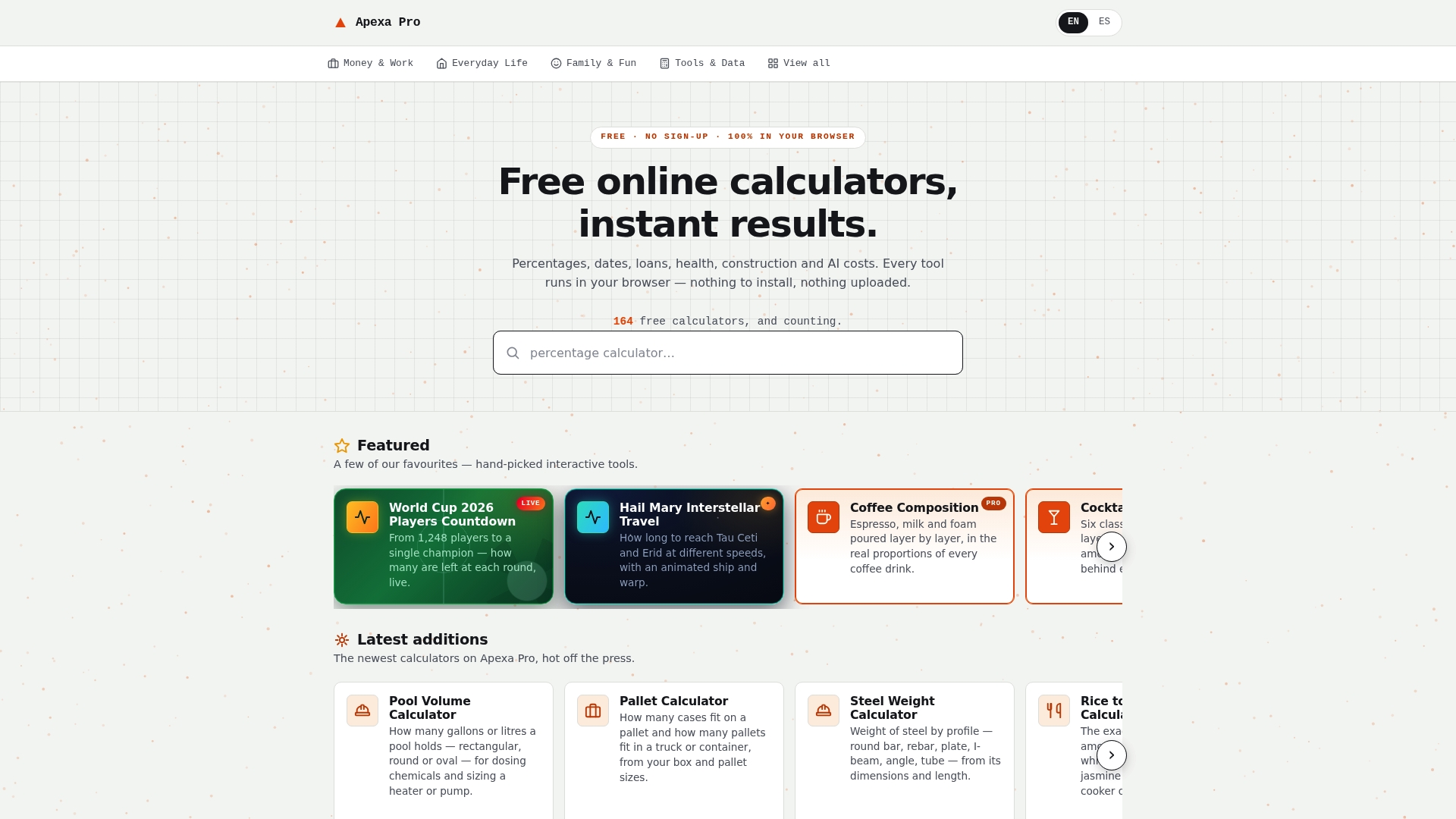
Apexapro's free mortgage calculators run instantly in your browser with no account, no download, and no paywall. You can test different loan terms, model the impact of rolling in closing costs versus paying them out of pocket, and see the break-even point update in real time. The tools are fully bilingual in English and Spanish, and the interface stays clean enough that the numbers stay front and center. Visit Apexapro to run your refinance scenarios now and walk into any lender conversation with the numbers already in hand.
Key Takeaways
The most effective refinance analysis combines a break-even calculation with a full lifetime interest comparison, not just a monthly payment reduction.
| Point | Details |
|---|---|
| Break-even formula | Divide total closing costs by monthly savings to find the payoff month. |
| Closing cost range | Closing costs typically range from 2% to 6% of the loan amount, affecting break-even timing directly. |
| Term reset risk | Resetting to a longer term can increase total interest paid even when monthly payments fall. |
| Three-lender rule | Comparing quotes from at least three lenders is the most reliable way to avoid overpaying on fees. |
| Apexapro tools | Apexapro offers free, no-sign-up refinance calculators to model multiple scenarios before talking to a lender. |