TL;DR:
- APR reflects the annual cost of borrowing, including fees, while APY indicates the actual yearly return on deposits with compounding. Use APR to compare loan costs and APY to assess savings benefit, but never compare the two directly. The Apexapro calculator simplifies conversions between APR and APY instantly.
APR is the annual cost you pay to borrow money, expressed as a percentage that folds in the interest rate plus lender fees. APY is the annual percent yield you earn on a deposit account, reflecting the interest rate after compounding is applied. The rule of thumb is simple: you want a low APR when borrowing and a high APY when saving.
- APR (Annual Percentage Rate): the true yearly cost of a loan, required by the Truth in Lending Act to be disclosed by lenders
- APY (Annual Percent Yield): the actual return on a deposit after compounding, governed by the Truth in Savings Act
- Quick rule: compare APR to APR on loans; compare APY to APY on savings accounts
- Tool: the Apexapro APR/APY calculator runs the math instantly, no sign-up needed
Pro Tip: Never compare a loan's APR to a savings account's APY as if they measure the same thing. They use different formulas and serve opposite purposes.
Table of Contents
- What does APR actually measure for borrowers?
- What does APY actually measure for savers?
- APR vs APY: a side-by-side comparison
- How to convert APR to APY and back, with worked examples
- A practical checklist for comparing real offers
- Common misunderstandings about APR and APY, quickly corrected
- How to use the Apexapro APR/APY calculator
- Key Takeaways
- The number that actually matters depends on which side of the transaction you are on
- The Apexapro APR/APY calculator makes this math effortless
- Useful sources for further reading
What does APR actually measure for borrowers?
APR, or Annual Percentage Rate, represents the total annualized cost of borrowing, not just the interest you pay on the principal. Under the Truth in Lending Act, every lender must disclose APR so you can compare loan offers on equal footing. The CFPB is explicit: compare APR to APR, not APR to the stated interest rate.
Here is what APR typically includes:
- Origination fees (charged by the lender to process the loan)
- Discount points (prepaid interest that lowers your rate)
- Certain closing costs on mortgages (title insurance, broker fees)
- The base interest rate itself
What APR usually excludes: appraisal fees, title search fees paid to third parties, and other costs the lender does not control. These vary by lender and loan type, so always read the Loan Estimate carefully.
The distinction between APR and the nominal interest rate matters most when you are comparing loans with different fee structures. Your actual monthly payment is calculated from the nominal interest rate on the promissory note, not from the APR. APR is a disclosure metric: it amortizes upfront fees across the loan term to give you a single comparable number. A loan with a 6.5% interest rate and $3,000 in origination fees will carry a higher APR than a loan at 6.75% with no fees, even though the second loan has a higher stated rate.
Regulatory note: The CFPB and Truth in Lending Act require lenders to disclose APR on all consumer loans, including mortgages, personal loans, and credit cards. This disclosure exists specifically to protect you from comparing a low-fee loan's interest rate against a high-fee loan's APR.
For adjustable-rate mortgages, the APR disclosure can be especially tricky. Because the rate will change after the initial fixed period, the disclosed APR may understate future costs if rates rise significantly. Always review the adjustment caps, index, and margin alongside the APR when evaluating an ARM.
Pro Tip: APR is most useful when comparing loans with different fee structures. If two loans have the same fees, the interest rate comparison is sufficient. If fees differ, APR is the number that levels the playing field.

What does APY actually measure for savers?
APY, or Annual Percent Yield, tells you how much a deposit account will actually earn over a year once compounding is factored in. The stated interest rate on a savings account or CD is the nominal rate. APY is always equal to or higher than that rate, because compounding adds interest on top of previously earned interest.
The APY formula is:
APY = (1 + r/n)^n − 1
Where r is the nominal annual interest rate (as a decimal) and n is the number of compounding periods per year.
Compounding frequency has a real effect on what you earn:
| Compounding Frequency | n (periods/year) | APY on a 5% nominal rate |
|---|---|---|
| Annually | 1 | 5.000% |
| Monthly | 12 | 5.116% |
| Daily | 365 | 5.127% |
The difference between annual and daily compounding on a 5% nominal rate is about 0.127 percentage points. On a $50,000 CD, that gap translates to a small but noticeable dollar amount more per year. Not life-changing on its own, but it compounds year over year.
Fidelity notes that the primary practical difference most consumers care about is this: APR folds in fees, APY folds in compounding. For deposit accounts, there are no fees baked into APY, which is why it is a clean measure of what you actually earn.

Pro Tip: Check the account disclosure or "Truth in Savings" document for the compounding frequency before you open an account. "High-yield" accounts sometimes compound monthly rather than daily, which affects your actual return.
APR vs APY: a side-by-side comparison
The table below maps the key dimensions you need when evaluating loans versus deposit accounts.
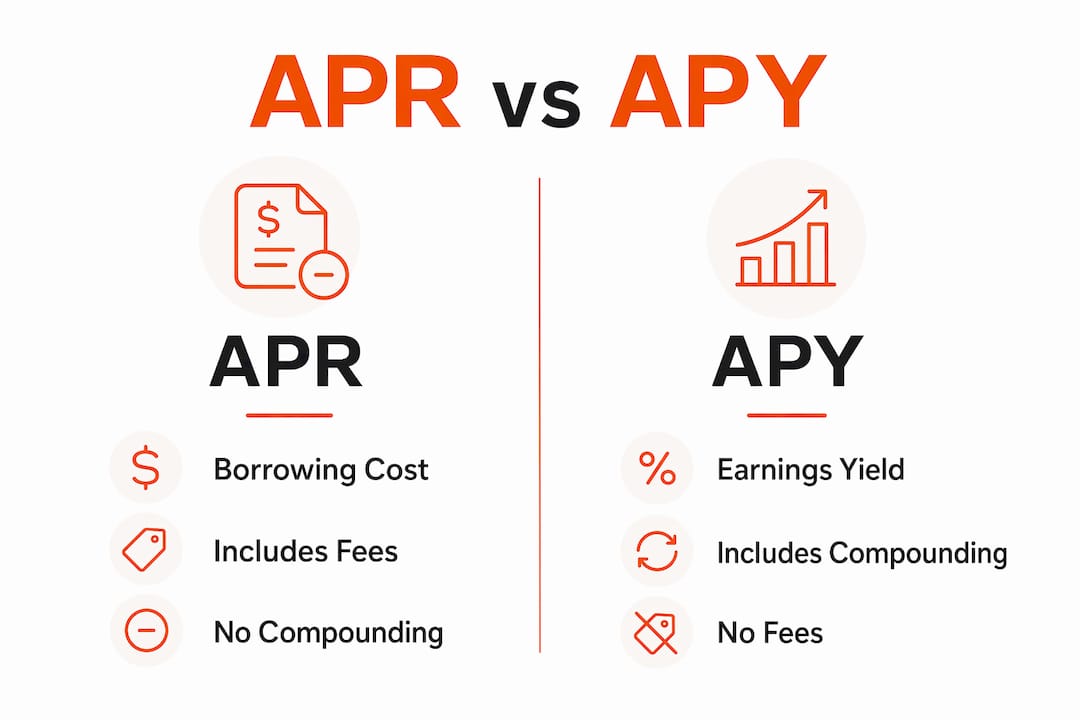
| Dimension | APR | APY |
|---|---|---|
| What it measures | Annual cost of borrowing | Annual yield on a deposit |
| Includes fees? | Yes (origination, points, some closing costs) | No |
| Accounts for compounding? | No | Yes |
| Typical products | Mortgages, personal loans, credit cards | Savings accounts, CDs, money market accounts |
| Formula | (Fees + Interest) / Principal × (365 / Loan term) | (1 + r/n)^n − 1 |
| What it tells you | True cost of the loan per year | True return on the deposit per year |
| Effect on payment/earnings | Does not determine monthly payment (interest rate does) | Directly reflects what you earn |
Translating the table into action:
- When comparing loan offers, always use APR. Two loans with the same interest rate but different fees will have different APRs, and the higher APR is the more expensive loan.
- When comparing savings accounts or CDs, always use APY. A higher APY means more money in your account at year end, regardless of how the bank structures its compounding.
- APR applies to loans (mortgages, personal loans, credit cards); APY applies to deposit accounts (savings, CDs). Never mix the two in the same comparison.
How to convert APR to APY and back, with worked examples
The conversion formulas are straightforward once you know the compounding schedule. Here is the step-by-step math for the most common scenario: a 5% APR with monthly compounding.
Converting 5% APR to APY (monthly compounding)
- Identify the nominal rate: r = 0.05
- Identify compounding periods: n = 12 (monthly)
- Apply the formula: APY = (1 + 0.05/12)^12 − 1
- Calculate: APY = (1.004167)^12 − 1
- APY = 1.05116 − 1 = 0.05116, or 5.116%
A loan advertised at 5% APR with monthly compounding carries an effective annual rate of 5.116%.
Converting 5% APY back to the nominal rate (monthly compounding)
- Start with APY = 0.05
- Rearrange: r = n × [(1 + APY)^(1/n) − 1]
- r = 12 × [(1.05)^(1/12) − 1]
- r = 12 × [1.004074 − 1]
- r = 12 × 0.004074 = 0.04889, or approximately 4.89%
Compounding schedule comparison for 5% nominal rate
- Annual compounding (n = 1): APY = 5.000%
- Monthly compounding (n = 12): APY = 5.116%
- Daily compounding (n = 365): APY = 5.127%
The Apexapro calculator handles all of this in seconds. Enter the nominal rate, select your compounding frequency, and the tool returns the APY instantly, no arithmetic required. It also supports fee inputs for APR-to-APY conversions on loan products. For readers who want to validate a mortgage APR calculation against real closing costs, that step-by-step walkthrough is worth running alongside the Apexapro output.
A practical checklist for comparing real offers
Before you sign anything, run through these questions. They take five minutes and can save you thousands.
For loan offers
- Are you comparing APR to APR, not APR to interest rate?
- What fees does the lender include in the APR, and which are excluded?
- Is the rate fixed or adjustable? If adjustable, what are the caps, index, and margin?
- What is the loan term, and how does a shorter or longer term affect total interest paid?
- Are there prepayment penalties that could negate refinancing savings?
For savings accounts and CDs
- Are you comparing APY to APY across all accounts?
- What is the compounding frequency (daily, monthly, quarterly)?
- Is there a minimum balance requirement to earn the advertised APY?
- Is the rate promotional or permanent? When does it expire?
- For CDs, what is the early withdrawal penalty?
Red flags to watch for:
- A lender who quotes only the interest rate and avoids mentioning APR
- Vague compounding language like "interest compounded regularly" with no frequency stated
- Teaser APY rates that drop sharply after 90 days
- ARM disclosures that do not include adjustment caps
Two questions worth scripting before any call with a lender or bank: "Does that APR include origination points?" and "What is the compounding frequency on the APY?" If the answer to either is evasive, that tells you something. You can also use a loan amortization calculator to see exactly how fees and interest interact across the full repayment schedule.
Common misunderstandings about APR and APY, quickly corrected
These are the mistakes that cost consumers real money.
-
Myth: APR and the interest rate are the same thing. They are only the same when a loan carries zero lender fees. For most mortgages and personal loans, APR is higher than the interest rate because it absorbs origination costs. For many credit cards, however, APR and the stated rate often match because card products typically carry no origination fee. Always read the cardholder agreement for annual fees and penalty APR triggers.
-
Myth: APY includes fees. APY is purely a compounding measure. It reflects how often interest is added to your balance, not what the bank charges you. Account maintenance fees, minimum balance penalties, and wire transfer fees are separate and do not appear in the APY figure.
-
Myth: APR tells you your monthly payment. Your monthly payment is calculated from the nominal interest rate on the note, not from APR. APR is a comparison tool, not a payment calculator. Two loans with identical APRs but different terms will produce different monthly payments.
-
Myth: A lower interest rate always means a lower total cost. A loan at 6.5% with $5,000 in fees can cost more over five years than a loan at 6.75% with no fees. APR captures this; the interest rate alone does not.
How to use the Apexapro APR/APY calculator
Hand math works, but a calculator eliminates rounding errors and lets you test multiple scenarios in under a minute. The Apexapro tool runs entirely in your browser, requires no account, and supports both English and Spanish.
Here is how to use it for the most common conversions:
- APR to APY: Enter the nominal rate (e.g., 5%), select the compounding frequency (daily, monthly, or annually), and the calculator returns the APY immediately. This mirrors the worked example above: 5% nominal with monthly compounding yields 5.116% APY.
- APY to nominal rate: Enter the APY and compounding frequency to reverse-engineer the nominal rate. Useful when a bank advertises APY and you need the underlying rate for comparison.
- Loan APR with fees: Enter the loan amount, interest rate, fees, and term. The tool computes the effective APR, which you can then compare directly against other lenders' disclosed APRs.
Sample inputs that mirror the worked examples above:
- Nominal rate: 5% / Compounding: Monthly → Output: APY = 5.116%
- Nominal rate: 5% / Compounding: Daily → Output: APY = 5.127%
- Nominal rate: 5% / Compounding: Annual → Output: APY = 5.000%
Pro Tip: Run the same nominal rate through all three compounding frequencies to see how much the frequency alone changes your effective yield. The difference between monthly and daily compounding is small but real, and it adds up on large balances over multi-year terms.
Key Takeaways
APR measures the true annual cost of borrowing including fees, while APY measures the true annual yield on deposits including compounding. Use APR to compare loans and APY to compare savings accounts.
| Point | Details |
|---|---|
| APR includes fees, APY includes compounding | APR folds in origination and closing costs; APY reflects how often interest compounds on your balance. |
| Monthly payments use the nominal rate | Your actual payment is calculated from the interest rate on the note, not from the APR. |
| Compounding frequency changes APY | A 5% nominal rate yields 5.000% APY annually, 5.116% monthly, and 5.127% daily. |
| Compare like with like | Always compare APR to APR on loans and APY to APY on savings accounts, never mix the two. |
| Apexapro calculator | The free, browser-based Apexapro tool converts between APR and APY instantly, with no sign-up required. |
The number that actually matters depends on which side of the transaction you are on
Most personal finance content treats APR and APY as a vocabulary lesson. The more useful frame is transactional: which number are you on the hook for, and which one is working in your favor?
When evaluating a mortgage, the interest rate tells you what your payment will be, but APR tells you whether Lender A is actually cheaper than Lender B once fees are counted. A lender offering 6.5% with $4,000 in origination fees versus one offering 6.625% with no fees is a real comparison that the interest rate alone cannot resolve. APR resolves it.
On the savings side, the compounding frequency question is one most people skip entirely. A bank advertising 5% on a high-yield savings account sounds identical to a competitor advertising 5%, but if one compounds daily and the other compounds monthly, the daily-compounding account pays more. The gap is small on a $10,000 balance, but on a $200,000 emergency fund or a six-figure CD ladder, it is worth checking.
One thing worth prioritizing over headline APR on longer-term loans: the total interest paid over the full term. A 30-year mortgage at 6.8% APR costs far more in total interest than a 15-year mortgage at 6.5% APR, even though the 15-year loan's monthly payment is higher. APR is an annual comparison tool, not a lifetime cost calculator. Use it alongside an amortization schedule, not instead of one.
The Apexapro APR/APY calculator makes this math effortless
Knowing the formulas is one thing. Testing a real offer in seconds is another. The Apexapro APR/APY calculator is free, browser-based, and fully bilingual in English and Spanish. No account, no download, no waiting. Enter a nominal rate, pick a compounding frequency, and get the converted figure immediately.
Start with the 5% example from this article to confirm you understand the output, then plug in a real quote from your bank or lender. The tool handles APR-to-APY conversions, APY-to-nominal-rate reversals, and fee-adjusted APR calculations for loans. Try it at apexapro.com and run your next loan or savings comparison in under a minute.
Useful sources for further reading
These are the primary and authoritative sources behind the definitions, formulas, and regulatory guidance in this article.
- Consumer Financial Protection Bureau (CFPB) — Official guidance on the difference between APR and the interest rate, including Truth in Lending Act disclosure requirements.
- CFPB: Mortgage APR vs. interest rate — Specific guidance on mortgage APR disclosures, ARM limitations, and what borrowers should review beyond the headline rate.
- Fidelity: APR vs. APY — Clear explanation of how compounding affects APY and the practical distinction between fees (APR) and compounding (APY).
- Bankrate: APR vs. APY — Overview of which products use APR versus APY and how to apply each metric when comparing offers.
- SoFi: APR vs. APY — APY formula breakdown with worked examples for different compounding frequencies.
- Apexapro calculator — Free, browser-based APR/APY conversion tool. No sign-up required; supports English and Spanish.
This article is general financial information, not professional advice. Confirm current rates, fees, and regulatory requirements with your lender, financial institution, or a qualified financial professional before making decisions.