Mortgage points, also called discount points, are upfront fees you pay at closing to buy down your loan's interest rate. One point costs 1% of your loan amount and typically reduces your rate by about 0.25%, according to CFPB guidance. That trade-off is the core of every mortgage points decision: pay more now, pay less every month for the life of the loan.
What are mortgage points and how do they work?
Discount points are optional prepaid interest. You hand the lender a lump sum at closing, and in return, the lender locks in a lower interest rate for the entire loan term. They are distinct from origination points, which are mandatory processing fees that do not reduce your rate at all.

The Consumer Financial Protection Bureau (CFPB) requires lenders to list any points on your Loan Estimate and Closing Disclosure in Section A, and by law those points must be connected to a discounted rate. That transparency makes it easier to compare offers across lenders.
Key features of mortgage discount points at a glance:
- One point equals 1% of the loan amount.
- Each point typically reduces the rate by roughly 0.25%, though this varies by lender and market.
- Points are paid at closing and added to total closing costs.
- You can buy fractional points, such as 0.5 or even 0.125 points.
- Discount points are optional; origination points are not.
- Around 40% of lenders cap the number of points at 3 or 4 per loan.
- Points appear as a positive number on loan disclosures; lender credits appear as negative numbers.
How buying points affects your interest rate and monthly payment
Paying points lowers your rate compared to a zero-point loan from the same lender on the same loan type. The rate reduction per point is not standardized. It depends on the lender, the loan product, and current market conditions, so the 0.25% figure is a useful benchmark, not a guarantee.

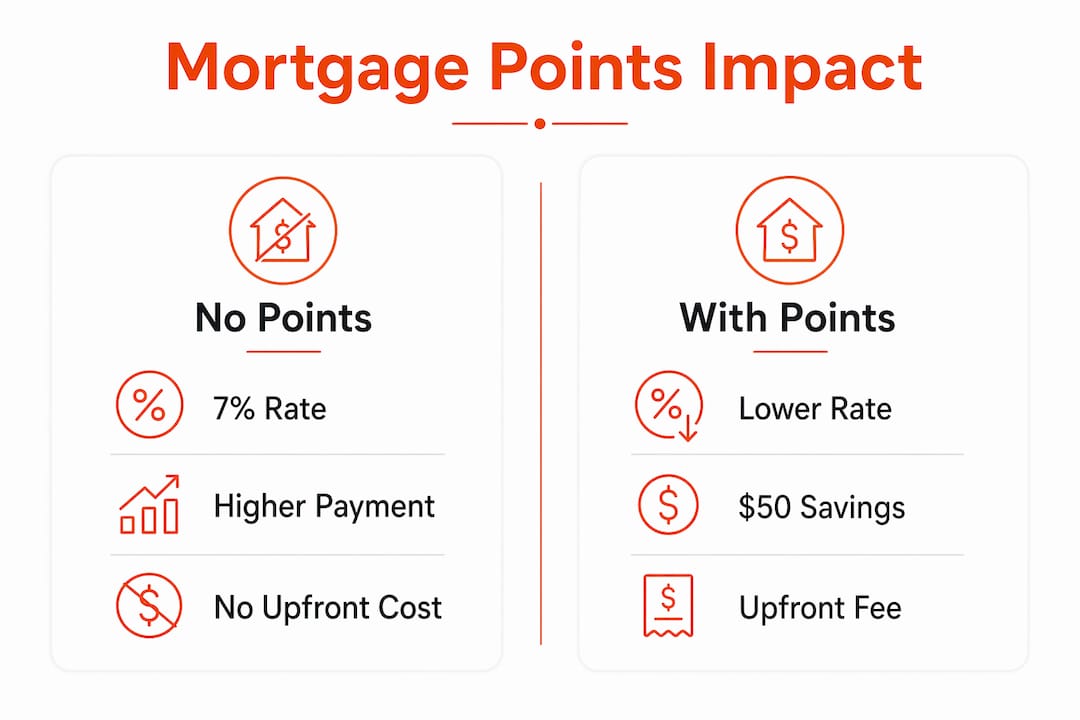
A concrete example makes this tangible. On a $300,000 loan at 7%, buying one point ($3,000) drops the rate to roughly 6.75%, cutting the monthly payment by approximately $50. Two points would save around $100 per month, with a break-even near 60 months in both cases.
Factors that influence how much your payment changes:
- Loan size: larger loans amplify the dollar savings per point.
- Rate environment: the higher the base rate, the more meaningful a 0.25% reduction becomes.
- Loan term: a 30-year term spreads savings over more payments than a 15-year term.
- Lender pricing: some lenders offer steeper rate cuts per point than others.
- Loan type: fixed-rate loans benefit fully; on adjustable-rate mortgages (ARMs), points apply only to the fixed period, which typically runs 3–10 years, making buydowns less common on ARMs.
| Scenario | Rate | Monthly Payment (est.) | Monthly Savings |
|---|---|---|---|
| No points | 7% | — | — |
| 1 point ($3,000) | 6.75% | — | ~$50 |
| 2 points ($6,000) | 6.5% | — | ~$100 |
Estimates based on a $300,000, 30-year fixed-rate loan.
What does buying mortgage points actually cost you?
Each discount point costs exactly 1% of the loan amount. On a mortgage, one point costs 1% of the loan amount, so the upfront payment scales with loan size. That cash comes out of pocket at closing, on top of your down payment and other closing costs, so the upfront burden is real.
Lender credits work in the opposite direction. You accept a higher rate, and the lender offsets part of your closing costs. The CFPB describes lender credits as "negative points" on loan worksheets. If cash is tight, credits can ease the closing-day strain, though you pay more interest over time.
Pro Tip: Request written loan estimates from at least three lenders showing the same loan with zero points, one point, and two points side by side. The CFPB recommends comparing these scenarios directly so you can see exactly what each point buys you in rate reduction before committing.
Financial advisors generally recommend keeping emergency reserves intact rather than draining savings to buy points. Buying points makes sense only when you have the cash available after covering your down payment and a healthy financial cushion. Selling or refinancing before you hit break-even means you lose money on every point purchased.
Key cost considerations before buying points:
- Confirm you can cover points without touching your emergency fund.
- Ask whether the seller will pay points on your behalf, which can happen in a buyer's market and reduces your rate without increasing your cash outlay.
- Check the lender's cap: most stop at 3 or 4 points.
- Weigh points against a larger down payment, which also reduces monthly costs and eliminates private mortgage insurance sooner.
- Get the Loan Estimate in writing before agreeing to any point structure.
How to calculate your savings and break-even point
The break-even formula is straightforward: divide the total cost of points by the monthly payment reduction. The result tells you how many months you need to stay in the home before the upfront cost pays off.
Break-even = Cost of points ÷ Monthly savings
Using the $300,000 example: one point costs $3,000 and saves roughly $50 per month. That gives a break-even of around five years, or five years. If you sell or refinance before month 60, you come out behind. Stay past it, and every subsequent month is pure savings.
| Points Purchased | Upfront Cost | Monthly Savings | Break-Even |
|---|---|---|---|
| 1 point | $3,000 | ~$50/month | ~60 months |
| 2 points | $6,000 | ~$100/month | ~60 months |
Steps to run this calculation for your own loan:
- Get the lender's quoted rate with zero points and with one or more points.
- Use a mortgage calculator to find the monthly payment at each rate.
- Subtract the lower payment from the higher to find monthly savings.
- Divide the total points cost by that monthly savings figure.
- Compare the result to how long you realistically plan to stay in the home.
Pro Tip: Run the numbers with a break-even buydown calculator to test multiple scenarios quickly. Changing the loan amount, rate, or number of points takes seconds and shows exactly where your break-even lands.
Tax implications of mortgage points in the US
Discount points are treated as prepaid interest by the IRS, which means they are generally tax-deductible if you itemize deductions. The full deduction in the year you pay them is allowed when specific conditions are met, including that the loan is secured by your primary residence and that paying points is a customary practice in your area. Otherwise, IRS Publication 936 requires you to spread the deduction over the life of the loan.
Origination points are a different story. Because they compensate the lender for processing the loan rather than buying down the rate, they are generally not tax-deductible. Knowing which type of point you are paying matters at tax time.
Key tax facts for mortgage discount points:
- Deductible only if you itemize; the standard deduction makes this moot for many filers.
- Full deduction in year paid requires the loan to be for buying or building your primary home.
- Points paid on a refinance are usually deducted over the loan term, not all at once.
- Seller-paid points on your behalf may still be deductible by you as the buyer.
- Consult a tax professional to confirm eligibility based on your specific situation and filing status.
The IRS also publishes Topic No. 504 specifically on home mortgage points, which outlines the conditions for full versus prorated deductions in plain language.
Tools and calculators that make mortgage points math easy
Online mortgage points calculators let you plug in your loan amount, current rate, and proposed points to see the monthly savings and break-even timeline instantly. The best ones allow scenario comparisons, so you can toggle between one, two, and three points and watch the numbers shift in real time.
Apexapro offers free, browser-based mortgage calculators with no sign-up required. You can run amortization scenarios, compare payment differences across rate options, and get a clear picture of long-term costs without downloading anything or creating an account.
Pro Tip: Try the mortgage points calculator to model rate buydown savings on your specific loan amount. Experimenting with fractional points, like 0.5 or 1.5, often reveals a sweet spot that standard whole-point comparisons miss.
For a deeper dive into break-even analysis, dedicated buydown guides walk through how different holding periods and refinancing assumptions change the math. The goal is always the same: find the scenario where the upfront cost and the long-term savings align with your actual plans.
Key Takeaways
Buying mortgage discount points makes financial sense only when you plan to stay in the home long enough to recover the upfront cost through lower monthly payments.
| Point | Details |
|---|---|
| One point costs 1% of the loan | On a $300,000 loan, one point costs $3,000 and typically cuts the rate by about 0.25%. |
| Break-even is the key metric | Divide the points cost by monthly savings; at $3,000 cost and $50/month savings, break-even is 60 months. |
| Discount vs. origination points | Discount points are optional and reduce your rate; origination points are mandatory processing fees and do not. |
| Tax deductibility has conditions | Discount points are generally deductible if you itemize and the loan is on your primary residence, per IRS Publication 936. |
| ARMs limit the benefit | On adjustable-rate mortgages, points apply only to the fixed period of 3–10 years, reducing their long-term value. |