Your credit utilization ratio is the percentage of your available revolving credit you're currently using, calculated as total balances divided by total credit limits, multiplied by 100. Aim to keep it under 30%, though the strongest credit profiles typically sit in the low single digits. The fastest move you can make right now:
- Pull your current statement balances and limits, calculate your ratio, and if it's high, pay down the balance before your statement closing date rather than waiting for the due date.
Key Takeaways
Credit utilization ratio measures revolving debt against revolving credit limits, and lowering it, especially before your statement closes, is one of the fastest ways to influence your credit score.
| Point | Details |
|---|---|
| Know the formula | Divide total revolving balances by total revolving limits, then multiply by 100. |
| Target single digits | Under 30% is acceptable, but top-score consumers typically run in the low single digits. |
| Time your payments | Pay down balances before the statement closing date, since that's the balance issuers report. |
| Prioritize the fastest fixes | Multiple monthly payments and targeting your highest-utilization card first beat opening new accounts. |
| Model changes before you act | Apexapro's free calculator lets you test a payment or limit change instantly, with no sign-up required. |
Table of Contents
- What Counts Toward Your Credit Utilization Ratio?
- How Do You Calculate Credit Utilization?
- What Is a Good Credit Utilization Rate?
- How Fast Does Utilization Affect Your Credit Score?
- What's the Fastest Way to Lower Your Utilization?
- How Do You Calculate Your Ratio Without the Guesswork?
- Check Your Numbers Before You Make a Move
- Frequently Asked Questions
- Sources
What Counts Toward Your Credit Utilization Ratio?
Only revolving accounts factor into this calculation. That means credit cards, home equity lines of credit (HELOCs), and personal lines of credit all count. Installment debt, including mortgages, auto loans, and personal loans, does not, because those loans have fixed balances that shrink on a set schedule rather than fluctuating with spending.
- Included: credit cards, HELOCs, retail store cards, personal lines of credit
- Excluded: mortgages, auto loans, personal loans, student loans
Here's the part most people miss: issuers typically report your balance to the bureaus around your statement closing date, not on the day you check your app. If you charge $2,000 on Monday and pay it off Friday, but your statement closed Wednesday, that $2,000 balance is what gets reported, regardless of your zero balance today.
Why this matters so much: utilization carries real weight in how your score gets built. VantageScore 3.0 assigns it about 20% of your score, while FICO folds it into the "amounts owed" category, which runs closer to 30%.
How Do You Calculate Credit Utilization?
The formula is the same whether you're checking one card or your entire wallet: total balance ÷ total credit limit × 100. The difference is whether you run that math per card or across every revolving account you hold.
Per-card example: Say you have a card with a $5,000 limit and a $1,500 balance. That's $1,500 ÷ $5,000 = 0.30, or 30%.

Overall example: Now say you hold three cards with limits of $5,000, $3,000, and $2,000 (a $10,000 total), and balances of $1,500, $600, and $200 (a $2,300 total). Your overall utilization is $2,300 ÷ $10,000 = 23%. Scoring models look at both numbers, so a single maxed-out card can hurt you even if your overall ratio looks fine.
To find your own figures:
- Log into each card issuer's website or app and note the current credit limit for each account.
- Pull your most recent statement balance for each card, not today's running balance.
- Add all balances together, add all limits together, then divide and multiply by 100.
- Cross-check against a recent credit report to confirm what's actually being reported to the bureaus.
Pro Tip: If you know your statement closing date, make a payment a few days before it hits. That lowers the balance that actually gets reported, which can shrink your utilization on paper even if you haven't finished paying off the card.
What Is a Good Credit Utilization Rate?
Most guidance points to keeping utilization under a moderate level as a baseline, but that's a ceiling, not a target. Consumers with the best scores tend to run much leaner.
- Under 30%: generally considered acceptable
- Under 10%: considered strong by most lenders
- Low single digits: common among consumers with top-tier credit scores
The overall average U.S. utilization sat around 29% in the third quarter of 2024, which tracks closely with the commonly cited 30% ceiling. But averages describe the middle of the pack, not the top. One nuance worth knowing: a flat 0% utilization isn't necessarily better than a small, non-zero balance, since some scoring models read a little activity as a healthier repayment signal than none at all.
Pro Tip: Pay your full statement balance by the due date every month. You avoid interest entirely, and since utilization is based on the reported balance rather than whether you carried debt, you can keep your ratio low without ever paying a cent in finance charges.
How Fast Does Utilization Affect Your Credit Score?
Utilization is one of the more responsive factors in your credit score, and that cuts both ways. Run up a balance and your score can dip quickly. Pay it down and the recovery can be just as fast.

Scoring models pull from whatever balance and limit data currently sits on your credit report, which is tied to your statement close, not real-time spending. That's why a paid-down balance doesn't help your score the moment you make the payment. It helps once the issuer reports the new number.
The general sequence looks like this:
- Your statement closes and locks in a balance figure.
- The issuer reports that balance to one or more credit bureaus, usually within a few days.
- The bureaus update your file, and your utilization ratio recalculates.
- Your score reflects the change, sometimes within the same billing cycle.
Exact timing varies by issuer and which scoring model a lender uses, but improvements often show up faster than people expect. This is genuinely one of the quickest levers you have compared to something like building payment history, which takes months to shift meaningfully.
What's the Fastest Way to Lower Your Utilization?
Not every fix carries the same speed or risk. Here's how to prioritize.
Fastest, lowest risk:
- Pay down your balance before the statement closing date, not just the due date.
- Make two or three smaller payments throughout the month instead of one lump sum at the end.
- Target your highest-utilization card first, since a single near-maxed card can drag down your overall ratio even when other cards sit at zero.
Credit-limit strategies (moderate speed, moderate risk): Requesting a limit increase or opening a new card raises your total available credit, which lowers your ratio mathematically, but only if your spending doesn't creep up to match it. Both moves can also trigger a hard inquiry and slightly lower your average account age, which are minor, short-term trade-offs against a longer-term utilization gain.
Balance-shifting strategies:
- A balance transfer to a lower-rate card shifts debt around but doesn't reduce your total revolving balance, so weigh transfer fees against the interest you'd actually save.
- Consolidating credit card debt into a personal loan works differently: because installment loans don't count toward revolving utilization, moving the balance off your cards can drop your ratio fast. It also gives you a fixed payoff timeline, which pairs well with a structured approach like the debt snowball method if you're tackling multiple balances at once.
- Becoming an authorized user on a low-utilization account can help, but only if that account's issuer reports authorized-user activity to the bureaus.
Pro Tip: Watch for the trap of raising a limit and then spending up to it. A higher ceiling only helps your ratio if your balance stays where it was.
Red flags to avoid: opening several new cards in a short window shortens your average account age and can hurt more than utilization gains help, and balance transfer fees (often 3% to 5%) can eat into savings if you're not paying attention.
How Do You Calculate Your Ratio Without the Guesswork?
Running this math by hand across three or four cards is where most people make mistakes, especially when trying to model "what if I pay this off first" scenarios. An interactive calculator removes that friction and lets you test a move before you make it.
Here's a quick worked example using the earlier numbers: three cards, $10,000 in combined limits, $2,300 in combined balances, for a 23% overall ratio. Now model paying $800 off the highest-balance card before its statement closes. New combined balance: $1,500.
- Apexapro's credit utilization calculator runs this exact math instantly in your browser.
- No sign-up, no downloads, and nothing to install before you get an answer.
Pro Tip: Check your statement closing date before making an extra payment. Paying the day after it closes means the lower balance won't show up until next cycle.
Balancing Utilization Goals With Everyday Banking
Chasing a perfect utilization number can turn into its own kind of stress, and opening new cards purely to boost available credit often does more harm than good through account churn.
It keeps you ahead of the ratio without requiring you to check it obsessively.*
Check Your Numbers Before You Make a Move
Before you call an issuer to request a limit increase or decide which card to pay down first, run your real numbers through Apexapro's free credit utilization calculator. It's the same browser-based tool used for the worked example above: no sign-up, no download, and results appear instantly whether you're on a phone or a laptop. Apexapro's calculator catalog also runs bilingually in English and Spanish, so the tool works the same way regardless of which language you're most comfortable reading numbers in.
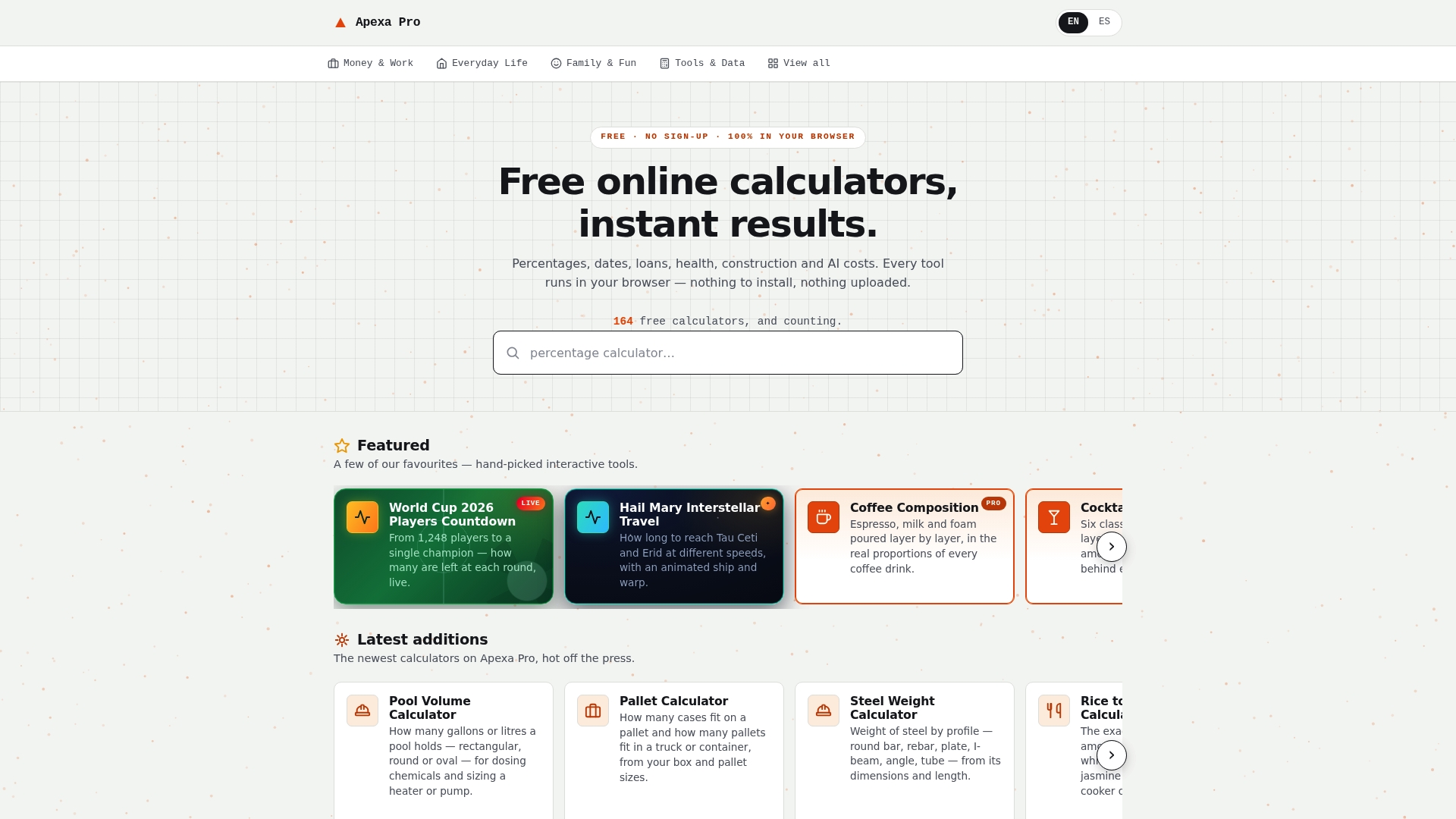
Plug in your actual balances and limits, then test a payment amount before you send it. Try the credit utilization calculator now to see exactly how much a single payment could move your ratio ahead of your next statement closing date.
Frequently Asked Questions
It's not bad, but it's not optimal either.
Does paying my credit card twice a month help my utilization? Yes. Making a payment mid-cycle and another before the statement closes keeps your reported balance lower than if you wait for one payment at the due date.
Will closing a credit card improve my utilization ratio? Usually not. Closing a card removes its limit from your total available credit, which can raise your overall ratio even if your balances stay the same.
How quickly will my score change after I lower my utilization? Often within the same billing cycle, once your issuer reports the new balance to the bureaus. The exact timing depends on your issuer's reporting schedule.
Does a debt-to-income ratio affect utilization the same way? No. Debt-to-income compares your monthly debt payments to your income and matters mostly for loan approval, while utilization compares revolving balances to revolving limits and factors directly into your credit score.
This article is general information, not a substitute for advice from a qualified financial advisor. Consult a qualified financial professional about your own circumstances before acting on anything here.
Sources
- What Is a Credit Utilization Rate? - Experian
- What Is Credit Utilization Ratio? - Citi
- What is credit utilization? - TD Bank
- How credit utilization affects credit scores - SoFi
- What is credit utilization ratio? - U.S. Bank