
The slope formula is m = (y2 − y1) / (x2 − x1), and it measures how steep a line is and which direction it moves between two points. Slope is rise over run: how far a line climbs or drops (rise) for every unit it moves sideways (run). A positive result means the line rises left to right; a negative result means it falls. Two special cases show up constantly: a horizontal line has a slope of exactly 0, and a vertical line has an undefined slope because the run equals zero, and dividing by zero has no answer. Everything else in this guide builds on that one equation.
Key Takeaways
The slope formula m = (y2 − y1) / (x2 − x1) measures rise over run, and mastering it requires practicing the formula, the graph method, and equation conversions together.
| Point | Details |
|---|---|
| Core formula | Slope equals (y2 − y1) / (x2 − x1), the vertical change divided by the horizontal change. |
| Special cases | Horizontal lines have a slope of 0; vertical lines have an undefined slope. |
| Graph method | Count rise and run between two integer-coordinate points, starting from the left point. |
| Equation forms | Slope-intercept form (y = mx + b) shows m directly; standard form requires solving for y first. |
| Verify your work | Apexa Pro's free slope calculator checks fraction, decimal, angle, and percent grade instantly. |
Table of Contents
- How Do You Calculate Slope Using the Slope Formula?
- How Do You Find Slope from a Graph?
- How Do You Find Slope from an Equation?
- How Do You Use Point-Slope Form to Write a Line?
- What Do Different Slope Values Actually Mean?
- How Does Slope Relate to Angle and Percent Grade?
- What Mistakes Cause Wrong Slope Answers?
- Practice Problems: Test Your Slope Calculations
- Verify Your Answer with an Interactive Slope Tool
- A Note on Learning Slope Effectively
- Check Your Work with Apexa Pro's Slope Calculator
- Frequently Asked Questions About the Slope Formula
- Sources
How Do You Calculate Slope Using the Slope Formula?
Calculating slope from two points follows the same five steps every time, no matter how the numbers look.
- Pick your two points on the line, labeled (x1, y1) and (x2, y2).
- Subtract the y-values: y2 − y1.
- Subtract the x-values in the same order: x2 − x1.
- Divide the y-difference by the x-difference.
- Simplify the fraction or convert it to a decimal.
Here's a positive-slope example. Using points (2, 3) and (6, 11): m = (11 − 3) / (6 − 2) = 8/4 = 2. The line rises 2 units for every 1 unit it moves right.
Now a negative-slope example, using (1, 8) and (4, 2): m = (2 − 8) / (4 − 1) = −6/3 = −2. The line drops 2 units for every 1 it moves right, so the negative sign carries real meaning, not just an arithmetic quirk.
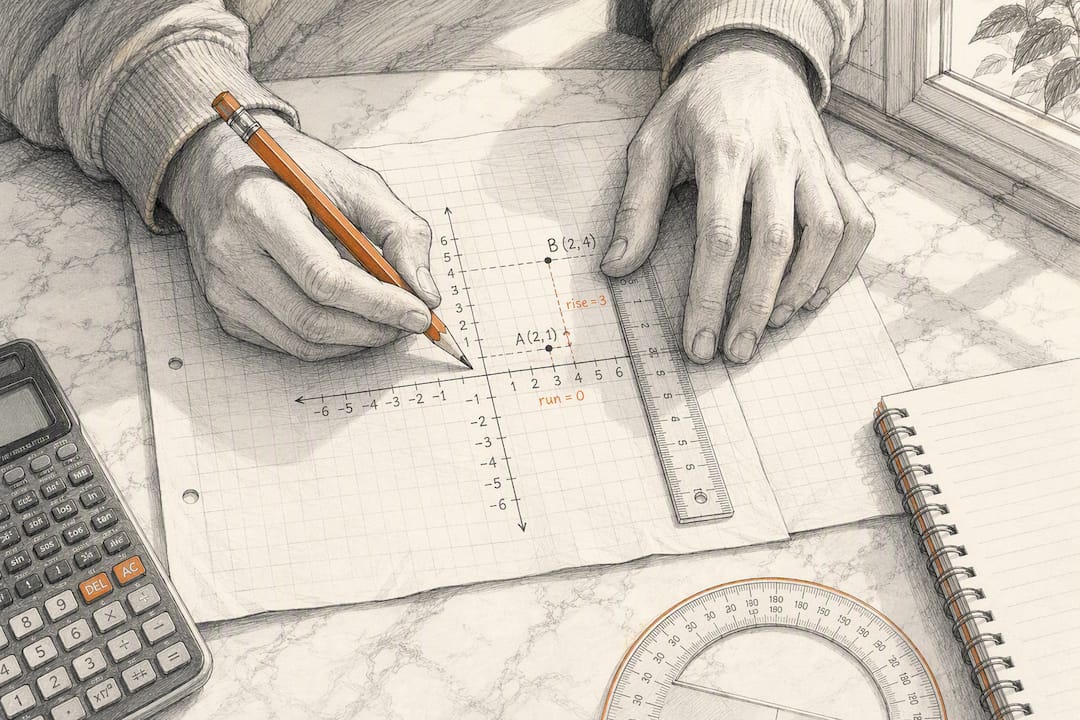
Pro Tip: The order you list the points in doesn't matter, as long as you subtract consistently. Swap (2,3) and (6,11) around and you get (3 − 11)/(2 − 6) = −8/−4 = 2, the same answer, as Purplemath's worked examples demonstrate.
Before moving on, check your work: did you subtract y-values on top and x-values on bottom? Did the fraction simplify all the way? And if the denominator ever hits zero, stop. That's a vertical line, and the slope is undefined, not zero.
How Do You Find Slope from a Graph?
When you're looking at a graph instead of a table of coordinates, rise over run becomes something you can literally count with your finger.
- Choose two points on the line where the grid lines cross cleanly, integer coordinates only.
- Sketch a right triangle connecting them, using a vertical leg and a horizontal leg.
- Count the rise: how many units up or down the vertical leg goes.
- Count the run: how many units left or right the horizontal leg goes.
- Divide rise by run to get the slope.
If the line climbs as you move right, the rise counts as positive. If it drops, count the rise as negative. OpenStax's geoboard-based approach builds this rise/run intuition before students touch the algebraic formula at all, and it sticks.
Pro Tip: Always start counting from the point on the left. That keeps your run positive and removes one variable from the sign-tracking, so all you have to watch is whether the rise goes up or down.
How Do You Find Slope from an Equation?
An equation hands you the slope directly, once you know where to look.
Slope-intercept form is written as y = mx + b, where m is the slope and b is the y-intercept. If you see y = 3x − 5, the slope is simply 3, no calculation required.
Standard form, written as Ax + By = C, hides the slope until you solve for y. The conversion rule is:
- Rearrange to isolate y: By = −Ax + C
- Divide every term by B: y = (−A/B)x + (C/B)
- The slope equals −A/B
Try it with 4x + 2y = 10. Solving for y: 2y = −4x + 10, then y = −2x + 5. The slope is −2, read straight off the x-coefficient once the equation is in slope-intercept form.
How Do You Use Point-Slope Form to Write a Line?
Point-slope form solves a different problem: you know one point and the slope, but not the full equation yet. The formula is:
y − y1 = m(x − x1)
Use it whenever a problem gives you a single coordinate plus a rate of change, rather than two full points.
Say you're given the point (3, 4) and a slope of 2. Plugging in: y − 4 = 2(x − 3).
- Rearrange into slope-intercept form: y = 2x − 6 + 4, so y = 2x − 2.
- Plot a second point by moving 1 unit right and 2 units up from (3, 4), landing on (4, 6).
- Draw a line through both points and confirm the rise/run matches your original slope of 2.
What Do Different Slope Values Actually Mean?
Slope tells you two things at once: steepness and direction. A few patterns come up on nearly every test.
- Horizontal line: rise is 0, so m = 0/run = 0, no matter how long the run is.
- Vertical line: run is 0, so the denominator is zero and the slope is undefined, not zero.
- Positive slope (m > 0): the line rises as you move left to right, like climbing a hill.
- Negative slope (m < 0): the line falls as you move left to right, like walking downhill.
A quick numeric check: points (2, 5) and (7, 5) share the same y-value, giving m = 0/5 = 0, a flat line. Points (4, 1) and (4, 9) share the same x-value, giving m = 8/0, undefined.
Pro Tip: The most common error here is swapping which difference goes on top. Rise (the y-change) always sits in the numerator; run (the x-change) always sits in the denominator. Flip them and you'll get the reciprocal of the real slope.
How Does Slope Relate to Angle and Percent Grade?
Slope isn't just a fraction. It converts directly into an angle and into the percent grades you see on road signs.
The trigonometric relation is m = tan(θ), and solving for the angle gives θ = arctan(m).
- A slope of 0.05 (or 5%) works out to an angle of roughly 2.86 degrees.
- A slope of 0.02 (or 2%) converts to about 1.15 degrees.
Both examples show how gentle most real-world "steep" grades actually are in angle terms, since even a noticeable hill often sits under 3 degrees.
On a calculator, look for the atan or tan⁻¹ button, and double-check whether the output mode is set to degrees or radians before trusting the number. Mixing those up is one of the most common calculator mistakes students make when converting slope to angle.
What Mistakes Cause Wrong Slope Answers?
Most slope errors trace back to a handful of repeat offenders: mixing up which value is x and which is y, subtracting in a different order for the top and bottom of the fraction, forgetting to simplify the final fraction, dividing by zero on a vertical line, and dropping a negative sign somewhere along the way.
- Plug your answer back into y = mx + b using one of the original points to confirm it holds true.
- Recompute the same two points with the order reversed. You should land on the identical slope.
- Verify on a graphing tool or an online slope calculator if the fraction looks unusual.
Pro Tip: Stick to integer coordinate points whenever you're double-checking by hand, and always reduce your fraction to lowest terms before calling it your final answer.
Practice Problems: Test Your Slope Calculations
Work through these five, then check your answer against the steps below each one.
- Find the slope between (1, 2) and (5, 10).
- Find the slope between (3, 9) and (7, 1).
- Find the slope between (−2, 4) and (6, 4).
- Find the slope between (5, −1) and (5, 8).
- Find the slope of the line y = −3x + 7.
Answers:
- Problem 1: m = (10 − 2)/(5 − 1) = 8/4 = 2
- Problem 2: m = (1 − 9)/(7 − 3) = −8/4 = −2
- Problem 3: same y-value both points, m = 0/8 = 0 (horizontal)
- Problem 4: same x-value both points, denominator is 0, slope is undefined (vertical)
- Problem 5: already in slope-intercept form, m = −3
If any answer surprises you, plot the two points on paper and recount the rise and run by hand, then confirm with a calculator.
Verify Your Answer with an Interactive Slope Tool
Manual checks catch most errors, but a quick digital verification settles any doubt fast. Apexa Pro's free slope calculator takes two coordinate points and returns the slope as both a fraction and a decimal, along with the angle of inclination, percent grade, and the line's equation in slope-intercept, point-slope, and standard forms, plus a plotted graph.
- Enter your two (x, y) points exactly as given in the problem.
- Compare the calculator's fraction to your hand-simplified answer.
- Check the graph to confirm the rise/run direction matches what you expected.
Treat it as a verification aid for work you've already done by hand, not a replacement for learning the steps yourself.
A Note on Learning Slope Effectively
Students tend to lock in the slope formula fastest by pairing it with a visual check, not by memorizing the equation alone. A practical study path: learn the formula, work three examples by hand, try the graph method on the same points, then verify everything with a calculator. Run through the practice problems above and check your work against the tool before moving to point-slope or standard-form conversions.
Check Your Work with Apexa Pro's Slope Calculator
Apexa Pro's slope calculator gives you an instant answer without the arithmetic risk of a rushed homework session. It's free, runs entirely in your browser with no sign-up, and returns the slope as a fraction and decimal, the angle of inclination, percent grade, and the line written in slope-intercept, point-slope, and standard form, alongside a plotted graph.

Enter your two coordinate points and the tool walks through the steps automatically, so you can see exactly where your own calculation matched or diverged. It's built for verification and visualization, not as a shortcut around learning the formula itself. Open the Apexa Pro slope calculator the next time a homework set has you second-guessing a fraction, and confirm your answer before you submit it.
Frequently Asked Questions About the Slope Formula
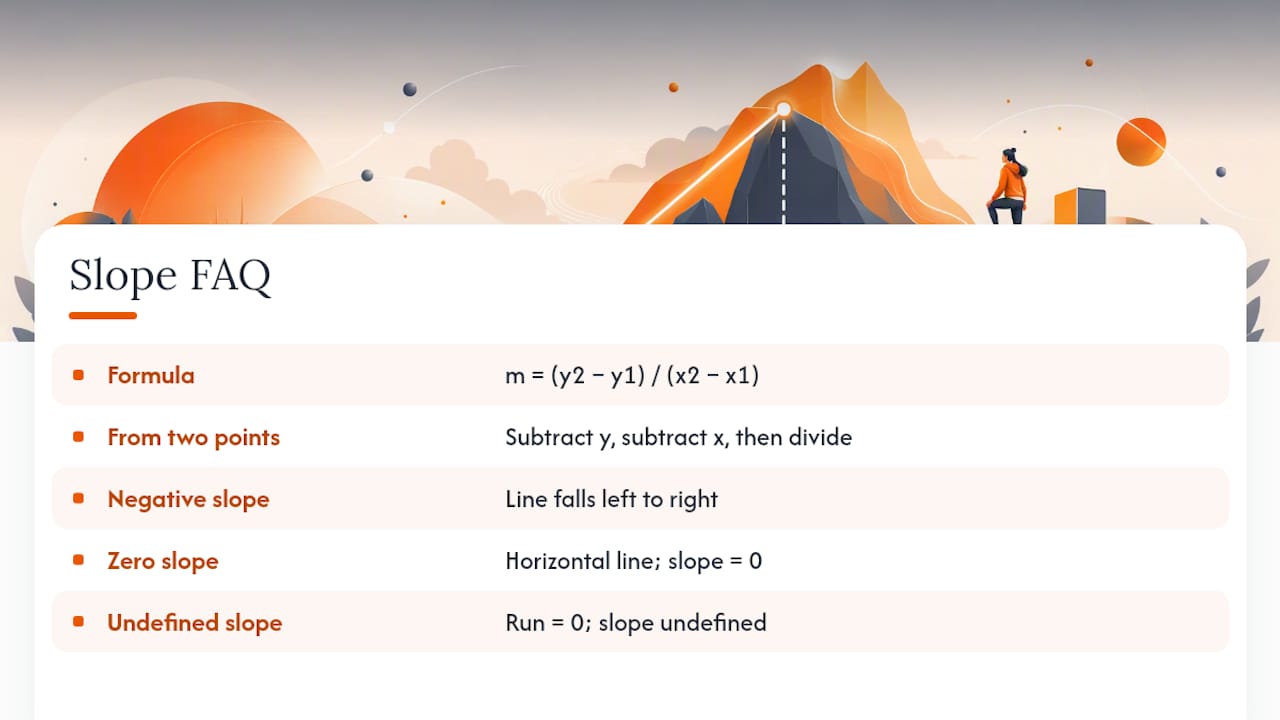
What is the slope formula in math? The slope formula is m = (y2 − y1) / (x2 − x1), where m represents slope and the coordinates come from two points on a line.
How do you calculate slope from two points? Subtract the y-values, subtract the x-values in the same order, then divide the first result by the second and simplify the fraction.
What does a negative slope mean? A negative slope means the line falls as it moves from left to right, the opposite direction of a positive slope.
Can slope be zero? Yes. A horizontal line has a slope of exactly 0 because there's no vertical rise between any two points on it.
Why is a vertical line's slope undefined? Because the run (horizontal change) equals zero, and dividing any number by zero produces no valid answer.
How do you find slope from a graph without coordinates listed? Pick two points where the line crosses clean grid intersections, then count the rise and run directly and divide rise by run.
How does slope relate to angle? Slope and angle connect through m = tan(θ), so you can find the angle of inclination with θ = arctan(m) on any scientific calculator.
Sources
For deeper practice beyond this guide, a few sources stand out. OpenStax's Intermediate Algebra covers formula theory and classroom-style examples. LibreTexts offers extra worked exercises on the graph method. Purplemath clarifies sign-handling and point order. Wikipedia's slope page documents formula variants and angle conversions. Apexa Pro's slope calculator rounds it out with instant, interactive verification.
- 3.2 Slope of a Line - Intermediate Algebra | OpenStax
- Slope
- Angle of inclination
- The Slope of a Straight Line | Purplemath