Baker's percentage expresses every ingredient as a percentage of the total flour weight, with flour always set to 100%. That single rule makes scaling and comparing recipes exact and repeatable. Your immediate first step: weigh your flour, weigh every other ingredient, then divide each ingredient's weight by the flour weight and multiply by 100. That number is its baker's percentage.
Table of Contents
- What does baker's percentage actually mean?
- Key terms you need to know before you calculate
- How do you calculate baker's percentage step by step?
- Worked example: simple white bread from percentages to scaled weights
- How to handle multiple flours and preferments
- What hydration range should your dough be?
- How to scale a formula reliably
- Practical tips, reference ranges, and common pitfalls
- Where can you automate the baker's percentage math?
- Apexapro's baker's percentage calculator makes the math instant
- Key Takeaways
- The part most guides skip about baker's percentage
- The Apexapro baker's percentage calculator is free and ready now
- Useful sources and further reading
What does baker's percentage actually mean?
The mathematical relationship is straightforward: baker's percentage = (ingredient weight ÷ flour weight) × 100. If a recipe uses 700 g of water and 1,000 g of flour, the water's baker's percentage is 70%. Notice that the percentages in a formula do not add up to 100% the way ordinary recipe percentages do. They can total 170%, 180%, or more, and that is perfectly correct.
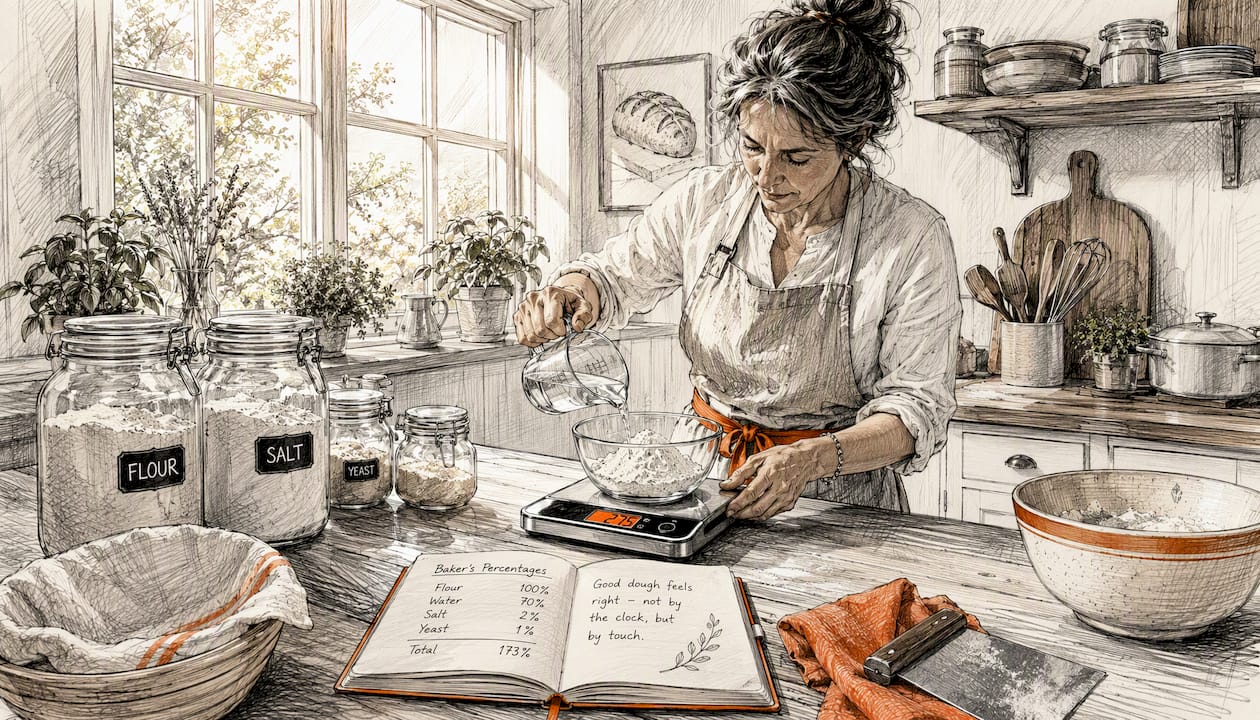
Flour is the fixed base because it is the dominant ingredient in nearly every bread formula and the one variable that stays constant when you adjust hydration, salt, or yeast. Changing the flour weight changes everything else proportionally, which is exactly the point.
That visibility is the real payoff. Two recipes with identical ingredient lists but different hydration percentages will behave completely differently in the oven. With baker's percentages, those differences jump off the page before you mix a gram of flour.
Key terms you need to know before you calculate
Getting the vocabulary right prevents most calculation errors. Here are the terms that come up constantly:
- Total flour weight: When a formula uses more than one flour (bread flour plus whole wheat, for example), you add all flour weights together. That combined total is the base — 100%.
- Hydration: The percentage of water (or water-based liquid) relative to total flour. Formula: hydration% = (total water weight ÷ total flour weight) × 100. Typical bread hydration runs roughly 60%–80%+, depending on style.
- Preferment: A portion of the dough fermented in advance, such as a poolish, biga, or levain. It contains its own flour and water, both of which count toward the formula's total flour and total water.
- Formula percentage: The sum of all individual baker's percentages in a recipe. A simple white bread formula (flour 100%, water 65%, salt 2%, yeast 1%) has a formula percentage of 168%. This number is used to scale batch sizes.
- True percentage vs. baker's percentage: True (total-batch) percentages divide each ingredient by the total batch weight so everything sums to 100%. Professional bakers use this approach for cakes, cookies, and high-fat formulas where treating flour as 100% produces awkward ratios for high-egg or high-butter doughs.
How do you calculate baker's percentage step by step?
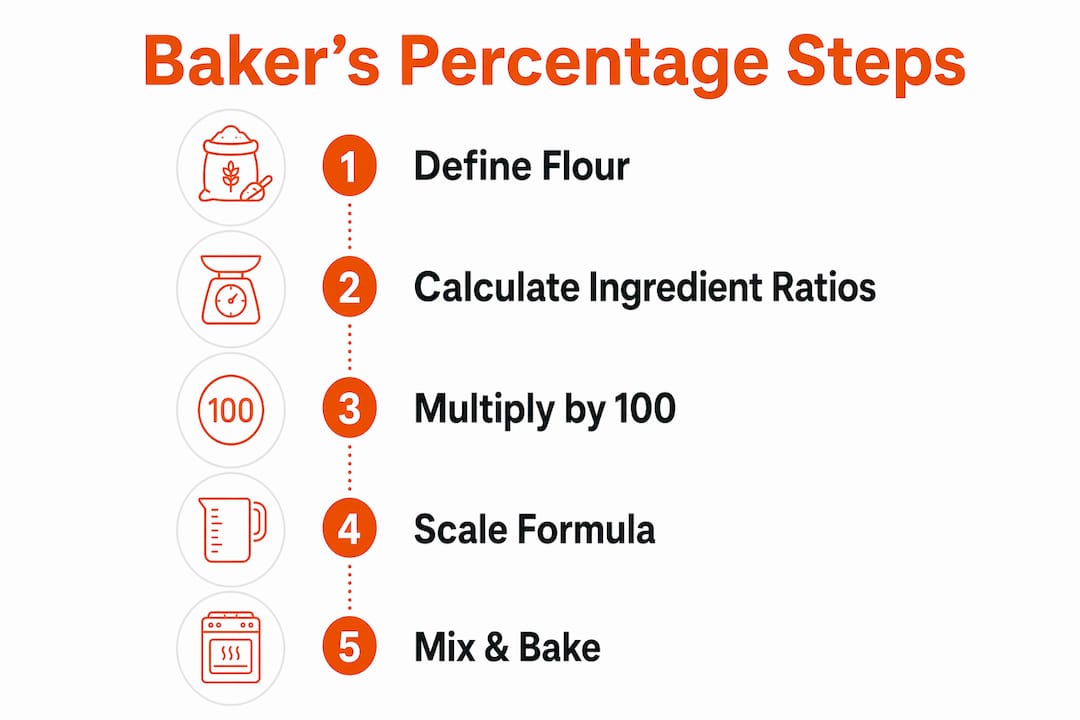
Two formulas cover everything. Master these and the rest is arithmetic.
-
Convert weight to baker's percentage: Divide the ingredient weight by the total flour weight, then multiply by 100. Baker's % = (ingredient weight ÷ flour weight) × 100
-
Convert baker's percentage to weight: Multiply the flour weight by the ingredient's baker's percentage, then divide by 100. Ingredient weight = flour weight × (baker's % ÷ 100)
-
Calculate hydration: Apply formula 1 using only water (or total water-based liquids) as the ingredient. A recipe with 650 g water and 1,000 g flour has 65% hydration.
-
Calculate the formula percentage: Add all individual baker's percentages together. For flour 100% + water 65% + salt 2% + yeast 1%, the formula percentage is 168%.
-
Scale to a target dough weight using a conversion factor: Divide the desired dough weight by the formula percentage (expressed as a decimal). That result is the new flour weight. Then apply formula 2 for every other ingredient. New flour weight = desired dough weight ÷ (formula percentage ÷ 100)
Worked example: simple white bread from percentages to scaled weights
Start with a basic formula expressed entirely in baker's percentages.
| Ingredient | Baker's % |
|---|---|
| Bread flour | 100% |
| Water | 65% |
| Salt | 2% |
| Instant yeast | 1% |
| Formula total | 168% |
Step 1: Choose a flour weight and convert to grams.
Set flour weight at 500 g. Every other ingredient weight follows directly.
- Flour: 500 g (given)
- Water: 500 × 0.65 = 325 g
- Salt: 500 × 0.02 = 10 g
- Instant yeast: 500 × 0.01 = 5 g
- Total dough weight: 500 + 325 + 10 + 5 = 840 g
Step 2: Scale to a target dough weight of 1,200 g.
Compute the conversion factor: 1,200 ÷ 1.68 = 714 g flour (new base).
- Flour: 714 g
- Water: 714 × 0.65 = 464 g
- Salt: 714 × 0.02 = 14 g
- Instant yeast: 714 × 0.01 = 7 g
- Total dough weight: 714 + 464 + 14 + 7 = 1,199 g (rounds to 1,200 g ✓)
Pro Tip: Round salt and yeast to the nearest 0.5 g for small batches, and to the nearest whole gram for batches above 1 kg. Rounding water to the nearest 5 g is fine; rounding flour to the nearest gram keeps the formula percentage accurate.
How to handle multiple flours and preferments
Combining flours
When a formula calls for more than one flour, add all flour weights together to establish the 100% base. A formula using 800 g bread flour and 200 g whole wheat flour has a total flour weight of 1,000 g. Bread flour is then 80% of total flour; whole wheat is 20%. Every other ingredient is still expressed as a percentage of that 1,000 g total, not of either flour individually.
Counting preferments
Preferments introduce flour and water before the final mix, which creates a bookkeeping choice. King Arthur Baking recommends computing an overall baker's percentage by summing all flour and all water across both the preferment and the final dough. That overall figure gives you the true hydration and salt level of the finished bread.
- Do add the preferment's flour to the final dough's flour to get total flour weight.
- Do add the preferment's water to the final dough's water to get total water weight.
- Do express the preferment itself as a percentage of total flour (e.g., a poolish at 30% means the poolish contains flour equal to 30% of total flour weight).
- Don't treat the preferment as a single opaque ingredient without accounting for its internal flour and water.
- Don't use only the final-dough flour as the base when a preferment is present — that understates hydration and overstates salt percentage.
For non-bread formulas (cakes, cookies, enriched doughs with high fat and egg content), total-batch percentages often make more intuitive sense than the flour-as-100% convention.
What hydration range should your dough be?
Dough hydration equals total water weight divided by total flour weight, multiplied by 100. Liquids that are mostly water, such as milk or beer, count toward hydration; fats like butter and oil do not.
| Hydration range | Dough feel | Typical crumb | Common styles |
|---|---|---|---|
| 60%–65% | Firm, smooth, easy to shape | Tight, fine crumb | Bagels, pretzels, sandwich loaves |
| 65%–75% | Soft, slightly tacky | Moderate open crumb | Everyday sourdough, baguettes |
| 75%–85% | Slack, sticky, spreads easily | Open, irregular crumb | High-hydration sourdough, ciabatta |
| 85%+ | Very wet, requires skilled handling | Very open, glossy crumb | Pan de cristal, some focaccia styles |
High-hydration doughs in the 75%–85%+ range produce more open crumb, but that result is not automatic. The open structure depends on strong gluten development and proper fermentation, not hydration alone. Techniques like stretch-and-fold sets during bulk fermentation, a cold retard overnight, and adequate bench time all help manage the slack texture. Bassinage (holding back roughly 10%–15% of the total water and adding it after initial gluten development) gives the flour time to fully hydrate before the dough becomes difficult to handle.
Pro Tip: Flour protein content and ambient humidity both shift effective hydration. A high-protein bread flour (13%+ protein) absorbs more water than an all-purpose flour at 11%, so a 72% hydration dough made with bread flour will feel firmer than the same percentage made with all-purpose. On humid summer days, reduce water by 10–20 g and adjust from there.
How to scale a formula reliably
Scaling works cleanly from either a target flour weight or a target dough weight. Choose based on what you know.
Scaling from a target flour weight (simplest approach):
- Decide how much flour you want to use (e.g., 600 g).
- Multiply each ingredient's baker's percentage by that flour weight and divide by 100.
- Sum all ingredient weights to confirm total dough weight.
Scaling from a target dough weight (useful when you need a specific loaf size):
- Decide the total dough weight you need (e.g., 900 g for one loaf with some trim loss).
- Divide that target by the formula percentage expressed as a decimal: 900 ÷ 1.68 = 536 g flour.
- Use that flour weight as the new base and apply each ingredient's baker's percentage.
A few decision rules worth keeping in mind: fix flour weight when you are buying ingredients by the bag and want to use a round amount. Fix dough weight when you are filling a specific pan, portioning a set number of rolls, or matching a commercial yield target. For professional bakers, scaling by dough weight is the more common approach because it ties directly to production output.
Practical tips, reference ranges, and common pitfalls
Reference ranges to keep handy
Salt in most bread formulas runs 1.8%–2.2% of flour weight. Instant yeast typically falls between 0.5% and 2%, with longer, cooler fermentations using less yeast and same-day recipes using more. Active dry yeast runs slightly higher than instant for equivalent leavening power.
Scale-first habits and rounding rules
- Always weigh flour and water on a digital kitchen scale. Switching from volume to weight is the single most impactful change for consistent results, because a cup of flour can vary by 20%–30% depending on how it is scooped.
- Round water to the nearest 5 g; round flour to the nearest gram; round salt and yeast to the nearest 0.5 g for small batches.
- For very small yeast weights (under 3 g), consider using a scale accurate to 0.1 g, or bloom the yeast in the measured water to distribute it evenly.
Common pitfalls
- Mixing by volume: Cup measurements make baker's percentages meaningless. Weigh everything.
- Forgetting preferment flour: Using only final-dough flour as the base when a preferment is present skews every percentage in the formula.
- Miscounting liquids: Milk and beer count as water-based liquids for hydration. Butter, oil, and eggs do not.
- Treating formula percentage as a quality score: A 200% formula percentage just means a rich, high-hydration dough. It says nothing about whether the bread will taste good.
Where can you automate the baker's percentage math?
Several reputable resources handle the arithmetic so you can focus on the baking.
King Arthur Baking offers a baker's percentage reference page that explains the system and provides worked examples alongside its broader recipe library. Their blog post on baker's math walks through the conversion-factor method in plain language, making it a reliable cross-check for manual calculations.
The Perfect Loaf covers hydration in depth, with practical guidance on handling techniques by hydration range. It is particularly useful when you are dialing in a high-hydration sourdough and want to understand why a specific percentage behaves the way it does.
Wikipedia's baker's percentage article provides the foundational math and notation in a neutral, reference format. It is a good starting point for verifying that your formula structure is correct.
Quick verification checklist for any calculator output:
- Pick one ingredient and calculate its weight manually (flour weight × baker's % ÷ 100).
- Confirm the tool's output matches your manual result within 1 g.
- Sum all ingredient weights and confirm the total matches the tool's stated dough weight.
Apexapro's baker's percentage calculator makes the math instant
Apexapro offers a free, browser-based baker's percentage calculator that handles all the conversions described in this guide without requiring a download or account. It is part of a broader catalog of cooking and baking tools built for instant, practical use.
Key features:
- Percent to weight and weight to percent: Enter either format and the calculator converts in both directions.
- Batch scaling: Set a target dough weight or a target flour weight and get rounded ingredient weights immediately.
- Visual, animated inputs: The interface shows ingredient relationships dynamically as you adjust percentages, which makes it easier to see how changing hydration affects the rest of the formula.
- Bilingual support: Full English and Spanish interface, useful for bakers working in multilingual kitchens or teaching environments.
- No sign-up, no download: Open the page and start calculating. Apexapro adds new tools regularly based on real search demand, so the calculator reflects current baking practice.
How to use it in three steps:
- Enter your ingredient baker's percentages (or weights) into the corresponding fields.
- Choose your base: target flour weight or target dough weight.
- Read the rounded ingredient weights and verify one line manually against the formula in this article.
For bakers who want to confirm the worked example above, entering flour 100%, water 65%, salt 2%, and yeast 1% with a 500 g flour base should return exactly the weights calculated in the worked example section.
Key Takeaways
Baker's percentage works because flour is the fixed 100% base, making every other ingredient's ratio instantly readable and every batch size scalable with a single conversion factor.
| Point | Details |
|---|---|
| Flour is always 100% | All baker's percentages are relative to total flour weight, never total dough weight. |
| Hydration formula | Hydration% = (total water weight ÷ total flour weight) × 100; typical bread runs 60%–80%+. |
| Scale by conversion factor | Divide target dough weight by formula percentage (as a decimal) to get new flour weight. |
| Salt and yeast reference ranges | Salt typically runs 1.8%–2.2%; instant yeast 0.5%–2% depending on fermentation method. |
| Apexapro calculator | The free, browser-based tool at Apexapro converts percentages to weights and scales batches instantly, no sign-up needed. |
The part most guides skip about baker's percentage
The math in baker's percentage is genuinely simple. What takes longer to internalize is the shift in how you read a recipe. Most home bakers spend years looking at ingredient lists as fixed quantities: 3 cups of flour, 1 teaspoon of salt. Baker's percentage asks you to see those quantities as relationships. Once that mental shift happens, a recipe stops being a set of instructions and starts being a description of a dough's character.
The hydration percentage is the clearest example. A 68% hydration sourdough and a 78% hydration sourdough are not just "wetter" and "drier" versions of the same bread. They behave differently at every stage: mixing, bulk fermentation, shaping, and baking. The 10-percentage-point gap changes how long you fold, how cold you retard, and how you score. Treating hydration as a handling cue rather than a quality metric is the practical insight that separates bakers who use the system from bakers who just know the formula.
The other thing worth saying plainly: the scale is not optional. A digital kitchen scale, accurate to 1 g, costs less than a bag of good bread flour. Without it, baker's percentages are theoretical. With it, they are the most reliable tool in your kitchen. If you are serious about improving as a baker, whether at home or in a professional setting, understanding how pastry and baking careers are built on precisely this kind of technical foundation is worth a moment's reflection. Precision is not a professional-only concern. It is what separates a repeatable result from a lucky one.
The Apexapro baker's percentage calculator is free and ready now
If you have worked through this guide and want to skip the arithmetic on your next bake, Apexapro's calculator handles it in seconds. No spreadsheet, no pencil math, no account to create.

Three reasons bakers use it:
- Instant math: Enter your percentages and flour weight, and every ingredient weight appears immediately with rounding applied.
- No sign-up: Open the page, calculate, bake. The tool is free and runs entirely in your browser.
- Visual scaling controls: Adjust hydration or batch size and watch every ingredient weight update in real time.
Try the calculator at Apexapro and use the worked example from this article (flour 100%, water 65%, salt 2%, yeast 1%, 500 g flour base) to verify the output against your manual calculation. That single check builds the habit of trusting the tool while keeping your arithmetic sharp.
Useful sources and further reading
These references back the formulas and ranges throughout this guide and are worth bookmarking for ongoing use.
- Baker's Percentage — Wikipedia: The foundational reference for the notation, the math, and the historical context. Use it to verify formula structure and confirm the flour-as-100% convention.
- King Arthur Baking: Baker's Math: A practical, plain-language walkthrough of the conversion-factor method with examples for home bakers. One of the clearest explanations of when to use baker's percentage versus total-batch percentages.
- King Arthur Baking: Baker's Percentage Reference: The professional reference page covering salt and yeast ranges, preferment accounting, and formula percentage. Cross-check any formula you build against the ranges listed here.
- The Perfect Loaf: Dough Hydration: The most thorough publicly available guide to hydration ranges, handling techniques (including bassinage and stretch-and-fold), and how hydration interacts with fermentation. Indispensable for high-hydration baking.
- Wikipedia: Pre-ferment: Covers poolish, biga, levain, and other preferment types with their typical flour and water ratios. Useful when you are building a formula that includes a preferment and need to account for its flour and water correctly.