TL;DR:
- A Roth IRA generally benefits those expecting higher taxes in retirement, while a Traditional IRA suits those needing a current-year deduction. The key differences involve tax timing and RMD requirements, which influence estate planning and withdrawal strategies. Using personalized calculators can help determine the optimal choice based on individual income, timeline, and future tax expectations.
If you expect higher taxes in retirement, a Roth IRA usually wins. If you need a tax break today, a Traditional IRA often makes more sense. That single rule covers the majority of decisions, though the details around eligibility, RMDs, and estate planning can shift the answer.
The core trade-offs at a glance:
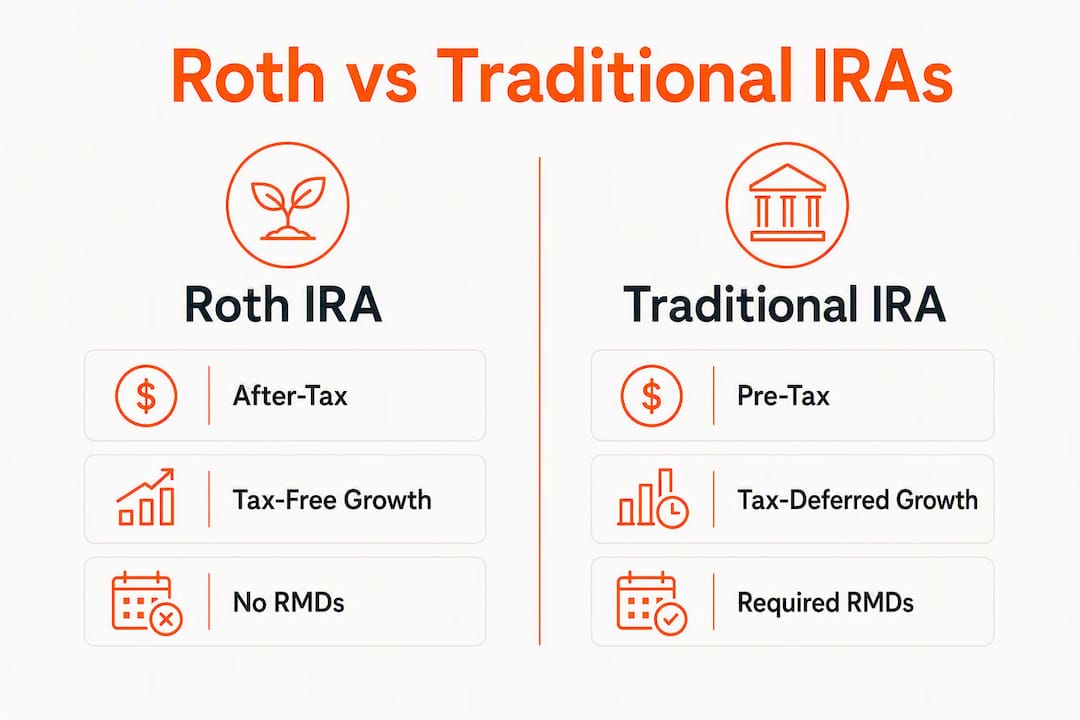
- Tax timing: Traditional IRAs give you a deduction now and tax the withdrawals later; Roth IRAs take after-tax dollars now and let qualified withdrawals come out completely tax-free.
- RMDs and estate planning: Traditional IRAs require minimum distributions starting at age 73; Roth IRAs have no required minimum distributions during the original owner's lifetime, which makes them a powerful estate-planning tool.
For 2026, the annual IRA contribution limit applies to the combined total across all your Traditional and Roth accounts, with higher limits allowed for savers age 50 and older.
Table of Contents
- How do Roth and Traditional IRAs compare side by side?
- Why tax timing is the core difference between Roth and Traditional IRAs
- Who can contribute, and how much can you put in for 2026?
- What are the withdrawal rules, penalties, and RMD requirements?
- How do Roth conversions and the backdoor Roth strategy work?
- How do you decide which IRA fits your situation?
- How can you use calculators to compare your Roth vs Traditional outcomes?
- Key Takeaways
- The case for tax diversification over picking a "winner"
- Run your own Roth vs Traditional numbers for free
- Useful sources and further reading
How do Roth and Traditional IRAs compare side by side?
| Dimension | Roth IRA | Traditional IRA |
|---|---|---|
| Tax treatment | After-tax contributions; tax-free qualified withdrawals | Pre-tax (deductible) contributions; withdrawals taxed as ordinary income |
| Best for | Savers expecting higher tax rates in retirement | Savers needing a current-year deduction or in a high bracket now |
| Eligibility & MAGI phaseouts | Full contribution under $153,000 (single) / $242,000 (MFJ); phaseout above those levels | No income ceiling; deductibility phases out if covered by a workplace plan |
| Contribution limit (2026) | $7,500 ($8,600 for age 50+) shared across all Roth and Traditional IRAs | $7,500 ($8,600 for age 50+) shared across all Roth and Traditional IRAs |
| Deadline | Tax-filing deadline (April 15) for prior-year contributions | Same |
| Withdrawal tax treatment | Contributions: anytime, tax- and penalty-free; earnings: tax-free if qualified | Taxable as ordinary income; 10% penalty if under age 59½ (exceptions apply) |
| RMDs | None during original owner's lifetime | Required starting April 1 after you turn 73 |
| Conversion rules | Can receive conversions from Traditional; taxable event | Can be converted to Roth; ordinary income tax owed on converted amount |
| Estate planning | No lifetime RMDs; passes tax-free to heirs (inherited account rules apply) | Heirs inherit a taxable account with RMD obligations |
Why tax timing is the core difference between Roth and Traditional IRAs
Traditional IRA contributions are generally tax-deductible in the year you make them, and the money grows tax-deferred until you withdraw it. Roth contributions get no upfront deduction, but qualified withdrawals in retirement are entirely tax-free. The question is simply: when do you want to pay the IRS?

Two scenarios with the same numbers:
| Assumption | Scenario A: Roth wins | Scenario B: Traditional wins |
|---|---|---|
| Annual contribution | $7,500 | $7,500 |
| Years invested | 30 | 30 |
| Annual return | 7% | 7% |
| Tax rate today | 22% | — |
| Tax rate in retirement | — | 22% |
| After-tax value (Roth) | — (tax-free) | N/A |
| After-tax value (Traditional) | ~$513,000 (taxed at —) | — |
When your retirement tax rate is higher than your current rate, the Roth wins by a wide margin. When your current rate is higher, the Traditional preserves more wealth. Neither account earns more in the market; the difference is entirely in the tax treatment.
Pro Tip: Partial Roth conversions across multiple years let you "fill up" lower tax brackets before retirement without triggering a large single-year tax bill. If you convert $20,000–$30,000 per year during a low-income period (early retirement, a sabbatical, or a gap year), you can shift a meaningful balance to tax-free status at a fraction of the cost of converting everything at once.
Who can contribute, and how much can you put in for 2026?
Contribution limits and the earned income rule
Both account types require earned compensation — wages, self-employment income, or alimony received under pre-2019 agreements. You cannot contribute more than you earned that year, even if the limit is higher. For 2026, the IRS-governed cap is $7,500 per person ($8,600 for those age 50 and older), shared across all your IRAs combined.

The contribution deadline is your tax-filing deadline, typically April 15. That means you can make a 2026 IRA contribution as late as April 15, 2027, giving you extra time to assess your income and tax situation before committing.
Roth IRA income phaseouts
Roth eligibility phases out based on your Modified Adjusted Gross Income (MAGI):
- Single filers: Full contribution allowed below a specified income limit; partial contribution allowed in the phaseout range; no direct contribution above the ceiling.
- Married filing jointly: Full contribution allowed below a specified income limit; partial contribution allowed in the phaseout range; no direct contribution above the ceiling.
If your income exceeds the ceiling, you cannot contribute directly to a Roth — but the backdoor Roth strategy (covered below) remains available.
When Traditional IRA contributions are deductible
There is no income ceiling for contributing to a Traditional IRA, but the deductibility depends on whether you (or your spouse) are covered by a workplace retirement plan. If neither of you has access to a 401(k) or similar plan, your Traditional contribution is fully deductible at any income level. If you are covered by a workplace plan, deductibility phases out at moderate income levels. Nondeductible Traditional contributions are still allowed; they just lose the upfront tax break, which makes the Roth or a workplace plan a better first choice in most cases.
Pro Tip: If you are in the SSDI system or approaching disability-related benefit decisions, SSDI's interaction with retirement savings can affect which account type makes sense — particularly for savers ages 55–65 weighing withdrawal timing.
What are the withdrawal rules, penalties, and RMD requirements?
Qualified distributions and the 5-year rule
Roth contributions can be withdrawn at any time, tax- and penalty-free — only the earnings are restricted. For earnings to come out tax-free, two conditions must be met: the account must be at least five years old, and you must be age 59½ or older. Traditional IRA withdrawals are taxed as ordinary income regardless of age, and withdrawals before age 59½ carry a 10% early-withdrawal penalty on top of the income tax owed.
Common penalty exceptions
The 10% early-withdrawal penalty is waived in several situations for both account types:
- First-time home purchase (up to $10,000 lifetime for Roth earnings)
- Qualified higher education expenses
- Total and permanent disability
- Unreimbursed medical expenses exceeding a threshold
- Substantially equal periodic payments (SEPP / Rule 72(t))
- Health insurance premiums during unemployment
RMD timeline: key ages and deadlines
| Age / Event | Traditional IRA | Roth IRA |
|---|---|---|
| Age 59½ | Penalty-free withdrawals begin | Penalty-free withdrawals begin (if 5-year rule met) |
| Age 73 | First RMD must be taken by April 1 of the following year | No RMD required |
| Year after first RMD | Second RMD due by December 31 of that same year | No RMD required |
| Owner's lifetime | Annual RMDs continue | No RMDs ever |
The double-RMD trap in the first year is worth noting: if you delay your first Traditional IRA distribution until April 1, you must still take the second one by December 31 of that same year. Two distributions in one calendar year can push you into a higher bracket and increase Medicare premium surcharges (IRMAA).
How do Roth conversions and the backdoor Roth strategy work?
Conversion mechanics
A Roth conversion moves money from a pre-tax Traditional IRA into a Roth IRA. The converted amount is added to your taxable income for that year and taxed at your ordinary income rate. There is no limit on how much you can convert in a single year, but the tax bill can be substantial if you convert a large balance at once.
The strategic case for converting is straightforward: if you believe your tax rate will be higher later, paying tax now at a lower rate locks in the savings. Spreading conversions across several years — particularly during lower-income periods — keeps each year's tax cost manageable.
Pros and cons of converting:
- Pro: Eliminates future RMDs on the converted balance; tax-free growth from that point forward.
- Pro: Reduces the taxable estate for heirs.
- Con: Triggers an immediate tax bill; requires cash on hand to pay taxes without dipping into the converted funds.
- Con: Can increase MAGI, affecting Medicare premiums, Social Security taxation, or other income-based thresholds.
The backdoor Roth: a step-by-step overview
High earners above the Roth MAGI ceiling can still access Roth benefits through the backdoor Roth strategy:
- Make a nondeductible contribution to a Traditional IRA (no income limit applies).
- Convert that Traditional IRA balance to a Roth IRA shortly after.
- Report the nondeductible contribution on IRS Form 8606 to establish your cost basis.
- Pay tax only on any earnings that accrued between contribution and conversion (often minimal if done quickly).
Warning: The pro-rata rule complicates this strategy if you hold other pre-tax Traditional IRA balances. The IRS treats all your Traditional IRA accounts as one pool when calculating the taxable portion of a conversion. If you have $90,000 in a pre-tax Traditional IRA and add a $7,500 nondeductible contribution, roughly 92% of any conversion is taxable — not just the new $7,500. Rolling pre-tax balances into a current employer's 401(k) before executing the backdoor Roth can sidestep this issue.
Pro Tip: Keep meticulous records of every Form 8606 you file. The IRS does not track your nondeductible basis for you. Missing or lost forms can result in double taxation on money you already paid tax on.
How do you decide which IRA fits your situation?
A quick decision checklist
Run through these questions before choosing:
- Is your current marginal tax rate lower than you expect it to be in retirement? → Favor Roth.
- Do you need a tax deduction this year to reduce a high taxable income? → Favor Traditional.
- Does your MAGI exceed the Roth income ceiling? → Consider backdoor Roth or Traditional.
- Do you want to avoid mandatory withdrawals in retirement? → Roth has no RMDs.
- Is leaving a tax-free inheritance a priority? → Roth offers a cleaner estate-planning outcome.
- Do you have access to a 401(k) or other workplace plan? → Max that first if there's an employer match, then layer in an IRA.
Four scenarios mapped to likely choices
-
The young saver (age 22–35, income $55,000): In a low bracket now with decades of compounding ahead, a Roth IRA is the natural fit. Tax-free growth over 30+ years and no RMDs in retirement make the after-tax math hard to beat.
-
The peak earner (age 45–55, income $250,000+): Above the Roth MAGI ceiling for direct contributions. The backdoor Roth is available if no pre-tax IRA balances exist; otherwise, a Traditional IRA (nondeductible) or maximizing a 401(k) is the more practical path.
-
The near-retiree (age 60–68, income dropping): A lower-income window before Social Security and RMDs kick in is ideal for partial Roth conversions. Converting $20,000–$40,000 per year during this window can reduce future RMD obligations and the associated tax drag.
-
The estate planner (any age, wealth transfer goal): Roth IRAs pass to heirs without lifetime RMD obligations on the original owner, and qualified distributions remain tax-free. For readers focused on leaving assets to the next generation, the Roth's estate-planning edge is significant.
Before committing to either path, model your specific numbers with an interactive calculator. The right answer depends on your actual income, expected retirement bracket, and timeline — not just the general rules.
How can you use calculators to compare your Roth vs Traditional outcomes?
Interactive calculators are the fastest way to move from general rules to a personalized answer. Vanguard and Fidelity both publish scenario-testing tools that let you input your current tax rate, expected retirement rate, contribution amount, and time horizon to see projected after-tax balances side by side.
Three calculator scenarios worth running:
- Current vs. future tax rate comparison: Input your current bracket and two retirement-bracket assumptions (same rate, higher rate). The output shows how much the tax-timing difference is worth in dollars over your horizon.
- Conversion tax-cost modeling: Enter a Traditional IRA balance and a proposed annual conversion amount. The calculator shows the tax cost per year and the long-term benefit of eliminating RMDs on that balance.
- RMD impact projection: Model the mandatory distribution schedule from a Traditional IRA starting at age 73 to see how much taxable income RMDs add each year and whether they push you into a higher bracket or trigger IRMAA surcharges.
Example inputs to try:
- Young saver case: Age 25, $7,500 annual contribution, 7% return, 35-year horizon, current rate 22%, retirement rate 28%. Run both Roth and Traditional to see the after-tax gap.
- Mid-career conversion case: Age 52, $150,000 Traditional IRA balance, $25,000 annual conversion, current rate 24%, expected retirement rate 22%. The calculator shows whether the conversion cost is justified by the RMD reduction.
Financial planning tools that model tax diversification — holding both Roth and Traditional balances — are especially useful for readers who are not sure which bracket they will land in at retirement. Save your outputs before a tax or advisor conversation; having the numbers in front of you makes the discussion far more productive.
Pro Tip: Apexapro's free retirement calculators run entirely in your browser with no sign-up required. Try the IRA comparison tool at apexapro.com to model your specific contribution, tax rate, and timeline before making a final decision.
Key Takeaways
The single most important rule: choose Roth when you expect higher taxes in retirement, and Traditional when you need a deduction today — then use a calculator to confirm the numbers for your specific situation.
| Point | Details |
|---|---|
| Tax timing drives the decision | Roth pays tax now for tax-free withdrawals later; Traditional defers tax until retirement withdrawals. |
| 2026 contribution limits | $7,500 per year ($8,600 if age 50+), shared across all IRA accounts, due by April 15. |
| Roth income phaseouts | Direct Roth contributions phase out above $153,000 (single) and $242,000 (married filing jointly). |
| RMDs differ significantly | Traditional IRAs require distributions starting at age 73; Roth IRAs have no lifetime RMDs for the original owner. |
| Model your numbers first | Use an interactive calculator at Apexapro to compare after-tax outcomes before choosing or converting. |
The case for tax diversification over picking a "winner"
Most articles frame this as a binary choice, and that framing leads people astray. The conventional wisdom — "pick the one that matches your expected tax bracket" — assumes you can predict your retirement income with confidence. You probably cannot.
Tax policy changes. Social Security claiming strategies shift income. Unexpected medical costs, inheritance events, or a part-time consulting income in retirement can all move your bracket in ways you did not model at age 35. The readers who end up with the most flexibility in retirement are usually the ones who built both a Roth and a Traditional balance over time, giving themselves the ability to draw from whichever account minimizes their tax bill in any given year.
The two lessons that come up most often in practice: first, do not assume your tax rate will fall in retirement just because your salary will. RMDs, Social Security, and investment income can keep your effective rate surprisingly high. Second, recordkeeping matters more than most people realize. Every nondeductible Traditional contribution and every conversion needs a paper trail through Form 8606. Losing that documentation can mean paying tax twice on the same money, and the IRS will not catch the error in your favor.
Run your own Roth vs Traditional numbers for free
Choosing between these two accounts comes down to your specific tax situation, not a general rule. Apexapro's free, browser-based IRA calculator lets you plug in your contribution amount, current tax rate, expected retirement bracket, and time horizon to see projected after-tax balances for both account types side by side.
No sign-up, no download — the tool runs instantly and shows you outputs like after-tax retirement income and estimated conversion tax cost. It takes about two minutes to run the scenarios described in this article. Head to apexapro.com and try the retirement calculator before your next tax-filing deadline.
Useful sources and further reading
- Traditional and Roth IRAs — IRS: The authoritative source for contribution limits, deductibility rules, RMD ages, and qualified distribution requirements. Used for all tax-code-based rules in this article.
- Roth IRAs — IRS: IRS guidance specific to Roth account setup, contribution rules, and distribution requirements, including Publication 590-A and 590-B references.
- Roth IRA vs. Traditional IRA — Vanguard: Practical explainer covering tax timing, eligibility, and scenario-based guidance; used for the core tax-timing framework and conversion planning notes.
- 8 Key Benefits of a Roth IRA — Vanguard: Covers contribution flexibility, the 5-year rule, and estate-planning advantages; sourced for withdrawal rules and the no-RMD benefit.
- Traditional and Roth IRA Comparison — Fidelity: Side-by-side comparison used for RMD timing details, conversion tax consequences, and the pro-rata rule explanation.
- Traditional or Roth IRA? — Fidelity: Source for 2026 contribution limits ($7,500 / $8,600) and Roth MAGI phaseout thresholds ($153,000 single / $242,000 MFJ).
- 9 Roth IRA Benefits — Fidelity: Used for the tax diversification strategy and the case for holding both account types.
- Charles Schwab IRA planning resources: Schwab publishes practical IRA comparison and conversion planning guides widely used by advisers; consult schwab.com for additional scenario examples and conversion calculators.
- Apexapro IRA Calculator — apexapro.com: Free, browser-based tool for modeling Roth vs Traditional after-tax outcomes, conversion tax costs, and RMD projections with no sign-up required.
This article is general information, not tax or financial advice. Contribution limits, MAGI thresholds, and RMD rules can change; confirm current figures with the IRS or a qualified tax professional before making decisions for your own situation.