
TL;DR:
- A mortgage recast involves making a lump sum payment to reduce your principal without changing the rate or loan term. Refinancing replaces your loan, potentially altering the rate, term, and allowing cash access, but involves higher costs and longer processing times. Homeowners should compare total interest savings, breakeven points, and eligibility before choosing the best option.
If you have a low existing rate and a meaningful lump sum, a recast usually wins. If you need a lower rate, a different loan term, or cash from your equity, refinancing is the right move. Those two sentences cover the majority of homeowner situations, but the details matter enough to get wrong.
With the average mortgage balance sitting at $208,185, even a modest monthly payment reduction can free up hundreds of dollars a year. The fastest way to orient yourself is this mini comparison:
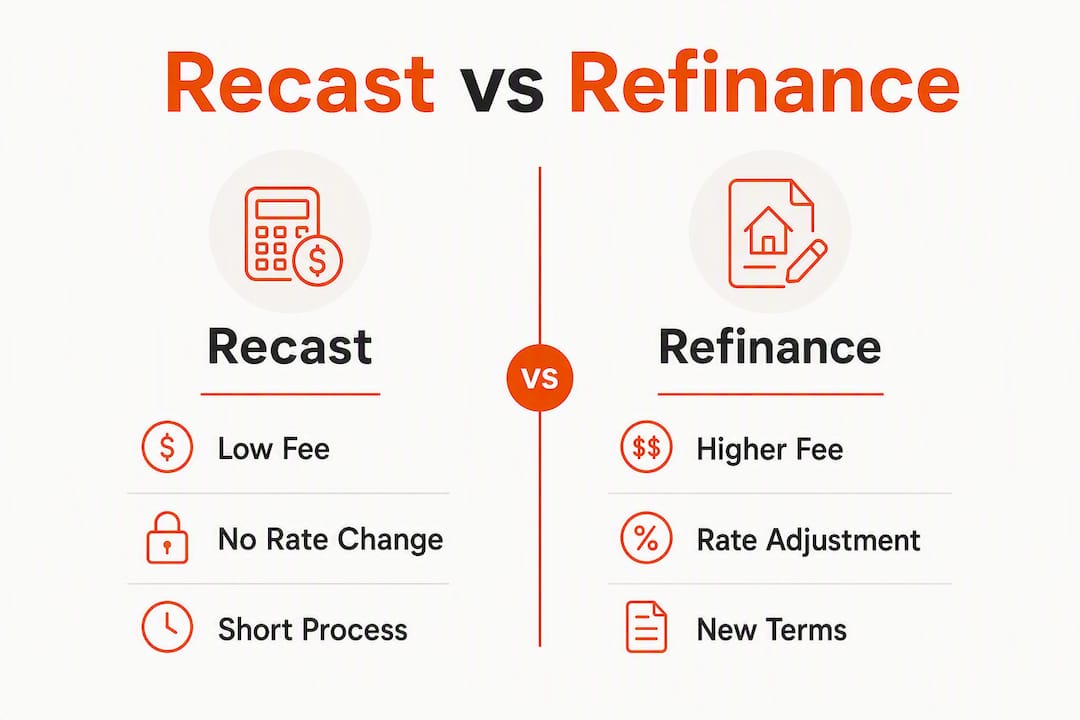
- Recast: Pay a lump sum, keep your rate and term, pay a a moderate flat administrative fee, done in days to weeks.
- Refinance: Replace the loan entirely, potentially change rate and term, pay a few percent in closing costs, takes 21–45 days.
- Rate impact: Recast changes nothing about your rate. Refinance can raise or lower it.
- Cash access: Recast locks cash in. Only a cash-out refinance puts money back in your pocket.
| Dimension | Recast | Refinance |
|---|---|---|
| Fee | $200–$500 flat | 2%–6% of loan amount |
| Rate change | None | Yes (up or down) |
| Loan term | Unchanged | Can be reset or shortened |
| Cash-out option | No | Yes |
| Timeline | Days to a few weeks | 21–45 days |
Immediate disqualifiers: No lump sum available means recasting is off the table entirely. FHA, VA, and USDA loans are typically ineligible for recasting, so government-backed borrowers almost always need to refinance if they want a lower payment.
Table of Contents
- What is a mortgage recast and how does it work?
- What refinancing is and what it actually costs you
- How do recast and refinance compare side by side?
- When does a recast make sense, and when should you refinance?
- What are the steps and timeline for each option?
- What questions should you ask your lender, and what are the red flags?
- How to use a mortgage calculator to model your own numbers
- Key Takeaways
- The case for running multiple scenarios before deciding
- Run your own recast and refinance numbers with Apexapro
- Authoritative sources and further reading
What is a mortgage recast and how does it work?
A mortgage recast is a re-amortization of your existing loan after you make a lump-sum payment toward the principal. Your interest rate stays exactly where it is. Your remaining loan term stays the same. The only thing that changes is how the servicer spreads the lower balance across your remaining payments, which produces a smaller monthly obligation.
The mechanics follow a straightforward sequence:
- You make a qualifying lump-sum principal payment directly to your servicer.
- You submit a formal recast request (more on why this step is non-negotiable below).
- The servicer re-amortizes the loan using the reduced balance and your original rate and term.
- Your new, lower monthly payment takes effect, typically within one billing cycle.
Eligibility matters. Lenders are not required to offer recasting, and many impose minimum lump-sum thresholds, commonly $5,000–$10,000 and sometimes higher. You also generally need to be current on payments before a servicer will accept a recast request. Federally backed loans — FHA, VA, USDA — are typically excluded from recasting, so if your loan falls into one of those categories, refinancing is your primary path to a lower payment.
The administrative fee for a recast commonly runs $200–$500, and no credit check, income verification, or appraisal is required. That absence of underwriting is one of recasting's sharpest advantages over refinancing.

Pro Tip: Simply making extra principal payments will not lower your scheduled monthly payment. You must submit a formal recast request to trigger re-amortization. Confirm the servicer's policy and minimum thresholds in writing before you send any lump sum — otherwise you lock cash into the loan without receiving a payment reduction.
What refinancing is and what it actually costs you
Refinancing replaces your existing mortgage with a brand-new loan. That new loan pays off the old one and can change virtually everything: your interest rate, your loan term, your loan type, and whether you walk away with cash in hand.
The most common refinance types and their objectives:
| Refinance Type | Primary Objective |
|---|---|
| Rate-and-term | Lower the interest rate or shorten/extend the term |
| Cash-out | Extract equity as cash while resetting the loan |
| ARM-to-fixed | Convert an adjustable rate to a fixed rate for stability |
| Shorten term | Move from a 30-year to a 15-year to pay off faster |
Every refinance requires underwriting. That means a credit check, income verification, and in most cases a full appraisal. The typical timeline runs 21–45 days from application to closing, and the process involves title work, escrow, and a stack of disclosure documents.
The cost is where refinancing demands careful math. Closing costs commonly run 2%–6% of the loan amount, which on a $300,000 balance translates to $6,000–$18,000. Some lenders offer "no-cost" refinances, but those costs are folded into a higher rate rather than eliminated.
Cost reality check: Paying closing costs makes sense when the rate drop is large enough that monthly savings recover those costs within a reasonable period, or when you are changing loan types for structural reasons (for example, removing mortgage insurance by moving from FHA to conventional). A small rate improvement on a loan you plan to sell in two years rarely justifies the upfront expense.
For a state-specific look at how refinancing works in practice, this Florida refinancing guide walks through the process and timeline step by step.
How do recast and refinance compare side by side?
The table below covers the eight decision dimensions that matter most to homeowners weighing these two options.

| Dimension | Recast | Refinance |
|---|---|---|
| Typical fees / closing costs | a moderate flat administrative fee | a few percent of loan amount |
| Eligibility / loan types | Conventional loans; lender must offer it; FHA/VA/USDA typically excluded | Available for most loan types; lender and credit requirements apply |
| Effect on interest rate | None — existing rate preserved | Can lower, raise, or change rate type |
| Effect on monthly payment | Reduced (lower balance, same rate/term) | Reduced or increased depending on new rate and term |
| Access to cash | None | Yes, via cash-out refinance |
| Timeline & paperwork | Days to a few weeks; no appraisal or credit check | 21–45 days; full underwriting, appraisal, title work |
| Long-term interest paid | Reduced (lower principal balance) | Reduced if rate drops; can increase if term resets |
| Common use cases | Lump sum available; existing rate is low; want speed and simplicity | Rate is too high; need cash; want to change term or loan type |
A worked example with real numbers
Assume a homeowner has a $350,000 balance, a 3.5% fixed rate, and 25 years remaining.
Option A: Recast with a $50,000 lump sum New balance: $300,000. Rate and term unchanged at 3.5% over 25 years. Approximate monthly payment drops from roughly $1,752 to about $1,502, a reduction of $250/month. Administrative fee: $200–$500. Total interest paid over the remaining term decreases because the principal is lower.
Option B: Refinance to a 6.5% rate (current market example) over 30 years New balance: $350,000 at 6.5%. Approximate monthly payment: roughly $2,212. That is $460 more per month than the original payment, plus $7,000–$21,000 in closing costs.
The numbers here illustrate the rate-delta problem directly. When your existing rate is substantially below prevailing market rates, refinancing can raise your payment even when you are not taking cash out. Recasting preserves the favorable rate while still reducing the monthly obligation.
You can swap in your own balance, rate, and lump-sum figures using a refinance calculator to test both scenarios before calling your servicer.
When does a recast make sense, and when should you refinance?
Three rules-of-thumb cover most situations:
- Rate delta rule: If your current rate is lower than today's market rates, refinancing will raise your rate. Recast instead.
- Lump-sum rule: If you have $10,000 or more available and do not need that cash for emergencies or other goals, a recast is worth exploring. If you have no lump sum, recasting is not an option.
- Liquidity rule: If you need cash from your equity — for a renovation, debt consolidation, or any other purpose — a cash-out refinance is your only mortgage-based route. A recast only moves cash into the loan.
Scenario examples
Scenario 1: Low-rate homeowner with a $50,000 windfall. You locked in a 3.25% rate in 2021 and just received an inheritance. Current rates are near 6.5%. Recasting is the clear choice: you lower the payment without surrendering the rate.
Scenario 2: High-rate homeowner with no lump sum. You bought in 2023 at 7.2% and rates have dropped to 6.0%. You have no large cash reserve. Refinancing makes sense if the monthly savings recover closing costs within your expected time in the home.
Scenario 3: Homeowner needing renovation cash. You have $80,000 in equity and want $40,000 for a kitchen remodel. A recast cannot help here. A cash-out refinance or a home equity line of credit is the path.
Scenario 4: ARM reset approaching. Your adjustable-rate mortgage resets in six months and you expect the new rate to be significantly higher. Refinancing into a fixed rate now eliminates that uncertainty, regardless of whether you have a lump sum.
Scenario 5: Buying before selling. You purchased a new home before your old one sold. Once the sale closes, you can use the proceeds to recast the new mortgage, reducing monthly obligations without requalifying for a new loan. This is one of recasting's most practical and underused applications.
The breakeven formula for refinancing
Breakeven months = Total closing costs ÷ Monthly payment savings
If closing costs are $9,000 and the new payment saves you $300/month, breakeven is 30 months. If you plan to stay in the home longer than 30 months, refinancing makes financial sense. If you might sell or refinance again before then, the costs likely outweigh the benefit.
Pro Tip: Never refinance into a higher rate just to access cash if you can avoid it. And always verify whether a refinance would remove or add mortgage insurance — moving from FHA to conventional can eliminate the annual MIP, which changes the true cost comparison significantly. Understanding mortgage points can also shift the breakeven calculation when you are buying down the rate at closing.
What are the steps and timeline for each option?
Recast process checklist
- Confirm eligibility in writing. Call your servicer and ask whether your loan type allows recasting, what the minimum lump sum is, and what the administrative fee is. Get the answer in writing or via email.
- Prepare the lump sum. Verify the funds are available and that using them will not deplete your emergency reserve.
- Submit the formal recast request. Complete any paperwork the servicer requires alongside the lump-sum payment.
- Pay the administrative fee. Typically $200–$500, paid at the time of the request.
- Servicer re-amortizes the loan. Processing can take a few days to a few weeks depending on the servicer.
- New payment takes effect. Usually within one to two billing cycles.
Refinance process checklist
- Shop rates from multiple lenders. Compare at least three loan estimates to find the best combination of rate and fees.
- Submit a formal application. Provide income documents, tax returns, bank statements, and authorization for a credit pull.
- Underwriting review. The lender verifies your income, assets, and creditworthiness. This stage often takes 1–2 weeks.
- Appraisal. A licensed appraiser visits the property to confirm current market value. Schedule this early.
- Closing disclosure review. You receive final loan terms at least three business days before closing.
- Closing. Sign documents, pay closing costs, and the new loan funds. The old loan is paid off.
For a detailed walkthrough of the recast mechanics in a state-specific context, this Florida recast guide covers eligibility and process clearly.
Typical fees at a glance
| Cost Item | Recast | Refinance |
|---|---|---|
| Administrative / origination fee | moderate flat fee | a fraction of a percent of loan amount |
| Appraisal | Not required | $200–$500 |
| Title insurance / search | Not required | — |
| Credit check | Not required | Included in application |
| Total typical range | $200–$500 | 2%–6% of loan amount |
Timing note: For a recast using home-sale proceeds, coordinate the lump-sum transfer and recast request within the same billing cycle when possible. For a refinance, lock your rate once you have a signed purchase agreement or when you are confident in the timeline, since rate locks typically run 30–60 days.
What questions should you ask your lender, and what are the red flags?
Questions to bring to every servicer or lender call
- Does my loan type allow recasting? (Confirm this before anything else.)
- What is the minimum lump-sum payment required to trigger a recast?
- What is the administrative fee, and when is it due?
- How long does the re-amortization process take, and when will my new payment take effect?
- Will you confirm your recast policy in writing or via email?
- For refinancing: What is the all-in APR, including all fees and points?
- What are the total estimated closing costs, itemized?
- Is there a prepayment penalty on my current loan that would apply if I refinance?
- How long will the rate lock last, and what happens if closing is delayed?
Red flags that should stop the deal
- Servicer refuses to confirm recast policy in writing. Verbal assurances are not enough. If they will not put it in an email, treat the answer as "no."
- "No-cost" refinance language with no explanation of where costs went. Costs rolled into the rate are still costs — they just accumulate over time rather than upfront.
- A refinance offer that raises your rate. This happens when current market rates exceed your existing rate and the lender emphasizes the lower payment from a longer term rather than the total cost.
- Lump-sum payment accepted without a formal recast request on file. Extra principal without a formal recast does not lower your monthly payment. Confirm the recast request is processed separately.
- Pressure to close before you receive the Closing Disclosure. Federal law requires a three-business-day review period. Any lender who discourages you from reading it carefully is a red flag.
One scenario worth understanding: a homeowner rolls $12,000 in closing costs into a refinance loan at a rate slightly higher than the original. The monthly payment drops modestly, but the total interest paid over the new 30-year term increases by tens of thousands of dollars. The payment looked better; the deal was not.
How to use a mortgage calculator to model your own numbers
Running your own numbers takes the guesswork out of this decision. The inputs you need are straightforward:
- Current loan balance
- Current interest rate
- Remaining loan term (months or years)
- Lump-sum amount you could apply (for recast scenario)
- Target refinance rate (for refinance scenario)
- Estimated refinance closing costs
- Desired new loan term (if refinancing)
With those inputs, work through three scenarios in sequence:
- Baseline: Calculate your current monthly payment and total interest remaining at your current rate and balance.
- Recast scenario: Subtract the lump sum from the balance, keep the rate and remaining term, and recalculate the monthly payment. Note the monthly savings and the total interest reduction.
- Refinance scenario: Apply the new rate and term to the full balance, add closing costs to the total cost, and calculate the monthly payment. Divide closing costs by monthly savings to get breakeven months.
What to look for in the output: the monthly payment difference tells you cash-flow impact today; the total interest comparison tells you the long-term cost; and the breakeven months tell you how long you need to stay in the home for refinancing to pay off.
Apexapro's free loan calculators let you run all three scenarios directly in your browser, with no sign-up required. Open the mortgage calculator, enter your current balance and rate for the baseline, then adjust the balance for the recast scenario and the rate for the refinance scenario. The side-by-side output makes the decision concrete rather than theoretical.
Key Takeaways
A recast wins when your rate is already low and you have a lump sum; refinancing wins when you need a rate change, a different term, or cash from your equity.
| Point | Details |
|---|---|
| Recast preserves your rate | If your existing rate is below current market rates, recasting avoids replacing it with a higher one. |
| Refinance costs are significant | Closing costs of 2%–6% of the loan amount require a breakeven analysis before committing. |
| Recast eligibility is not guaranteed | FHA, VA, and USDA loans are typically excluded; confirm your servicer's policy in writing first. |
| Speed favors recasting | A recast can be processed in days to a few weeks; a refinance typically takes 21–45 days. |
| Apexapro calculators model both | Run recast and refinance scenarios side by side at apexapro.com, free and with no sign-up. |
The case for running multiple scenarios before deciding
Most homeowners approach this decision with a single scenario in mind. They have a lump sum and assume a recast is obviously right, or they see a lower rate advertised and assume refinancing will save money. The actual math often tells a more complicated story.
The rate-delta problem is the most underappreciated factor in this decision. A homeowner who locked in a 3.0% rate in 2020 and refinances today at 6.5% to lower a monthly payment by extending the term is not saving money. They are trading a favorable rate for a lower short-term cash-flow number while dramatically increasing total interest paid. That trade is almost never worth it, yet it happens regularly because the monthly payment comparison looks appealing in isolation.
Liquidity is the other variable that deserves more weight than it typically gets. Using your entire emergency reserve to fund a recast lowers your monthly payment by a few hundred dollars but leaves you exposed to any unexpected expense. A recast that depletes savings is a worse outcome than a slightly higher monthly payment with a financial cushion intact. The right lump sum for a recast is the amount you can genuinely afford to lock into the loan, not the maximum you could theoretically send.
The most useful thing any homeowner can do before calling a servicer or lender is run the numbers on both options with their actual balance, rate, and available cash. The decision usually becomes obvious once the total-interest and breakeven figures are visible side by side.
Run your own recast and refinance numbers with Apexapro
Before you call your servicer or lock a refinance rate, know your numbers. Apexapro's free mortgage and loan calculators let you model a recast scenario, a refinance scenario, and a breakeven comparison in minutes, all in your browser with no account required.

Open the mortgage calculator at apexapro.com, enter your current balance, rate, and remaining term, then test the recast scenario by reducing the balance by your lump-sum amount. Switch to the refinance scenario by adjusting the rate and adding closing costs. The payment and total-interest outputs give you a concrete, side-by-side comparison you can bring to any lender conversation. The tool catalog is updated regularly, covers both English and Spanish, and works on any device without downloads or sign-ups.
Authoritative sources and further reading
- Mortgage Recasting vs. Refinancing — Experian: Covers eligibility rules, the recast process, and average mortgage balance context.
- Recast vs Refinance: Which Lowers Your Mortgage Payment? — JVM Lending: Detailed mechanics, rate-delta considerations, and timeline comparisons for both options.
- What Is Mortgage Recasting? — Bankrate: Explains lender requirements, minimum thresholds, and why written confirmation matters.
- Mortgage Recast Definition — Investopedia: Defines recasting and clarifies the liquidity trade-off versus cash-out refinancing.
- What Is Mortgage Recasting? — Zillow: Covers the bridge-buying strategy and fee comparisons between recast and refinance.
Lender-specific loan disclosures and a current payoff statement from your servicer are the most accurate inputs for any scenario you model. Use the sources above to verify general principles, then confirm exact figures with your own loan documents.
This article provides general information about mortgage recasting and refinancing. It is not financial or legal advice. Confirm current rates, fees, and eligibility rules with your servicer or a licensed mortgage professional before making any decision.