
The calorie deficit formula is straightforward: Calorie Deficit = TDEE − Calories Eaten. Your TDEE (Total Daily Energy Expenditure) is your BMR multiplied by an activity factor. A 500 kcal/day deficit is the most common clinical starting point, producing roughly 1 lb (0.45 kg) of weight loss per week for many people. That said, this is an estimate, not a guarantee, and going too low carries real risks covered below.
The one-line formula: Calorie Deficit = TDEE − Calories Eaten, where TDEE = BMR × Activity Factor.
Key Takeaways
The most reliable approach to a calorie deficit is to calculate your TDEE using the Mifflin–St Jeor formula, subtract 300–500 kcal/day, and recalculate every 4–8 weeks as your weight changes.
| Point | Details |
|---|---|
| Core formula | Calorie Deficit = TDEE − Calories Eaten; TDEE = BMR × activity multiplier. |
| 500 kcal/day rule | A 500 kcal/day deficit produces roughly 1 lb/week for many people, per MedlinePlus. |
| Realistic activity level | Overestimating activity inflates TDEE; when uncertain, choose one level lower and adjust. |
| Recalculate regularly | Metabolic adaptation lowers TDEE as you lose weight; update your numbers every 4–8 weeks. |
| Apexapro calculator | Use the free, no-signup tool at Apexapro to compute BMR, TDEE, and your daily target instantly. |
Table of Contents
- What is a calorie deficit, exactly?
- How to calculate your calorie deficit step by step
- Worked examples: BMR to TDEE to deficit
- How to choose the right activity multiplier for your lifestyle
- How deficits translate to weight loss, and why the math is approximate
- What is a safe calorie deficit, and when should you see a clinician?
- Practical ways to cut roughly 500 kcal/day without extreme restriction
- How to track your intake and when to recalculate
- What should a good calorie-deficit calculator include?
- The formula is the starting line, not the finish line
- Try Apexapro's free calorie-deficit calculator
- Sources
What is a calorie deficit, exactly?
A calorie deficit occurs when you consume fewer calories than your body burns over the course of a day. Your body then draws on stored energy, primarily body fat, to make up the gap. The CDC recommends combining reduced calorie intake with increased physical activity for sustainable loss, targeting roughly 1–2 lb per week.
Your total daily energy expenditure has four components:
- BMR (Basal Metabolic Rate): Calories burned at rest to keep organs functioning, typically 60–70% of TDEE.
- TEF (Thermic Effect of Food): Energy used to digest and absorb food, roughly 10% of total intake.
- NEAT (Non-Exercise Activity Thermogenesis): Calories burned through everyday movement like walking, fidgeting, and household tasks.
- Exercise: Structured physical activity on top of NEAT.
A simple example: if your body burns 2,200 kcal/day and you eat 1,700 kcal, you are running a 500 kcal deficit.
How to calculate your calorie deficit step by step
The Cleveland Clinic recommends the Mifflin–St Jeor equation as the most reliable starting point for estimating BMR. Here is the full process.
The Mifflin–St Jeor BMR formulas
For males:
BMR = (10 × weight in kg) + (6.25 × height in cm) − (5 × age in years) + 5
For females:
BMR = (10 × weight in kg) + (6.25 × height in cm) − (5 × age in years) − 161
Unit conversions if you use pounds and inches:
- Weight: divide pounds by 2.205 to get kg (e.g., 165 lb ÷ 2.205 = 74.8 kg)
- Height: multiply inches by 2.54 to get cm (e.g., 67 in × 2.54 = 170.2 cm)
Activity multipliers to convert BMR to TDEE
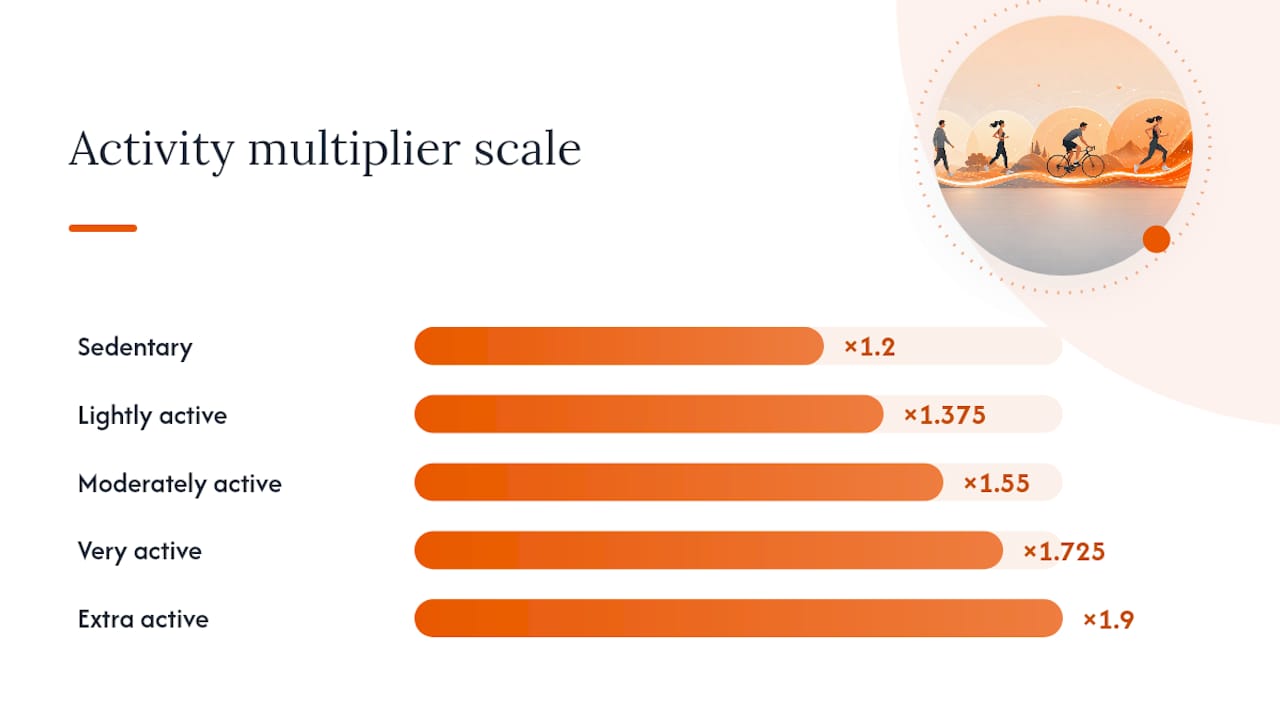
| Activity Level | Description | Multiplier |
|---|---|---|
| Sedentary | Desk job, little or no exercise | 1.2 |
| Lightly active | Light exercise 1–3 days/week | 1.375 |
| Moderately active | Moderate exercise 3–5 days/week | 1.55 |
| Very active | Hard exercise 6–7 days/week | 1.725 |
| Extra active | Physical job plus daily training | 1.9 |
Step-by-step checklist
- Measure your current weight (lbs or kg) and height (inches or cm).
- Calculate BMR using the Mifflin–St Jeor formula for your sex.
- Choose the activity multiplier that honestly reflects your typical week.
- Multiply BMR × activity factor to get your TDEE.
- Subtract your target deficit (typically 300–500 kcal) from TDEE to get your daily calorie goal.
- Log intake for at least 3–7 days and compare against that target.
Worked examples: BMR to TDEE to deficit
Two full examples below show how the math flows from inputs to a daily calorie target.
Example 1: 35-year-old male, lightly active
- Inputs: 185 lb (83.9 kg), 5 ft 10 in (177.8 cm), age 35, lightly active
- BMR: (10 × 83.9) + (6.25 × 177.8) − (5 × 35) + 5 = 839 + 1,111.25 − 175 + 5 = 1,780 kcal/day
- TDEE: 1,780 × 1.375 = 2,448 kcal/day
- Daily target (500 kcal deficit): 2,448 − 500 = 1,948 kcal/day
- Expected weekly loss: ~1 lb
Example 2: 28-year-old female, moderately active
- Inputs: 145 lb (65.8 kg), 5 ft 5 in (165.1 cm), age 28, moderately active
- BMR: (10 × 65.8) + (6.25 × 165.1) − (5 × 28) − 161 = 658 + 1,031.875 − 140 − 161 = 1,389 kcal/day
- TDEE: 1,389 × 1.55 = 2,153 kcal/day
- Daily target (500 kcal deficit): 2,153 − 500 = 1,653 kcal/day
- Expected weekly loss: ~1 lb
| Profile | BMR | TDEE | Daily Target | Est. Weekly Loss |
|---|---|---|---|---|
| Male, 35, 185 lb, lightly active | 1,780 kcal | 2,448 kcal | 1,948 kcal | ~1 lb |
| Female, 28, 145 lb, moderately active | 1,389 kcal | 2,153 kcal | 1,653 kcal | ~1 lb |
Both examples use a 500 kcal/day deficit. A 300–500 kcal/day deficit is the range most commonly associated with steady, sustainable loss without aggressive restriction.
How to choose the right activity multiplier for your lifestyle
Picking the wrong multiplier is the most common math error in any calorie deficit calculation. Most people overestimate how active they are, which inflates TDEE and makes the deficit look larger than it actually is.
- Sedentary (1.2): You sit most of the day. A desk job with no structured exercise and minimal walking fits here, even if you feel busy.
- Lightly active (1.375): You walk 20–30 minutes a few times per week or do light workouts 1–3 days. This fits most casual gym-goers who are otherwise sedentary.
- Moderately active (1.55): You exercise with real intensity 3–5 days per week AND move around during the day. This is the most commonly claimed level but less commonly earned.
- Very active (1.725): Athletes in daily training or people with physically demanding jobs who also exercise.
- Extra active (1.9): Manual laborers who train on top of their work, or competitive athletes in two-a-day sessions.
A quick self-test: count your average daily steps for one week using your phone or a fitness tracker. Under 5,000 steps with no structured exercise? You are sedentary. Around 7,500–10,000 steps plus 3 workouts? Lightly to moderately active is more honest.
Choosing one level too high (say, moderately active instead of lightly active) can overstate your TDEE by 150–200 kcal/day, which erases a meaningful portion of a 300 kcal deficit before you even start. When in doubt, go one level lower and adjust upward if the scale does not move after 2–3 weeks.
The American Cancer Society's calorie counter provides plain-English descriptions of each activity category that can help you self-assess more accurately.
How deficits translate to weight loss, and why the math is approximate
The classic approximation is that 3,500 kcal equals roughly 1 lb of body fat. A 500 kcal/day deficit over seven days totals 3,500 kcal, which is why the "1 lb per week" rule-of-thumb holds up reasonably well as a starting estimate. MedlinePlus confirms that cutting about 500 kcal/day produces approximately 1 lb of loss per week for many people.

The real world is messier, though. Several factors make the prediction nonlinear:
Metabolic adaptation is the biggest one. As you lose weight, your body reduces resting energy expenditure beyond what the weight loss alone would predict. A deficit that works in week one may produce slower results by week eight, not because you are doing anything wrong, but because your TDEE has dropped.
Water and glycogen shifts can cause the scale to move 2–4 lb in either direction within a single week, especially early in a diet. Rapid loss exceeding roughly 2 lb/week often reflects these shifts rather than fat loss, according to the NIDDK's Body Weight Planner.
Measurement error compounds the issue. Research published in PMC6163457 shows that people systematically underreport calorie intake and overestimate activity, meaning the actual deficit is often smaller than calculated.
What is a safe calorie deficit, and when should you see a clinician?
A 300–500 kcal/day deficit is the range most practitioners consider appropriate for steady loss. The CDC guidance of 1–2 lb per week maps directly to that range. Going beyond 500 kcal/day is not automatically dangerous, but it narrows the margin for meeting micronutrient needs and raises the risk of muscle loss.
Minimum daily calorie floors (general guidance, not a medical prescription):
- Most women: do not routinely go below ~1,200 kcal/day without medical supervision.
- Most men: do not routinely go below ~1,500 kcal/day without medical supervision.
These floors exist because the Dietary Guidelines for Americans make clear that very low calorie intakes make it nearly impossible to meet vitamin and mineral requirements from food alone.
Stop and consult a registered dietitian or clinician if you notice:
- Persistent fatigue or inability to concentrate
- Disrupted sleep or worsening mood
- Severe or constant hunger that makes the plan unsustainable
- Hair thinning or brittle nails
- Loss exceeding 2 lb/week for more than two consecutive weeks
- Any existing medical condition, or if you take medications that affect weight
If you are on medications that influence weight or metabolism, a conversation with a pharmacist or clinician about drug interactions with weight-loss plans is worth having before you start.
Practical ways to cut roughly 500 kcal/day without extreme restriction
MedlinePlus notes that small, targeted swaps can add up to a 500 kcal/day reduction without requiring dramatic dietary overhauls. Here are the highest-impact changes, with approximate savings:
- Skip one sugary drink (soda, juice, sweetened coffee): ~150–200 kcal saved
- Replace a high-calorie snack (chips, cookies) with fruit or raw vegetables: ~150 kcal saved
- Reduce dinner portion by 20% and add a side salad (no heavy dressing): ~100–150 kcal saved
- Cut one alcoholic drink per day: ~100–150 kcal saved
- Add a 35–40 minute brisk walk: ~150–200 kcal burned
A sample day combining these swaps: swap morning juice for water (−150 kcal), replace afternoon chips with an apple (−130 kcal), reduce dinner by one serving (−120 kcal), skip the evening beer (−120 kcal). That totals roughly 520 kcal without a single dramatic sacrifice.
Pro Tip: Prioritize protein at every meal. Protein has a higher thermic effect than carbohydrates or fat, and it reduces hunger-driven snacking more effectively than any other macronutrient. Aiming for 25–30 grams of protein per meal tends to keep appetite in check through the afternoon and evening, which is when most unplanned eating happens.
Registered dietitians at the Cleveland Clinic often recommend combining a modest 200–300 kcal food reduction with increased activity rather than cutting calories alone, because many people find that combination easier to sustain over months.
How to track your intake and when to recalculate
Accurate tracking closes the gap between your calculated deficit and what is actually happening. Most people underreport intake and overestimate activity, so a structured approach matters.
- Weigh yourself at the same time each morning (after waking, before eating) and record it. Use the weekly average, not any single day.
- Log food for at least 3–7 consecutive days, including weekends, using a food scale rather than volume estimates where possible.
- Track activity separately from your activity multiplier. If you have a particularly active or inactive week, note it.
- Compare your logged average intake to your TDEE estimate. If the scale is not moving after two full weeks, your actual intake is likely higher than logged, or your TDEE estimate is lower than assumed.
- Recalculate BMR and TDEE every 4–8 weeks or after losing roughly 5% of your starting body weight. Metabolic adaptation means your TDEE drops as you lose weight, so the same intake that produced a 500 kcal deficit at 185 lb may produce only a 300 kcal deficit at 170 lb.
The NIDDK's Body Weight Planner models these changes dynamically, which is why individualized, recalculated plans outperform a single static calculation over time.
What should a good calorie-deficit calculator include?
A trustworthy caloric deficit calculator should ask for and output the following:
Required inputs:
- Age, sex assigned at birth, height, and current weight
- Activity level (with plain-English descriptions of each category)
- Goal (target weight or target deficit size)
Meaningful outputs:
- Estimated BMR
- Estimated TDEE
- Suggested daily calorie target
- Projected timeline to reach goal weight
Mini validation check: Run the worked examples from earlier through any calculator you use. For the 35-year-old male (185 lb, 5 ft 10 in, lightly active), a well-configured tool should return a TDEE close to 2,448 kcal. If the output differs by more than 100–150 kcal, the calculator is likely using a different BMR formula (such as Harris–Benedict) or rounding aggressively. Neither is wrong, but knowing which formula is in use helps you interpret the result.
Watch for red flags in any calculator output:
- A suggested daily target below 1,200 kcal for women or 1,500 kcal for men without a medical disclaimer
- A "guaranteed" timeline with no caveats about metabolic adaptation
- No mention of recalculating as weight changes
- Activity descriptions so vague you cannot place yourself in a category
For complex situations, indirect calorimetry (a clinical measurement of actual resting metabolic rate) is more accurate than any formula-based estimate. Apps that sync with wearables and track real intake over time also reduce the systematic error that comes from a single static calculation.
The formula is the starting line, not the finish line
Formulas give you a number to act on. What they cannot do is account for the full complexity of how your body responds to a sustained deficit over weeks and months. Meghan Salamon at Massachusetts General Hospital, cited in Harvard Health, makes the point plainly: maintenance calories fall as body mass drops, so periodic recalculation is not optional for long-term success. It is the mechanism that keeps the math honest.
The real value of a free, no-signup calculator is not that it replaces clinical judgment. It is that it removes the friction of doing the unit conversions and multiplication by hand, which means more people actually run the numbers, and more people update them as their weight changes. Transparent, accessible tools that show their work, including the BMR formula used and the activity multiplier applied, let you verify the output rather than just trust it. That transparency matters, especially when the number you get shapes what you eat every day.
Try Apexapro's free calorie-deficit calculator
Apexapro's free, browser-based calorie-deficit calculator runs instantly with no sign-up and no download. Enter your age, sex, height, current weight, activity level, and goal, and it returns your estimated BMR, TDEE, suggested daily calorie target, and a projected timeline. As your weight changes, recalculate in seconds to keep your target accurate.

The tool uses the Mifflin–St Jeor formula shown in this article, so the outputs match the worked examples above. If your calculated daily target falls below 1,200 kcal (women) or 1,500 kcal (men), or if you have a medical condition or take medications that affect weight, consult a registered dietitian or clinician before acting on the number. Use the calculator at Apexapro to get your personalized daily target today.
Sources
- Calorie deficit explained: Is it a safe, sustainable approach to weight loss? - Harvard Health
- 10 ways to cut 500 calories a day: MedlinePlus Medical Encyclopedia
- Body Weight Planner - NIDDK
- Losing Weight - CDC
This article provides general information for educational purposes and is not a substitute for professional medical or nutritional advice. Confirm your specific calorie needs with a registered dietitian or qualified clinician.