
BMI calculation is the process of determining body mass index, a numerical value that reflects weight relative to height, used to screen for weight status and potential health risks. The World Health Organization, the American Heart Association, and the CDC all rely on this single index to classify adults into four categories: underweight, normal weight, overweight, and obese. BMI is not a direct measure of body fat, but it serves as a fast, free, and widely accepted screening tool. Knowing your number is the first step toward understanding where you stand and what to do next.
What is the BMI calculation formula?
Two formulas cover every unit system. The metric BMI formula divides weight in kilograms by height in meters squared: BMI = kg ÷ m². The imperial formula multiplies weight in pounds by 703, then divides by height in inches squared: BMI = (lb × 703) ÷ in². Both produce the same result when measurements are accurate.
The table below summarizes both formulas at a glance.

| System | Formula | Weight unit | Height unit |
|---|---|---|---|
| Metric | BMI = kg ÷ m² | Kilograms (kg) | Meters (m) |
| Imperial | BMI = (lb × 703) ÷ in² | Pounds (lb) | Inches (in) |
The multiplier 703 exists solely to convert the imperial result into the same kg/m² scale. Without it, the numbers would be incomparable to the metric output.
One nuance worth knowing: the height squared exponent in the standard formula is a simplification. Some researchers propose using height raised to the power of 2.5 to improve accuracy for very tall or very short people. Consumer calculators and clinical tools still use the exponent 2, so that is the version you will encounter everywhere.
Pro Tip: Always convert height to meters before using the metric formula. A common error is entering height in centimeters without dividing by 100 first. A person who is 175 cm tall has a height of 1.75 m, giving a squared value of 3.0625, not 30,625.
How to calculate BMI step by step
Accurate results start with accurate measurements. The right measurement tools are a stadiometer for height and a calibrated scale for weight. A standard tape measure against a wall works well at home if a stadiometer is not available.
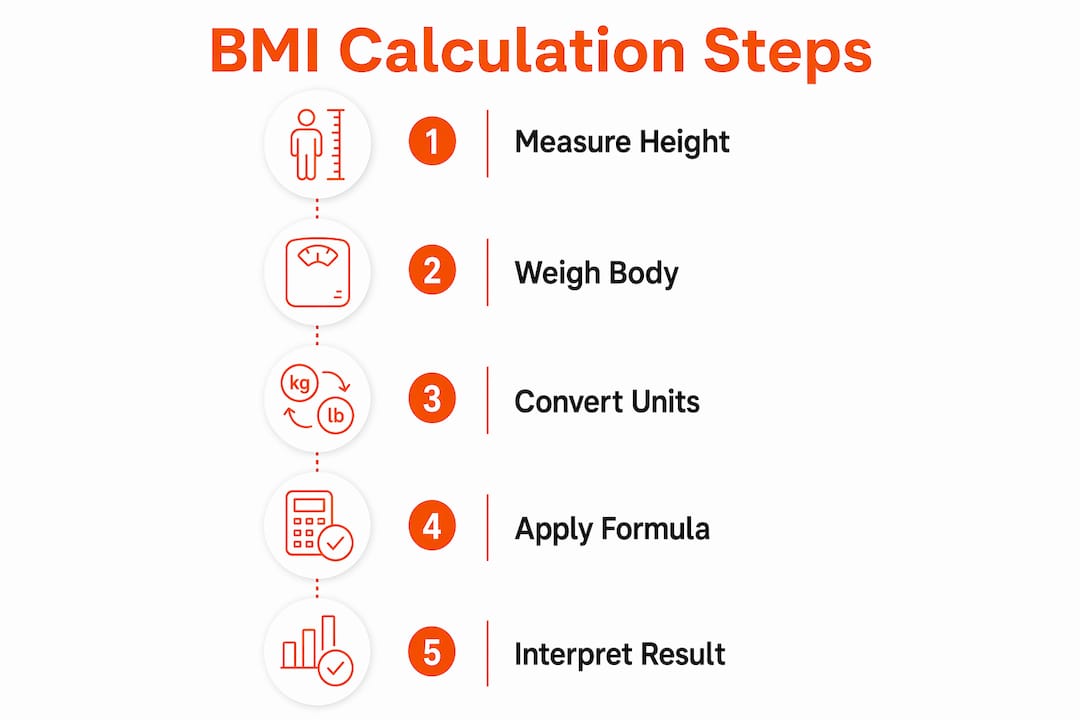
Measuring correctly before you calculate
Stand straight against a flat wall without shoes. Place a flat book on top of your head, mark the wall, then measure from the floor to the mark. For weight, step on the scale in the morning before eating, wearing minimal clothing. Both readings should be consistent across sessions.
Manual calculation: numbered steps
- Measure your height in meters (or inches if using imperial).
- Square that height value (multiply it by itself).
- Measure your weight in kilograms (or pounds).
- Divide weight by the squared height value.
- If using imperial, multiply the result by 703.
- Round to one decimal place. That number is your BMI.
Example (metric): A person weighing 70 kg at 1.75 m tall calculates: 70 ÷ (1.75 × 1.75) = 70 ÷ 3.0625 = 22.9
Example (imperial): A person weighing 154 lb at 69 inches tall calculates: (154 × 703) ÷ (69 × 69) = 108,262 ÷ 4,761 = 22.7
Using a BMI calculator online
A browser-based BMI calculator online eliminates manual math and reduces input errors. Enter your height and weight in the correct units, confirm the unit selection before submitting, and read the result. Most reputable tools also display the BMI category alongside the number.
A few tips for getting accurate results from any online tool:
- Double-check whether the calculator uses feet and inches separately or total inches.
- Confirm weight is entered in the correct unit (lb vs. kg).
- Avoid rounding height or weight before entering it. Use exact values.
Note on children and teens: Standard BMI formulas apply only to adults aged 20 and older. Children and teenagers require age- and sex-specific percentile charts instead. A BMI of 22 means something very different for a 12-year-old than for a 35-year-old. Pediatric BMI assessment uses growth chart percentiles published by the CDC.
What do BMI categories mean for your health?
The WHO classifies adult BMI into four standard categories. These categories apply to all adults aged 20 and older, regardless of sex or ethnicity, though interpretation may vary by population group.
| BMI range | Category | General health implication |
|---|---|---|
| Below 18.5 | Underweight | Possible nutrient deficiency, bone density concerns |
| 18.5–24.9 | Normal weight | Associated with lowest risk of weight-related disease |
| 25.0–29.9 | Overweight | Elevated risk of cardiovascular disease and type 2 diabetes |
| 30.0 and above | Obese | Significantly higher risk of metabolic and cardiovascular conditions |
The healthy range spans 18.5 to 24.9. A BMI of 22 sits near the midpoint of that range and is often used as a practical reference target when calculating ideal weight. That midpoint matters because it provides a buffer on both sides before crossing into overweight or underweight territory.
Each category signals a different level of health risk, not a diagnosis. A person with a BMI of 25.2 is technically overweight by the index, but that single number does not confirm any specific condition. It flags a risk level worth discussing with a healthcare provider.
Pro Tip: Combine your BMI result with waist circumference for a clearer picture. The American Heart Association recommends using BMI alongside blood pressure, cholesterol, and other metrics for a full health assessment. A waist measurement above 35 inches for women or 40 inches for men signals elevated abdominal fat risk, even when BMI falls in the normal range.
What are the limitations of BMI as a health measure?
BMI is a quick, inexpensive screening tool, but it lacks the nuance to distinguish lean muscle from fat. That gap creates real misclassification problems for specific groups.
A competitive athlete with low body fat and high muscle mass may register a BMI in the overweight range. An older adult with little muscle but significant fat may register a normal BMI. In both cases, the index gives a misleading picture of actual body composition.
BMI also misses fat distribution, which matters significantly for metabolic health. Visceral fat stored around the abdomen carries a higher risk of metabolic disease than fat stored in the thighs or arms. Two people with identical BMI scores can have very different health profiles depending on where their fat sits.
Other factors the BMI index does not account for include:
- Age: Older adults tend to carry more fat at the same BMI as younger adults.
- Sex: Women generally carry more body fat than men at the same BMI.
- Ethnicity: Research shows that people of Asian descent face higher metabolic risk at lower BMI thresholds than the standard WHO categories reflect.
- Physical activity level: A highly active person and a sedentary person can share the same BMI with very different health outcomes.
Common misconceptions about BMI worth correcting:
- A normal BMI does not guarantee good health.
- An overweight BMI does not automatically mean a person is unhealthy.
- BMI is not a body fat percentage measurement. It is a weight-to-height ratio.
- BMI cannot replace a clinical evaluation by a healthcare provider.
The quick, non-invasive nature of BMI is exactly why it remains widely used despite these gaps. The right approach is to treat it as a starting point, not a final verdict.
Key Takeaways
BMI calculation gives you a fast, standardized weight status screening number, but its value depends entirely on how you interpret and apply it alongside other health data.
| Point | Details |
|---|---|
| Two formulas, one result | Use kg/m² for metric or (lb × 703)/in² for imperial; both produce the same BMI value. |
| Four WHO categories | Underweight, normal, overweight, and obese correspond to BMI ranges below 18.5, 18.5–24.9, 25–29.9, and 30 or above. |
| Children need different tools | Adults use the standard formula; children and teens require age- and sex-specific CDC percentile charts. |
| BMI misses muscle and fat location | Muscular individuals may score as overweight; visceral fat risk is invisible to the index. |
| Pair BMI with other measures | Waist circumference, blood pressure, and cholesterol together give a fuller health picture than BMI alone. |
BMI is useful, but it told me only half the story
I have tracked my BMI for years, and the number always felt satisfying to calculate. It is clean, fast, and gives you something concrete to hold onto. But the moment I started strength training seriously, my BMI crept into the overweight range even as my body fat dropped. That experience changed how I think about the index entirely.
The problem is not that BMI is wrong. It is that people treat it as a complete answer when it is really just an opening question. A BMI of 27 on a sedentary person and a BMI of 27 on a trained athlete represent completely different health situations. The number is identical. The reality is not.
What I tell anyone who asks: calculate your BMI, note the category, and then go one step further. Measure your waist. Get your blood pressure checked. Ask your doctor about cholesterol. BMI gives you a coordinate on a map, not the full terrain. Used that way, it is genuinely useful. Used alone, it can mislead you in either direction.
The people I have seen get the most value from BMI tracking are those who use it as one data point in a longer conversation with their healthcare provider, not as a self-diagnosis tool. That is the responsible way to use it, and it is the approach that actually leads to better health decisions.
— Javier
Apexapro health tools for your next step
Calculating your BMI is a strong starting point. Taking that number further requires tools that go beyond a single formula.
Apexapro offers a free, browser-based collection of health and fitness calculators you can use instantly, with no sign-up and no download required. From weight and BMI tracking to calorie and nutrition tools, the full catalog is available at Apexapro in both English and Spanish. Every tool is built around real search demand, so what you need is already there. Run your calculations, compare results across different metrics, and walk into your next health conversation with actual numbers in hand.
FAQ
What is BMI and why does it matter?
BMI, or body mass index, is a numerical ratio of weight to height used to screen for weight-related health risks. The WHO uses it to classify adults into underweight, normal weight, overweight, and obese categories.
How do I calculate my BMI manually?
Divide your weight in kilograms by your height in meters squared for the metric result, or multiply your weight in pounds by 703 and divide by your height in inches squared for the imperial result.
What is a healthy BMI range for adults?
The healthy BMI range for adults is 18.5 to 24.9, as defined by the WHO and the American Heart Association. A BMI of 22 sits near the midpoint and is a common reference target.
Can BMI be inaccurate for some people?
Yes. BMI cannot distinguish muscle from fat, so muscular individuals often score as overweight despite low body fat. Age, sex, and ethnicity also affect how accurately BMI reflects actual health risk.
Do children use the same BMI formula as adults?
No. Children and teenagers use age- and sex-specific percentile charts from the CDC rather than the standard adult formula, because body composition changes significantly during growth.