TL;DR:
- The most useful oven temperature conversion number is 350°F, which equals 180°C and corresponds to Gas 4. Adjust for fan ovens by reducing the conventional temperature by about 20°C, or 36°F. Accurate results depend on knowing the formula, applying the correct adjustment, and verifying with a thermometer.
350°F ≈ 180°C (Gas 4) is the single most useful number in oven temperature conversion. That one pairing covers the majority of cake, bread, and casserole recipes you will ever encounter. If your recipe gives a Fahrenheit temperature and your oven reads Celsius, or vice versa, the mini table below gets you to the right setting in seconds. If you have a fan or convection oven, subtract roughly 20°C (≈36°F) from whatever the conventional temperature is.
| °F | °C (conventional) | Gas mark | Fan/convection °C |
|---|---|---|---|
| 325°F | 165°C | Gas 3 | — |
| 350°F | 180°C | Gas 4 | 160°C |
| 375°F | 190°C | Gas 5 | — |
| 400°F | 200°C | Gas 6 | — |
| 425°F | 220°C | Gas 7 | — |
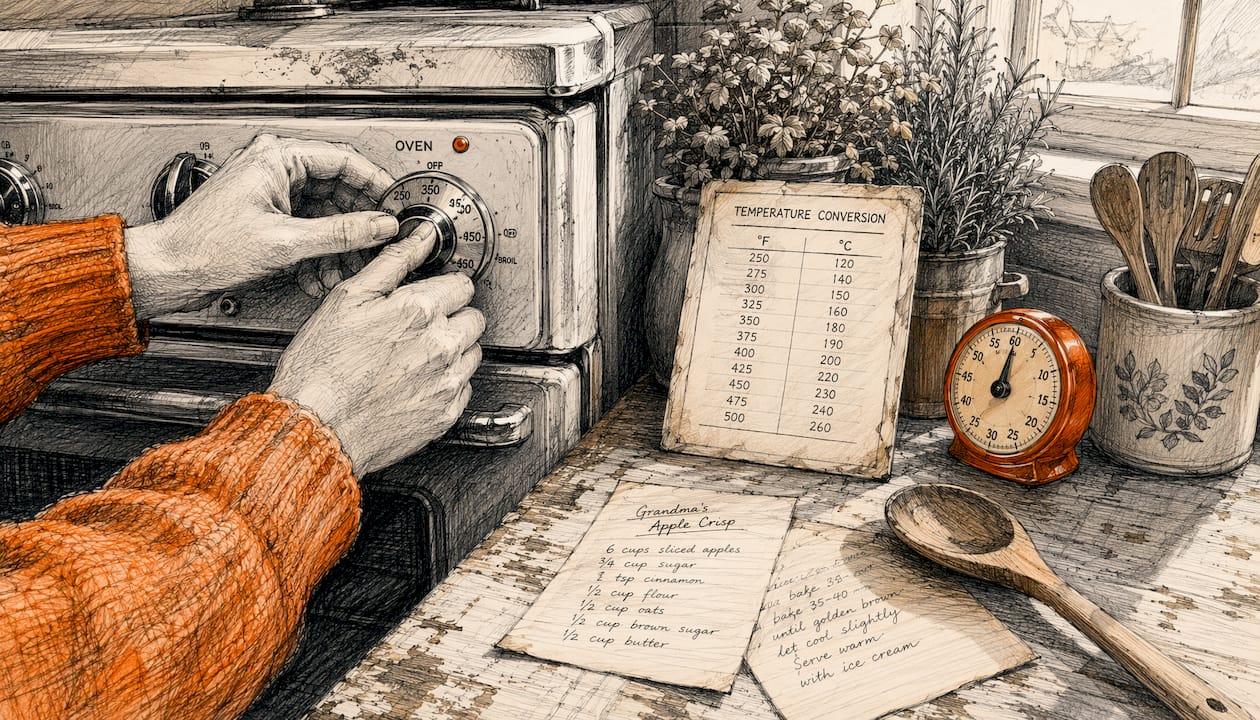
Match the column that fits your oven dial. Fan oven? Use the right-hand column. Done.
Table of Contents
- How do you convert Fahrenheit to Celsius (and back)?
- What are gas marks, and how do you adjust for a fan oven?
- Printable conversion chart: full range from 225°F to 475°F
- How do you check and calibrate your oven's accuracy?
- Key Takeaways
- Why trusting the chart beats trusting your dial
- Apexapro's free oven temperature converter handles any setting instantly
- Sources and tools worth bookmarking
How do you convert Fahrenheit to Celsius (and back)?
The two formulas are: C = (F − 32) × 5/9 and F = (C × 9/5) + 32. Memorize those and you can convert any temperature a recipe throws at you.
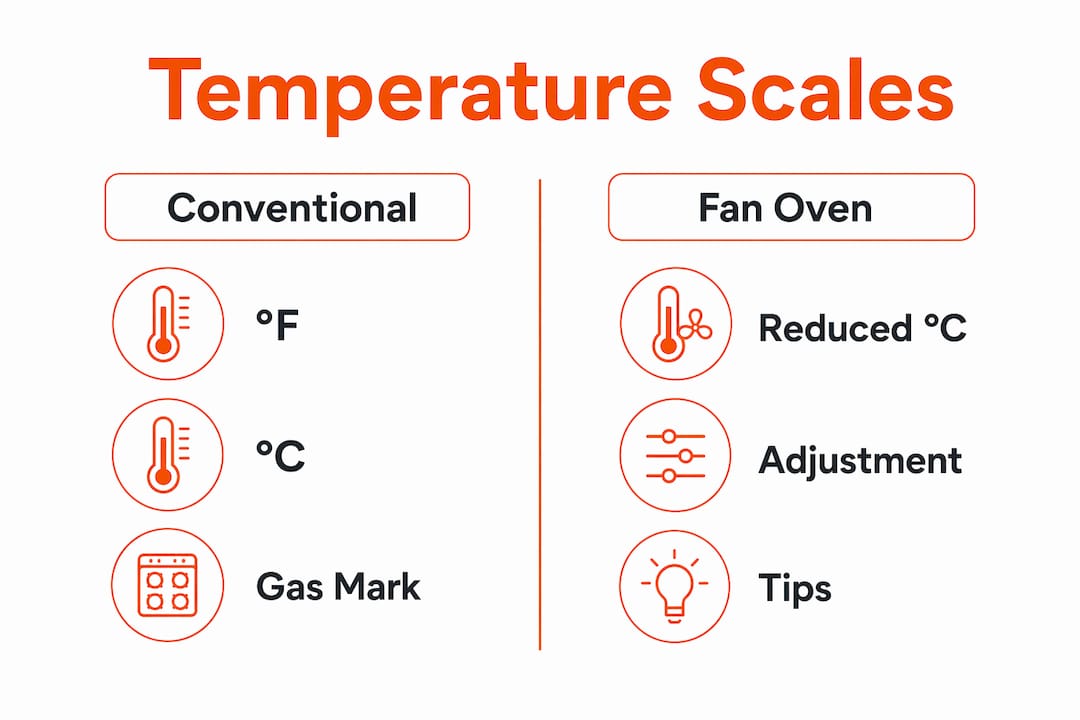
Worked example 1 — Fahrenheit to Celsius: 350°F → (350 − 32) × 5/9 = 318 × 0.556 = 176.7°C, rounded to 180°C in cookbooks. That rounding is intentional: cookbook charts round °C and °F to tidy recipe-facing numbers because ovens are typically accurate only to about ±10°F anyway, so 177°C and 180°C are functionally identical.
Worked example 2 — Celsius to Fahrenheit: 180°C → (180 × 9/5) + 32 = 324 + 32 = 356°F, rounded to 350°F in most recipes.
For quick mental math, AllRecipes suggests subtracting 30 from the Fahrenheit value and dividing by 2. That shortcut gives you a close-enough estimate for most baking situations. When precision matters, such as with delicate pastry or temperamental custards, use the full formula and round to the nearest 5°C or 5°F.
What are gas marks, and how do you adjust for a fan oven?
Gas marks are a British scale, not a universal standard. Each step represents roughly 25°F, and the scale runs from Gas ¼ (very low) up to Gas 9 (very hot). Because the scale is quantized, any conversion from a precise °F or °C value is always a nearest-match approximation. For temperamental batters and fine pastry, keep the exact °F or °C figure in your recipe notes rather than relying solely on the Gas mark.
Common Gas mark equivalents:
- Gas 2 = 300°F / 150°C (slow oven)
- Gas 3 = 325°F / 165°C (moderately slow)
- Gas 4 = 350°F / 180°C (moderate — the everyday default)
- Gas 5 = 375°F / 190°C (moderately hot)
- Gas 6 = 400°F / 200°C (hot)
- Gas 7 = 425°F / 220°C (very hot)
For fan ovens, the rule is straightforward: reduce the conventional setpoint by ~20°C (≈36°F). So 180°C conventional becomes 160°C fan. When a recipe explicitly labels itself "fan" or "convection," use the temperature as written — the author already made that adjustment. The most common mistake is skipping this step entirely, which leads to overbrowning on the outside before the center is fully cooked.
Printable conversion chart: full range from 225°F to 475°F
The table below covers the common recipe range. Cookbook values are rounded for readability; your oven typically varies ±10°F, so these rounded figures are practical, not imprecise. Print or save this chart and tape it inside a cabinet door for fast reference.
| °F | °C (conventional) | Gas mark | Fan/convection °C |
|---|---|---|---|
| 225°F | — | Gas ¼ | — |
| — | — | Gas ½ | — |
| — | — | Gas 1 | — |
| 300°F | 150°C | Gas 2 | — |
| 325°F | 165°C | Gas 3 | — |
| 350°F | 180°C | Gas 4 | 160°C |
| 375°F | 190°C | Gas 5 | — |
| 400°F | 200°C | Gas 6 | — |
| 425°F | 220°C | Gas 7 | — |
| 475°F | — | Gas 9 | 225°C |
Fan/convection column = conventional °C − 20°C. Gas marks are approximate; favor the exact °F or °C column when precision matters.
How do you check and calibrate your oven's accuracy?
Start with an oven thermometer and multiple readings. Place the thermometer in the center of the oven, set the dial to a known temperature (350°F is a good benchmark), and wait for the preheat signal. Then take five temperature readings over the next 20 minutes and calculate the average. One reading is not enough because heating elements cycle on and off continuously, so any single snapshot can be misleading.
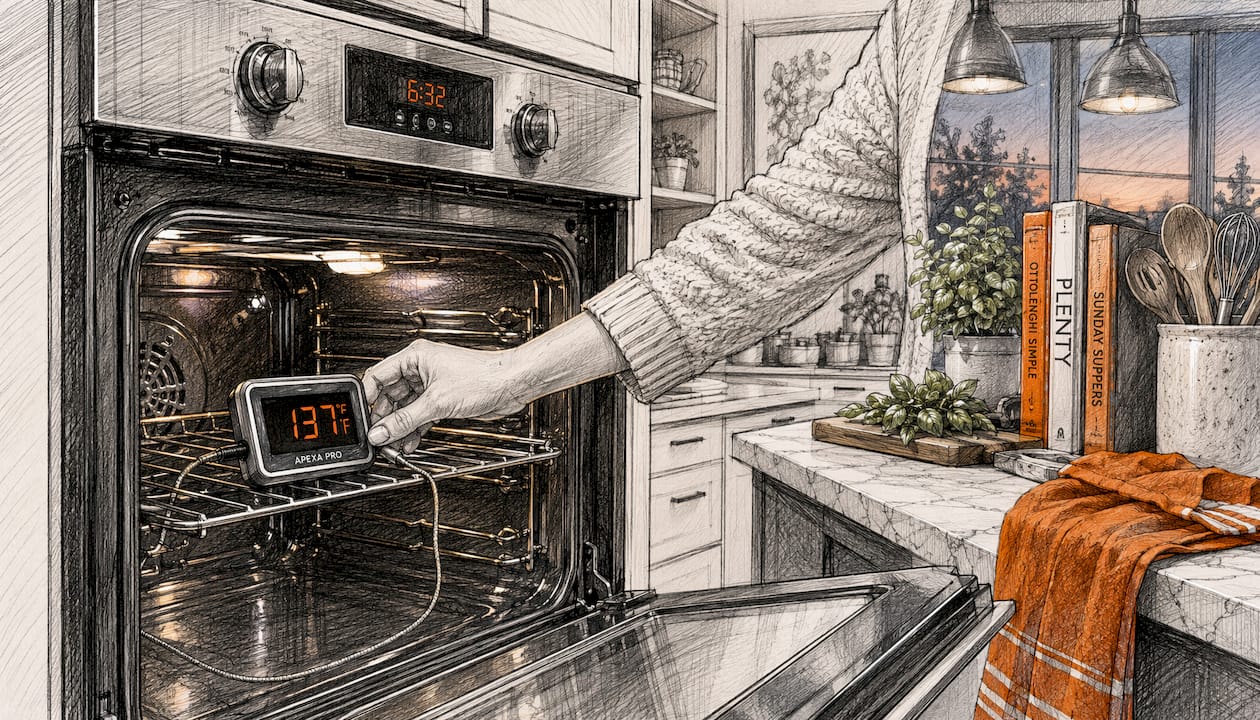
According to KitchenAid's product guidance), rack placement, oven load, and whether you completed a full preheat cycle explain most perceived temperature inaccuracy. Check those variables across multiple baking sessions before concluding the thermostat is at fault.
If the average deviation is consistent and your oven supports electronic calibration, adjust in 5°F (3°C) increments. Most modern ovens allow a total offset of about ±30–35°F. If the deviation exceeds that range, the temperature sensor or control board likely needs replacement rather than adjustment.
| Issue | DIY option | Typical cost |
|---|---|---|
| Small consistent offset (≤30°F) | Electronic calibration via settings menu | $0 |
| Faulty temperature sensor | Sensor replacement (DIY part) | $20 |
| Control board or complex electrical fault | Professional repair | $150 |
Pro Tip: Check your oven across at least three separate baking sessions before calibrating. Rack position and how full the oven is affect results more often than sensor drift.
Key Takeaways
Accurate oven temperature conversion comes down to three things: knowing the correct formula, applying the fan adjustment, and verifying your oven's actual output with a thermometer before blaming the recipe.
| Point | Details |
|---|---|
| Default moderate oven | 350°F = 180°C = Gas 4; use this when a recipe says "moderate" with no number. |
| Fan/convection adjustment | Subtract ~20°C (≈36°F) from the conventional temperature for equivalent results. |
| Rounding is intentional | Cookbook charts round to the nearest 5–10°C; ovens vary ±10°F, so rounded values are accurate enough. |
| Calibrate carefully | Adjust in 5°F (3°C) increments; most ovens support ±30°F total offset before a sensor repair is needed. |
| Apexapro converter | Use the free Apexa Pro oven temperature converter for any temperature outside this chart or to generate a printable custom chart instantly. |
Why trusting the chart beats trusting your dial
Most home cooks assume their oven dial is a precise instrument. It is not, and that is not a flaw — it is by design. Heating elements cycle on and off to maintain an average temperature, which means the actual air temperature inside swings above and below the setpoint constantly. A well-calibrated oven at 350°F might read anywhere from 335°F to 365°F at any given moment. Recipes are written with that tolerance in mind.
The real danger in oven temp adjustments is not the ±10°F swing. It is the cook who converts a recipe from Fahrenheit to Celsius, sets the fan oven to the conventional temperature, and then wonders why the top is dark and the center is raw. That one missed fan adjustment, roughly 20°C, is responsible for more baking failures than any thermostat drift. The chart handles the math. Your job is to remember which column applies to your oven.
Check your bake 5–10 minutes early the first time you use a converted temperature. That single habit catches most conversion errors before they become ruined dinners.
Apexapro's free oven temperature converter handles any setting instantly
No recipe temperature should leave you stuck doing mental math at the counter. The Apexa Pro oven temperature converter is a free, browser-based tool that converts between °F, °C, Gas marks, and fan-adjusted values in one click, with no sign-up and no download required.
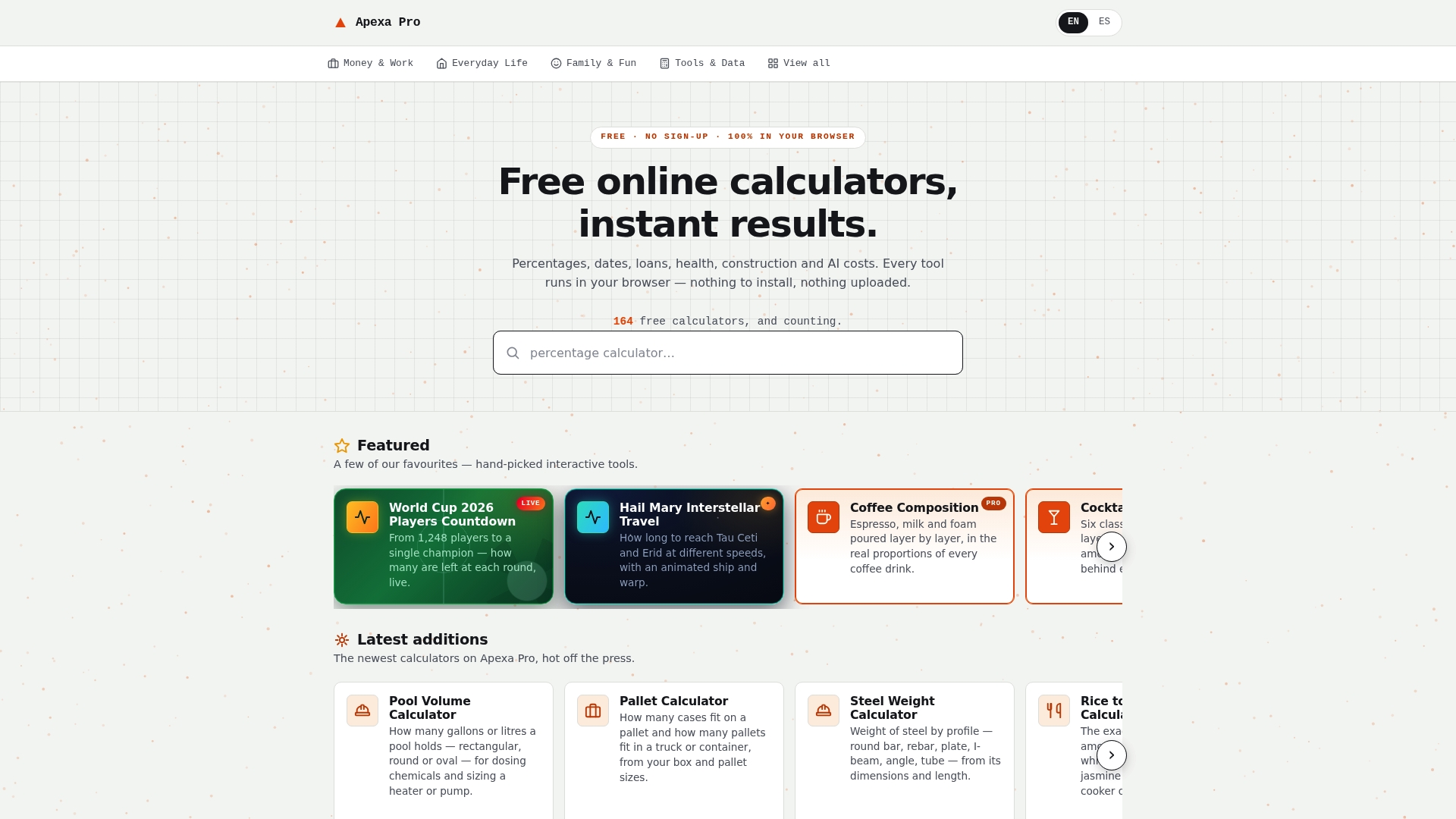
The tool uses the same rounded cookbook values shown in the chart above, covers the full recipe range from very low to very hot, and displays a printable chart you can save or post in your kitchen. It runs entirely in the browser, works in both English and Spanish, and is updated based on real cooking search demand. Whether you are scaling a British recipe with Gas marks or adjusting a convection bake, Apexapro gives you the right number immediately. Visit apexapro.com to use the converter now.
Sources and tools worth bookmarking
These are the primary references behind the conversions, calibration steps, and adjustment rules in this guide.
- AllRecipes — Oven Temperature Conversion Chart: A widely used U.S. cooking reference with a clean °F-to-°C table and the practical "subtract 30, divide by 2" shortcut for quick mental estimates.
- KitchenAid Product Help — Oven Temperature Incorrect): Manufacturer guidance on why ovens read differently and how rack placement, oven load, and preheat completion affect results before calibration is considered.
- Axis Repair — Calibrate Thermostat Guide: Appliance repair expertise covering the five-reading test method, safe calibration increments, and sensor replacement costs.
- Which? — Oven Temperature Conversion Table: UK consumer testing organization; the source for the standard ~20°C fan oven reduction rule and Gas mark mappings.
- Apexapro Oven Temperature Converter: Free browser-based tool providing instant °F, °C, Gas mark, and fan-adjusted conversions with a printable chart — no account needed.