
Your pregnancy due date is calculated by adding 280 days (40 weeks) to the first day of your last menstrual period (LMP). This method, known as Naegele's rule, assumes a standard 28-day cycle with ovulation occurring on day 14. It is the most widely used approach in clinical practice and forms the basis of guidance from the American College of Obstetricians and Gynecologists (ACOG) and the Cleveland Clinic.
Here is how the LMP method works in practice:
- Start date: The first day of your last menstrual period
- Add: 280 days (or 40 weeks) to that date
- Result: Your estimated due date (EDD)
- Assumption: A 28-day cycle with ovulation at day 14
- Adjustment: If your cycle is shorter or longer than 28 days, the estimate shifts accordingly
For example, if your last period began on January 1, 2026, your estimated due date falls around October 8, 2026. Keep in mind this is an estimate, not a guaranteed delivery date. ACOG is clear that due date calculators serve as planning tools, not precise predictors of when labor will begin.
Other ways to calculate your due date

The LMP method works well for people with regular cycles, but it is not the only option. Three other approaches offer useful alternatives, each suited to different situations.
Conception date method

If you know the exact date you conceived, you can add 266 days (38 weeks) to that date. This approach tends to be more accurate for people with irregular cycles, since it bypasses the assumption about when ovulation occurred. Tracking ovulation through basal body temperature, ovulation predictor kits, or fertility monitors can help you pinpoint conception with enough confidence to use this method.
IVF transfer calculations
IVF pregnancies require their own formulas because the embryo's age at transfer is already known. According to the Cleveland Clinic, you add 261 days for a 5-day embryo transfer and 263 days for a 3-day transfer. Using a general conception calculator for an IVF pregnancy produces inaccurate results because the standard formulas do not account for embryo development age at the time of transfer.
Ultrasound dating
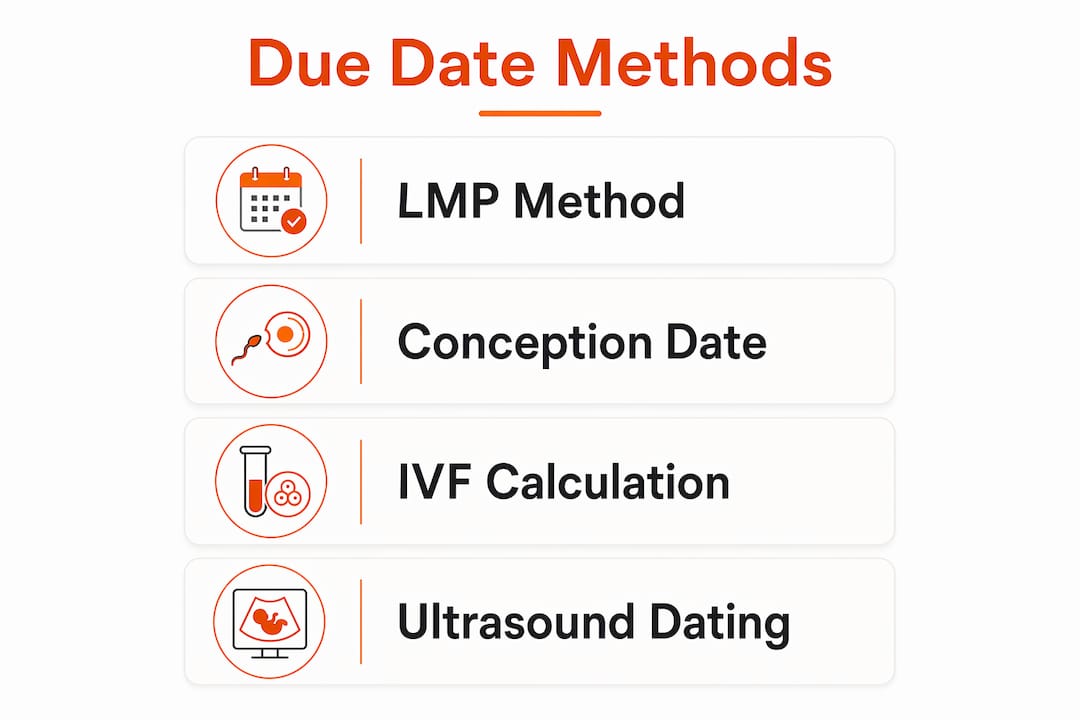
An early ultrasound, particularly one performed in the first trimester, is considered the gold standard for confirming or adjusting your estimated due date. Fetal measurements taken during these scans provide more precise gestational age estimates than LMP dating alone, especially when cycle length is uncertain.
Here is a summary of each method and the days added:
| Method | Days Added | Best Used When |
|---|---|---|
| Last menstrual period (LMP) | 280 days (40 weeks) | Regular 28-day cycles, LMP known |
| Conception date | 266 days (38 weeks) | Exact conception date is known |
| IVF 5-day embryo transfer | 261 days | IVF pregnancy, 5-day blastocyst |
| IVF 3-day embryo transfer | 263 days | IVF pregnancy, 3-day embryo |
| First-trimester ultrasound | Calculated from fetal measurements | Irregular cycles, uncertain LMP |
- Cycle tracking apps and menstrual cycle records can improve the accuracy of LMP-based estimates
- Ultrasound dating is especially valuable when the LMP is unknown or the cycle length varies significantly
- IVF-specific formulas are non-negotiable for assisted reproduction pregnancies
How accurate is your estimated due date?
Only about 4% of babies are born on their exact due date. That figure alone tells you something important: the due date is a target, not a deadline.
Clinical perspective: The American College of Obstetricians and Gynecologists states that due date calculators are tools for guiding care and tracking pregnancy, not precise indicators of when labor will begin. Natural birth timing varies widely even among healthy, low-risk pregnancies.
Several factors influence how close the estimate lands:
- Cycle variability: Cycles shorter or longer than 28 days shift ovulation timing, which shifts the actual conception date away from the assumed day 14
- Ovulation timing: Even within a 28-day cycle, ovulation does not always occur on exactly day 14
- Measurement differences: Ultrasound measurements carry a small margin of error, which grows slightly as pregnancy progresses
- Individual biology: Fetal growth rates vary naturally between pregnancies
The NHS defines a healthy term pregnancy as lasting between 37 and 42 weeks from the first day of the last menstrual period. That five-week window reflects normal biological variation, not a problem. Providers track fetal growth and development throughout pregnancy precisely because the due date alone cannot capture the full picture of readiness for birth.
Pro Tip: Focus on the term window (37–42 weeks) rather than fixating on a single date. Most healthy pregnancies deliver somewhere within that range, and your care team monitors growth milestones to guide decisions regardless of where you land.
Why your due date might change during pregnancy
A due date set at your first prenatal visit is not always the one you finish with. Providers adjust it regularly, and that is a normal part of care.
The most common reason for a change is the first-trimester ultrasound. Early fetal measurements, particularly crown-rump length taken between weeks 8 and 13, are highly reliable for establishing gestational age. When those measurements differ meaningfully from the LMP-based estimate, the ultrasound dating takes precedence. Providers use it to supersede the original calculation, especially for people with irregular cycles or uncertain LMP dates.
Key reasons your due date may be revised:
- Irregular menstrual cycles that make LMP-based calculation less reliable
- Uncertain LMP because the exact start date was not recorded or remembered
- First-trimester ultrasound findings that differ from the original estimate by more than a week
- Fetal growth differences identified in later scans that prompt reassessment
- IVF or assisted reproduction where transfer timing requires a different formula from the start
When your provider updates your due date, the new date becomes the reference point for all subsequent care decisions, including timing of screenings, growth checks, and delivery planning. Sticking with an outdated estimate when a more accurate one is available can affect the timing of important interventions.
Understanding pregnancy weeks and what "full term" actually means
Pregnancy is counted from the first day of your last menstrual period, which means the clock starts roughly two weeks before conception actually occurs. This can feel counterintuitive, but it reflects the clinical convention established long before home pregnancy tests existed, when the LMP was the only reliable date a person could report.
The distinction between gestational age and fetal age matters here. Gestational age counts from the LMP and is what your provider uses. Fetal age counts from conception and runs about two weeks behind. When your provider says you are 10 weeks pregnant, the embryo itself is closer to 8 weeks old.
Key pregnancy milestones by gestational week:
| Gestational Week | Milestone |
|---|---|
| Week 4 | Positive pregnancy test typical |
| Week 8–10 | Heartbeat detectable by ultrasound |
| — | End of first trimester; dating scan offered |
| — | Anatomy scan; midpoint of pregnancy |
| Week 37 | Start of full-term window |
| Week 40 | Estimated due date |
| Week 42 | End of full-term window; post-term threshold |
- Preterm: Before 37 weeks
- Early term: 37–38 weeks
- Full term: 39–40 weeks
- Late term: 41 weeks
- Post-term: 42 weeks and beyond
The NHS confirms that pregnancy normally lasts from 37 to 42 weeks from the first day of the last period. Babies born anywhere in the 37–42 week range are generally considered term deliveries, though outcomes and readiness vary across that window. Providers typically discuss induction options when pregnancy extends past 41 or 42 weeks.
A common misconception is that pregnancy lasts exactly nine months. In practice, 40 weeks is closer to nine months and one week, and the full term window spans nearly five weeks on either side of the due date.
Try Apexapro's free pregnancy due date calculator
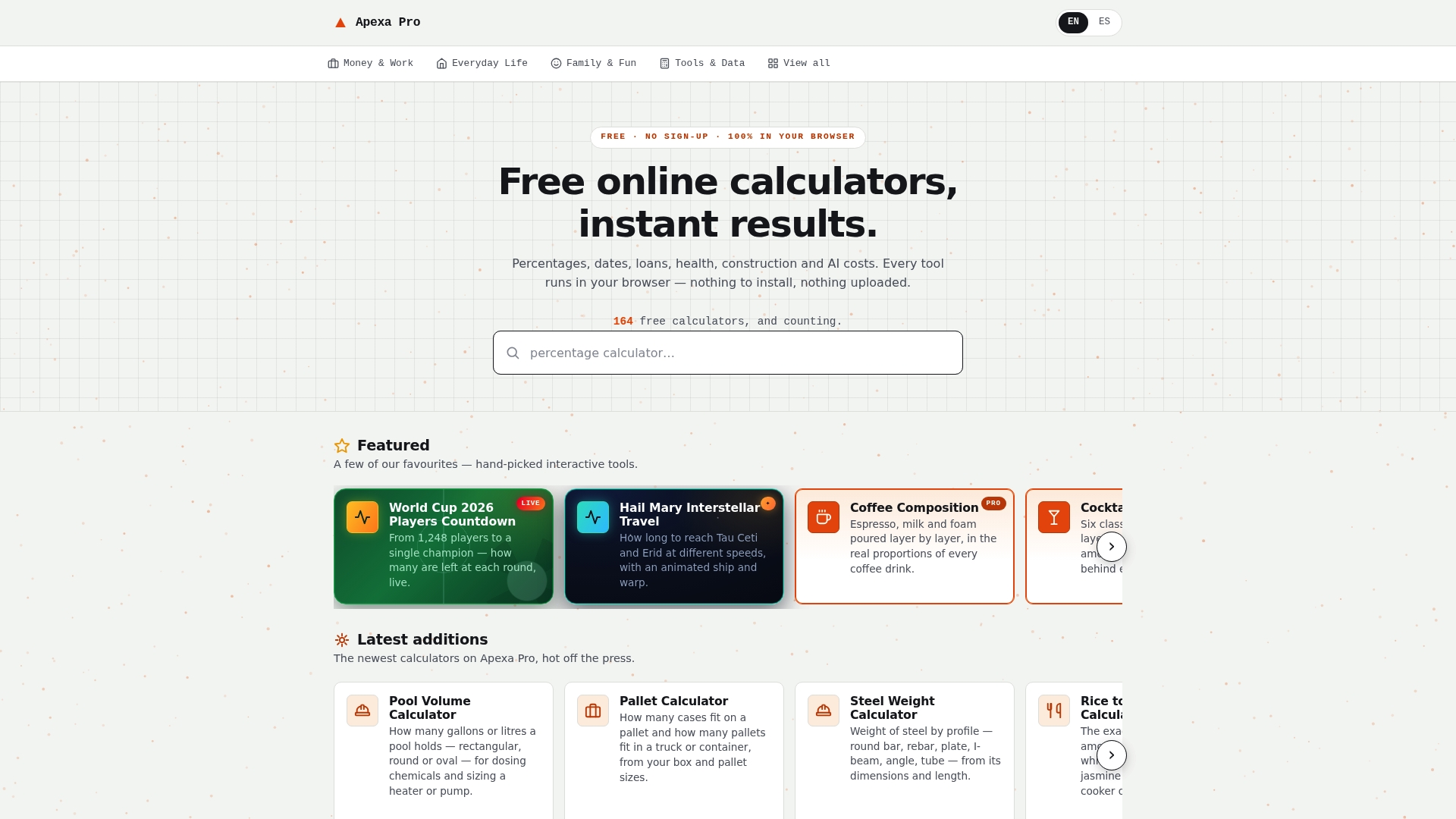
Apexapro offers a free, browser-based pregnancy due date calculator that runs instantly without any sign-up or download. It supports multiple calculation methods, including LMP-based dating, conception date entry, and IVF transfer options, so you can get an estimate that fits your specific situation.
Key features of the Apexapro due date calculator:
- Completely free with no account required and no app to install
- Bilingual support in both English and Spanish for broader accessibility
- Multiple methods covering LMP, conception date, and IVF transfer calculations
- Instant results displayed directly in your browser on any device
- Interactive interface that walks you through each input clearly
Pro Tip: Use the Apexapro calculator to get your initial estimate, then bring that date to your first prenatal appointment. Your provider will confirm or adjust it based on your ultrasound, giving you the most clinically accurate due date possible.
Apexapro's tool is designed as a starting point, not a replacement for clinical care. The calculator gives you a reliable baseline to share with your midwife or OB-GYN, who will refine the estimate using fetal measurements and your full medical history. Because due date calculators are planning tools rather than exact predictors, pairing a good calculator with professional guidance is the most practical approach for any pregnancy.
Key Takeaways
The most reliable pregnancy due date comes from combining an LMP-based calculation with first-trimester ultrasound confirmation, since only about 4% of births occur on the exact estimated date.
| Point | Details |
|---|---|
| Standard LMP method | Add 280 days to the first day of your last period, assuming a 28-day cycle. |
| IVF requires specific formulas | Add 261 days for a 5-day transfer or 263 days for a 3-day transfer. |
| Only 4% deliver on the due date | The due date is an estimate; healthy births occur across a 37–42 week window. |
| Ultrasound refines the estimate | First-trimester scans are the gold standard for confirming gestational age. |
| Due dates can and do change | Irregular cycles, uncertain LMP, or ultrasound findings all prompt provider adjustments. |