Switching to biweekly mortgage payments can shorten a 30-year loan by several years and save tens of thousands of dollars in interest — but only if your servicer applies each partial payment directly to principal rather than holding it until a full monthly amount accumulates. The core math is straightforward: paying half your monthly mortgage every two weeks produces 26 half-payments per year, which equals 13 full monthly payments instead of 12. That one extra payment per year chips away at your principal balance faster, reducing the interest that compounds on the remaining balance every month.
Before you call your servicer, run through these three checks:
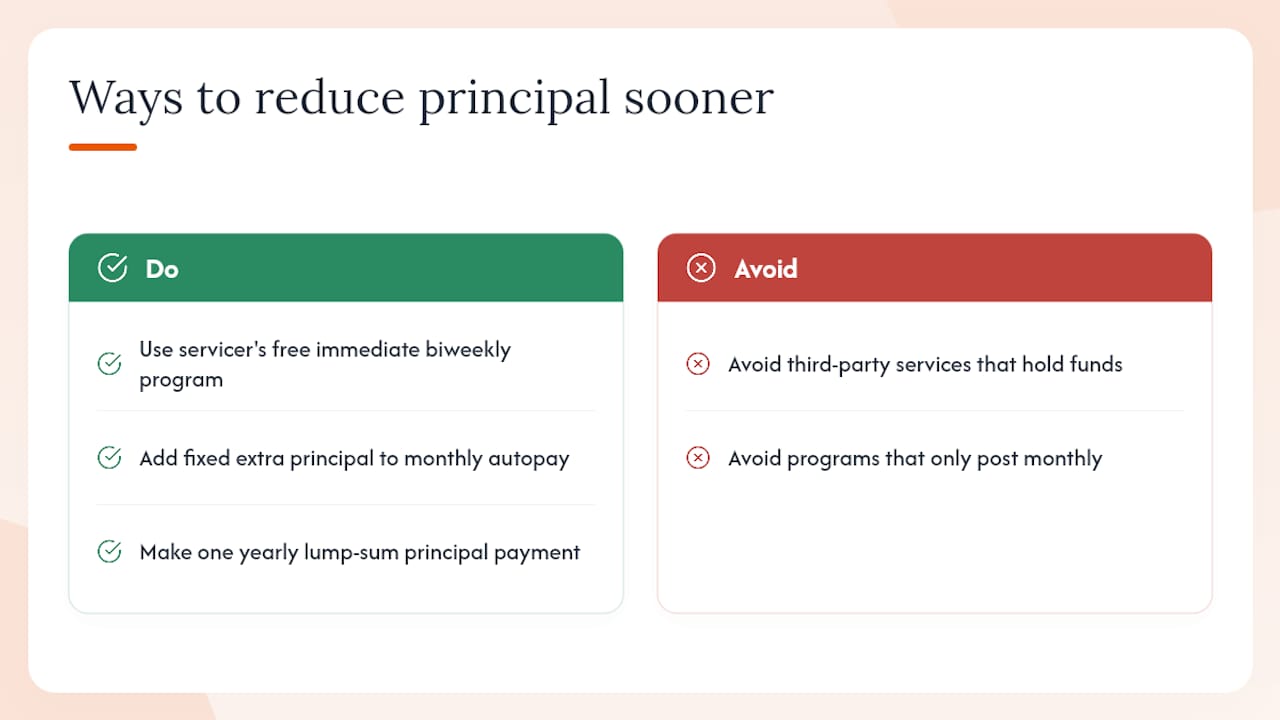
- Can your servicer accept partial payments? Some apply them immediately; others hold them in a suspense account.
- Is there an enrollment or processing fee? Fees from third-party processors can erase the savings entirely.
- Will extra funds go to principal? Confirm in writing that any overage beyond a standard monthly payment reduces principal, not just the next month's payment.
Key Takeaways
Biweekly mortgage payments save interest and shorten your loan only when your servicer applies each half-payment immediately to principal and no fees offset the benefit.
| Point | Details |
|---|---|
| The core math | 26 biweekly half-payments equal 13 full monthly payments per year, adding one extra payment annually. |
| Savings depend on servicer rules | If your servicer holds partial payments until a full monthly amount is reached, the interest benefit disappears. |
| Fees can erase the advantage | Third-party processor fees and enrollment charges reduce net savings; always get the fee schedule in writing. |
| Manual extra principal works just as well | Adding 1/12 of your monthly payment each month delivers the same annual extra principal with no fees or program enrollment. |
| Apexapro calculator | Use the free Apexa Pro biweekly mortgage calculator at apexapro.com to estimate your personal interest savings and shortened payoff term instantly. |
Table of Contents
- How does a biweekly payment schedule actually work?
- What does the math actually look like?
- What are the pros and cons of biweekly mortgage payments?
- How do you set up biweekly payments? Three practical options
- What alternatives give you the same payoff acceleration?
- Are you a good candidate for biweekly payments?
- When are biweekly payments worth it, and what should you do next?
- The case for keeping it simple
- The Apexa Pro biweekly mortgage calculator is free and ready to use
- Sources and further reading
How does a biweekly payment schedule actually work?
A standard mortgage runs on a monthly cadence: 12 payments per year, each covering interest accrued since the last payment plus a slice of principal. A biweekly payment schedule shifts that cadence to every 14 days. Because a calendar year has 52 weeks, dividing by two gives you 26 payment dates, not 24. That two-payment gap is where the extra annual payment comes from.
It helps to distinguish biweekly from semimonthly. Semimonthly pay means twice a month on fixed dates (the 1st and 15th, for example), producing exactly 24 payments per year. Biweekly means every 14 days, producing 26. The difference matters because a semimonthly mortgage payment schedule does not generate an extra payment the way a biweekly one does.
How servicers handle partial payments
Here is where the strategy can break down. Not every servicer credits your account the moment a half-payment arrives. Some hold partial payments in a non-interest-bearing suspense account until a full monthly amount is collected, then post the combined amount on your regular due date. When that happens, your loan balance sees no reduction between posting dates, and the interest-savings advantage disappears almost entirely.
The servicers that do apply payments immediately reduce your principal balance on the day each half-payment posts. Because mortgage interest accrues daily on most U.S. loans, even a two-week reduction in the outstanding balance trims the interest charged for that period. Over 30 years, those small reductions compound into meaningful savings.
A simplified calendar view helps: in a year with 26 biweekly payment dates, two calendar months will contain three payment dates instead of two. Those are the months where the "extra" payment effectively occurs. Biweekly payroll calendars follow the same 26-period structure, which is why homeowners paid on a biweekly schedule often find this approach natural to budget around.

What does the math actually look like?
Concrete numbers make the benefit tangible. Consider a $350,000 loan at a 7.00% fixed rate on a 30-year term.
Monthly payment (principal + interest): approximately $2,329
Biweekly payment: $2,329 ÷ 2 = $1,164.50
Annual payments under each schedule:
| Metric | Monthly schedule | Biweekly schedule |
|---|---|---|
| Payments per year | 12 | 26 |
| Extra principal per year | — | ~$2,329 |
| Estimated payoff time | 30 years | ~26 years |
| Estimated interest savings | — | a substantial amount |
The savings range widely depending on your rate, remaining balance, and how early in the loan you start. A borrower who switches in year 15 of a 30-year loan saves far less than one who starts at origination, because most of the early-year interest has already been paid. Published worked examples consistently show multi-year reductions and significant interest savings for typical loan sizes in the $300,000–$500,000 range.
How to calculate your own savings
You need four inputs: loan balance, annual interest rate, remaining term in months, and your current monthly payment. The biweekly payment is simply half the monthly payment. Multiply that by 26 to get annual outflow, then subtract your current annual outflow (monthly payment × 12) to find the extra principal going in each year. Running a full amortization comparison by hand is tedious, which is why an interactive tool saves time.
Pro Tip: Start the biweekly schedule as early in your loan as possible. Because interest accrues on the outstanding balance, every dollar of principal you eliminate in year one saves more in compounding interest than the same dollar eliminated in year 20.
What are the pros and cons of biweekly mortgage payments?
Red flags to watch for
- A third-party processor that collects your payments and holds funds before forwarding them to your servicer. Some programs delay crediting, which eliminates the interest-savings advantage entirely.
- A servicer that only posts payments on the scheduled monthly due date, regardless of when funds arrive.
- Fees structured as a percentage of your payment rather than a flat annual amount, which can scale unexpectedly with larger loan balances.
If you are considering a third-party processor, verify its registration through NMLS Consumer Access before sending any funds. For guidance on where to hold budgeted extra payments while you set up a plan, FDIC deposit insurance categories explain how standard bank accounts are covered, which matters if you are temporarily parking funds before transfer.
How do you set up biweekly payments? Three practical options
Option A: Direct biweekly plan through your servicer
- Call your servicer's customer service line and ask whether they offer a formal biweekly payment program.
- Request the fee schedule and the specific policy on how partial payments are credited.
- If the program is free and credits payments immediately, enroll and set up autopay for the half-payment amount.
- Confirm the first two or three payments post correctly by checking your online account statement.
Option B: Manual extra principal payments (recommended for most borrowers)
This route replicates the biweekly benefit without third-party fees or servicer program requirements.
- Divide your monthly principal-and-interest payment by 12. For the $350,000 example above, that is $2,329 ÷ 12 = approximately $194.
- Add that amount to each monthly payment and designate it as an extra principal payment in your servicer's online portal.
- Confirm the portal applies the extra amount to principal, not to the next scheduled payment.
- Set up autopay for the combined amount so the habit is automatic.
This approach delivers the same annual extra principal as a biweekly schedule ($194 × 12 = $2,328, essentially one extra monthly payment) with no enrollment fees and full transparency. For more debt-reduction strategies that use the same behavioral logic, the debt snowball method applies a similar principle of consistent extra payments to accelerate payoff.
Option C: Third-party biweekly processors
Third-party services collect half your payment every two weeks and forward a full payment to your servicer each month, holding the remainder until the end of the year when they send the extra payment. The risk is that your servicer receives only 12 payments per year until the year-end lump sum, meaning the daily-interest benefit of more frequent payments may not materialize. Fees vary by provider.
Sample call script: "I'd like to confirm how your system handles partial payments. If I send half my monthly payment every two weeks, does each half-payment post to my account immediately and reduce my principal balance, or does it sit in a suspense account? Are there any fees for this arrangement?"
If the servicer cannot confirm immediate posting, Option B is the cleaner path.
What alternatives give you the same payoff acceleration?
A formal biweekly plan is not the only way to make one extra mortgage payment per year. Several alternatives achieve the same or similar result with less complexity.
| Strategy | How it works | Ease | Interest savings | Fees |
|---|---|---|---|---|
| Biweekly plan (direct) | Half-payment every 2 weeks via servicer | Moderate | High (if applied immediately) | Possible enrollment fee |
| Monthly extra principal | Add 1/12 of monthly payment each month | Easy | High (same annual extra) | None |
| One lump-sum extra payment | Make one full extra payment per year | Easy | High (same annual extra) | None |
| Shorter-term refinance | Refinance to 15-year term | Complex | Very high | Closing costs |
| Lump-sum prepayment | Large one-time principal reduction | Situational | High (immediate) | None |
The monthly extra principal approach and the annual lump-sum approach produce the same total extra principal as a biweekly schedule over a full year. The difference is timing: a biweekly plan with immediate posting reduces the balance slightly faster throughout the year because smaller reductions happen every two weeks rather than once. For most borrowers, that timing difference is modest compared to the risk of servicer processing delays or third-party fees.
Refinancing to a shorter term is the most aggressive option and typically delivers the largest interest savings, but it requires qualifying for a new loan and paying closing costs. The best refinance calculators can help you model whether the math works for your situation. If your rate is already competitive, extra principal payments often make more sense than refinancing.
Are you a good candidate for biweekly payments?
Run through this checklist before committing:
- Your monthly cash flow is stable enough to sustain a half-payment every two weeks without overdraft risk.
- You are paid biweekly or are comfortable with the extra monthly outflow.
- Your servicer confirms it applies partial payments immediately to your balance.
- Your servicer charges no enrollment or processing fee, or the fee is small enough that savings still exceed it over your planned holding period.
- Your loan documents contain no prepayment penalty clause.
- Your financial priority is paying off the mortgage faster rather than investing extra cash elsewhere (where returns might exceed your mortgage rate).
If you checked all six, a direct biweekly plan or the manual extra-principal approach will both work well. If your servicer holds partials or charges fees, go with Option B above: add 1/12 of your monthly payment to each month's payment and designate it as principal. Then run your numbers in the calculator to see exactly what the payoff timeline looks like.
When are biweekly payments worth it, and what should you do next?
Biweekly mortgage payments deliver real savings when three conditions align: your servicer applies partial payments immediately, no significant fees apply, and your cash flow can sustain the schedule without strain.
Who benefits most:
- Borrowers early in a 30-year loan with a balance above $200,000.
- Homeowners paid biweekly who want payment timing to match their paycheck cadence.
- Borrowers whose servicer offers a free, immediate-posting biweekly program.
Who should consider alternatives instead:
- Borrowers whose servicers hold partial payments until a full monthly amount is reached.
- Anyone facing enrollment fees from a third-party processor that reduce net savings.
- Homeowners with variable income or tight monthly cash flow.
- Borrowers more than 20 years into a 30-year loan, where most interest has already been paid.
Recommended next steps:
- Call your servicer this week and ask the three questions from the checklist above.
- Run your loan details through the Apexa Pro calculator to see your personal savings estimate.
- If servicer rules or fees make a formal biweekly plan unattractive, set up a monthly autopay that adds 1/12 of your payment as extra principal.
For older homeowners weighing whether to accelerate payoff or explore other mortgage structures, understanding reverse mortgage myths and facts can provide useful context before making a long-term decision.
This article is general information, not financial or legal advice. Confirm current servicer policies, fees, and loan terms with your lender or a qualified financial professional before changing your payment schedule.
The case for keeping it simple
The biweekly mortgage debate tends to get framed as a binary: enroll in a program or stay on the standard monthly schedule. That framing misses the more practical point. What actually saves interest is reducing your principal balance sooner, not the specific cadence you use to do it. A biweekly plan with immediate posting achieves that. So does adding a fixed extra amount to every monthly payment. So does making one deliberate lump-sum payment each year.
The borrowers who get into trouble are the ones who sign up for a third-party biweekly service, pay the setup fee, and assume the work is done. When those services hold funds before forwarding them, or when servicers only post on the monthly due date regardless, the borrower has paid for a program that delivers no measurable benefit. The cleaner path is almost always to go directly through your servicer or to handle the extra principal yourself through your online portal.
If your servicer offers a free, immediate-posting biweekly program, use it. If not, set up a monthly autopay that includes a fixed extra principal amount. The math lands in the same place either way, and you keep full control of where your money goes.
The Apexa Pro biweekly mortgage calculator is free and ready to use
Calculating your exact savings by hand takes time and a spreadsheet. The Apexa Pro biweekly mortgage calculator gives you an instant amortization comparison the moment you enter your loan details, with no account, no download, and no cost.
Enter your current loan balance, interest rate, and remaining term, and the tool shows you side-by-side how a biweekly payment schedule compares to your current monthly plan, including total interest paid and months saved. It also lets you model the manual extra-principal approach so you can compare both strategies against your specific numbers before calling your servicer.
Visit Apexapro to run your estimate now. This tool provides estimates for informational purposes only and does not constitute financial or legal advice.
Sources and further reading
The following resources were used in preparing this guide and are worth consulting directly for verification and additional detail:
- Biweekly vs. Monthly Mortgage Payments: What’s Better | Chase
- Should You Make Biweekly Mortgage Payments? | Forbes Advisor
- Biweekly Payments Vs. Monthly Mortgage Payments | Business Insider
- Biweekly 2026 Payroll Calendar
- FDIC deposit insurance categories
- NMLS Consumer Access
- Biweekly pay schedule (Gusto)