The interest rate is the lender's base cost to borrow, and it determines your monthly payment. The APR (annual percentage rate) adds required fees to that base cost and expresses the total as an annualized percentage, making it the better number for comparing two offers side by side.
- Use the interest rate when you want to estimate your monthly payment or compare how different rates affect cash flow.
- Use the APR when you want to compare the true total cost of two loan offers that may carry different fees.
- Credit card exception: On most credit cards, APR and interest rate are effectively the same number because cards typically carry no upfront origination fees, as Experian notes.
Key Takeaways
APR is the more complete comparison metric for total borrowing cost, but the interest rate is what sets your monthly payment — knowing which number to use in each situation is the core skill.
| Point | Details |
|---|---|
| Interest rate drives monthly payment | Use the stated interest rate to calculate and compare monthly cash-flow impact across offers. |
| APR captures fees | APR adds origination fees, points, and other required charges; use it to compare total cost on same-term offers. |
| Ask for itemized fees | APR may exclude appraisal, escrow, and optional costs; always request the full fee schedule. |
| Term length changes the math | A short holding period amplifies the APR impact of upfront fees; test your expected payoff date, not just the full term. |
| Apexapro calculators | Run your exact loan figures free at apexapro.com to see monthly payment and APR side by side instantly. |
Table of Contents
- What is the interest rate on a loan, and how does it affect your payment?
- What does APR mean, and which fees does it include?
- How APR and interest rate differ by loan type
- How to compare two loan offers using APR and interest rate
- A worked example: seeing the numbers side by side
- When APR can mislead you
- Where to verify disclosures and run your own calculations
- The one rule of thumb that actually holds up
- Run your own numbers with Apexapro's free calculators
- Sources
What is the interest rate on a loan, and how does it affect your payment?
The interest rate is the percentage of the loan principal a lender charges you each year for borrowing. Nothing else enters the formula at that stage.
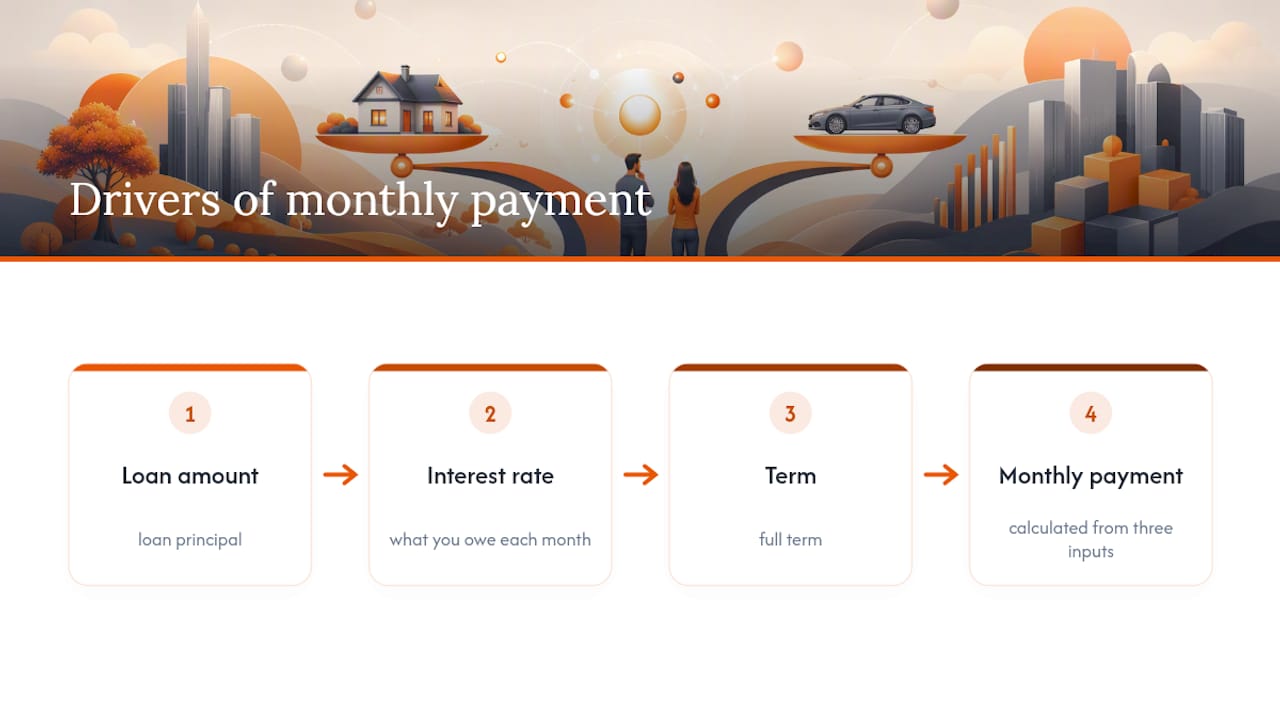
For installment loans (mortgages, auto, personal), the monthly payment is calculated from three inputs: loan amount, interest rate, and term. A higher rate means a higher payment and more total interest paid over the life of the loan. A lower rate does the opposite.
Rates come in two forms. A fixed rate stays constant for the full term, so your payment never changes. A variable rate is tied to a benchmark index (such as the prime rate or SOFR), meaning your payment can rise or fall as market conditions shift. Variable rates often start lower but carry more risk over a long term.
Pro Tip: If your main concern is monthly cash flow or you plan to repay within a few years, focus on the interest rate first. It is the direct driver of what you owe each month.
What does APR mean, and which fees does it include?
APR, as the CFPB explains, is the interest rate plus certain additional fees, expressed as a single annualized percentage. The Truth in Lending Act (TILA) requires lenders to disclose APR on most consumer loans so you can compare offers on a level playing field.
Fees that commonly push APR above the stated interest rate include:
- Origination fees (often ranging 1%–8% of the loan amount)
- Mortgage points (prepaid interest that buys a lower rate)
- Underwriting and processing fees
- Broker fees
- Certain closing costs on mortgage loans
Fees that are typically excluded from APR: appraisal fees, title insurance, escrow deposits, and optional add-ons like extended warranties. Because of those exclusions, Cornell Law notes that the exact legal definition of which fees count toward APR can vary by jurisdiction and loan type.
Worth knowing: APR is not the same as APY (annual percentage yield). Investopedia explains that APR does not account for within-year compounding the way APY does, so on products where interest compounds frequently, APR can understate the effective annual cost.
How APR and interest rate differ by loan type
The gap between APR and interest rate varies widely depending on the product. Understanding where that gap tends to be large helps you know when APR is most worth scrutinizing.
- Mortgages: Points, lender origination fees, and some closing costs all feed into APR, so the spread between APR and interest rate can be meaningful. APR is most useful here when you plan to hold the loan to full term. If you expect to sell or refinance within a few years, the break-even on mortgage points matters more than the APR alone.
- Auto loans: Dealer-arranged financing often involves a buy rate (what the lender charges the dealer) and a sell rate (what the dealer charges you). Documentation fees and add-on products can widen the APR vs. interest rate gap. For a practical look at how this plays out on car purchases, this auto-loan APR guide breaks down the negotiation dynamics.
- Personal loans: Origination fees are common and are typically folded into APR, making APR the more accurate comparison metric across competing offers.
- Credit cards: APR and interest rate are used interchangeably on most cards because there are no upfront fees. The card's periodic rate multiplied by 12 (or 365, depending on the issuer's method) gives you the APR.
How to compare two loan offers using APR and interest rate
Before you sign anything, gather the same data points from every lender. Here is a numbered checklist:
- Get both numbers in writing. Request the stated interest rate and the APR on the same loan amount and term.
- Ask for an itemized fee list. APR is only as useful as the fees it includes. An itemized list shows you what is and is not captured.
- Confirm the loan term is identical. APR comparisons are only valid when the term length matches across offers.
- Check for prepayment penalties. A lower APR offer with a stiff prepayment penalty can cost more if you pay off early.
- Ask about compounding frequency. Monthly compounding produces a slightly higher effective rate than annual compounding at the same stated APR.
- Clarify whether points are optional. Buying points lowers your interest rate but raises upfront cost; whether that trade-off makes sense depends on how long you keep the loan.
When APR is the deciding metric: Comparing two offers with the same term and similar structure? APR wins. It captures fees that the interest rate ignores.
When interest rate matters more: Planning to sell a home in three years or pay off a personal loan ahead of schedule? The interest rate drives your monthly payment, and a shorter holding period shrinks the fee-amortization benefit that APR assumes over the full term.
Red flags to watch for: a large gap between APR and interest rate with no itemized explanation; optional fees quietly rolled into the financed amount; or a lender who can only quote APR but not the underlying interest rate.
A worked example: seeing the numbers side by side
Suppose you are comparing two $25,000 personal loans, both with a 60-month term.
- Loan A: 7.00% interest rate, no origination fee
- Loan B: 6.75% interest rate, 2% origination fee ($500)
Loan B advertises a lower interest rate, but once the origination fee is spread across the 60-month term, its APR rises above Loan A's. The monthly payment is slightly lower, but the total cost is higher. Fidelity's consumer examples illustrate exactly this dynamic: a fee that looks small upfront can flip the comparison once annualized.
If you planned to pay off Loan B in 24 months instead of 60, the APR impact of that $500 fee would be even larger, because the fee gets compressed into a shorter period. Always test your expected holding period, not just the full term.
When APR can mislead you
APR is a standardized tool, but it has real limits. Knowing them keeps you from treating it as the final word.
- Compounding: APR does not reflect within-year compounding. When interest compounds monthly, the effective annual rate is slightly higher than the stated APR. For savings products, lenders use APY to show that effect; for loans, they are not required to.
- Short-term repayment: Upfront fees are amortized across the full stated term in the APR calculation. If you repay early, those fees hit you harder than the APR suggests.
- Excluded fees: Appraisal costs, title insurance, escrow deposits, and optional warranties often sit outside the APR. Always request the full itemized fee schedule.
- Variable-rate loans: APR on a variable-rate product is calculated at the initial rate. If the rate adjusts upward, the actual cost will exceed what the disclosed APR implied.
Where to verify disclosures and run your own calculations
Authoritative sources for checking lender disclosures and understanding your rights:
- CFPB (Consumer Financial Protection Bureau): consumerfinance.gov publishes plain-language explanations of TILA disclosure requirements and what lenders must show you before you sign.
- Truth in Lending Act (TILA): The federal law that mandates APR disclosure on most consumer credit products. Your loan's Truth in Lending disclosure statement is the official document to review before closing.
- NMLS Consumer Access (nmlsconsumeraccess.org): Lets you verify that a mortgage lender or broker is properly licensed in your state.
For running the numbers yourself, a loan payment calculator lets you input interest rate, term, and loan amount to see the monthly payment instantly. Pair that with an APR calculator where you can add origination fees to see how the annualized cost shifts. Apexapro's free, browser-based calculators handle both calculations side by side with no sign-up required.
The one rule of thumb that actually holds up
Most borrowers overthink the APR vs. interest rate question. The practical rule is straightforward: compare APRs when the loan terms are similar and you plan to hold the loan to term; compare interest rates when monthly payment is your binding constraint or you expect to repay early.
The caveat worth keeping in mind: APR is standardized by law, but it is not uniform in every detail. Because lenders have some discretion over which fees to include for certain products, two APR figures from different lenders are not always calculated on identical inputs. The itemized fee list is the check that APR alone cannot replace.
For a deeper look at how APR and APY diverge once compounding enters the picture, the APR vs. APY explainer on Apexapro walks through the math with concrete numbers.
Run your own numbers with Apexapro's free calculators
The worked example above used round numbers. Your actual loan offer has specific figures, and the difference of a few basis points or a $300 fee can shift the comparison.
Apexapro's free, browser-based loan and APR calculators let you plug in your exact interest rate, origination fee, and term to see monthly payment, total cost, and APR side by side in seconds. No account, no download, no waiting. Head to Apexapro to run the numbers on your real offers and save the comparison before you sign.
Sources
- What is the difference between a loan interest rate and the APR? | Consumer Financial Protection Bureau
- Annual percentage rate (APR) — Investopedia
- APR — Legal Information Institute — Cornell Law School
- APR vs. Interest Rate: What's the Difference? | Experian
- APR vs. interest rate: What's the difference? | Fidelity
Review your loan's Truth in Lending disclosure statement carefully before signing. That document is the official record of the APR, fees, and terms your lender is legally required to honor.
This article provides general financial information for educational purposes. It is not a substitute for advice from a licensed financial professional. Confirm current disclosure requirements and loan terms directly with your lender or a qualified advisor.