
TDEE equals BMR multiplied by an activity multiplier. For general use, the Mifflin–St Jeor equation is the most accurate validated formula for estimating BMR in non-obese adults, according to Forbes Health. Once you have that number, you multiply it by a factor between 1.2 and 1.9 depending on how active you are.
TDEE = BMR × Activity Multiplier
The multipliers run like this: sedentary (1.2), lightly active (1.375), moderately active (1.55), active (1.725), and very active (1.9), based on ranges cited by Medscape. Even with the right inputs, expect your result to land within roughly ±10 to 15% of your true energy expenditure. Formulas estimate. They don't measure. That gap matters more for some people than others, and you'll see exactly why in the sections ahead.
Key Takeaways
Your TDEE equals BMR multiplied by an activity multiplier, and Mifflin–St Jeor remains the most defensible starting formula for most adults.
| Point | Details |
|---|---|
| Core formula | TDEE = BMR × activity multiplier, with multipliers ranging from 1.2 to 1.9. |
| Best default formula | Mifflin–St Jeor works for most non-obese adults using only weight, height, age, and sex. |
| When to switch formulas | Use Katch–McArdle if you know your body fat percentage and carry above-average muscle mass. |
| Expect a margin of error | Formula estimates run roughly ±10 to 15% off true expenditure, wider for atypical bodies. |
| Test before trusting | Eat at your calculated TDEE for 2 to 3 weeks, track trend weight, then adjust in small steps. |
| Try it instantly | Apexapro's free calculator runs Mifflin–St Jeor and Katch–McArdle side by side with no sign-up required. |
Table of Contents
- What Is TDEE and What Makes It Up?
- Which BMR Formula Should You Use?
- How Do You Pick the Right Activity Multiplier?
- Worked Example: Calculating TDEE Step by Step
- How Accurate Is a TDEE Formula, Really?
- How Do You Use TDEE to Hit a Weight Goal?
- What Mistakes Wreck a TDEE Calculation?
- What's the Smartest Way to Actually Use a TDEE Formula?
- Try the Free TDEE Calculator Built for Real-World Use
- Sources
What Is TDEE and What Makes It Up?
Total daily energy expenditure is the number of calories your body burns in a full day, counting everything from lying in bed to sprinting up stairs. It breaks into four parts, and each one behaves differently depending on your body and your lifestyle.
- Resting metabolic rate (RMR/BMR): the energy your body burns just staying alive, typically 60 to 75% of TDEE.
- Thermic effect of food (TEF): calories spent digesting and processing what you eat, often approximated at 10% of intake, per OPEX Fitness.
- Exercise activity (EA): calories burned during intentional workouts, running, lifting, cycling.
- Non-exercise activity thermogenesis (NEAT): everything else, fidgeting, walking to your car, standing at your desk.
Resting metabolic rate dominates the equation, which is why the formula you use to estimate it matters more than any other single choice you make. Fat-free mass, not total body weight, is the stronger predictor of that resting burn, according to background data on energy expenditure. A muscular 180-pound person and a less muscular 180-pound person can have meaningfully different BMRs, even though a weight-only formula would score them identically.
Which BMR Formula Should You Use?
Three formulas dominate TDEE calculators, and each one trades simplicity for precision in a different way.
Mifflin–St Jeor is the default recommendation for most people. The equations are:
- Men: (10 × weight in kg) + (6.25 × height in cm) − (5 × age) + 5
- Women: (10 × weight in kg) + (6.25 × height in cm) − (5 × age) − 161
It needs only weight, height, age, and sex, and Forbes Health cites it as the most accurate validated option for general, non-obese populations.
Harris–Benedict (revised) is the older sibling of Mifflin–St Jeor. It uses the same four inputs but tends to overestimate BMR slightly compared to more modern equations, particularly for people carrying more body fat. It still shows up in clinical settings and older calculators, but for everyday use, Mifflin–St Jeor has mostly replaced it.
Katch–McArdle swaps total body weight for lean body mass, which means you need a body fat percentage to use it. That extra input pays off for muscular or lean individuals, where weight-only formulas tend to misjudge resting burn. Built With Science notes that lean-mass calculators improve accuracy specifically for people whose body composition sits outside the average range the other equations were built around.
Pro Tip: If you don't know your body fat percentage, skip Katch–McArdle rather than guessing. A rough DEXA scan, calipers, or even a decent smart scale gives you a usable estimate. A wildly wrong body fat number will throw off Katch–McArdle worse than just using Mifflin–St Jeor in the first place.
How Do You Pick the Right Activity Multiplier?
The multiplier is where most people sabotage their own numbers, because everyone thinks they're more active than they actually are.
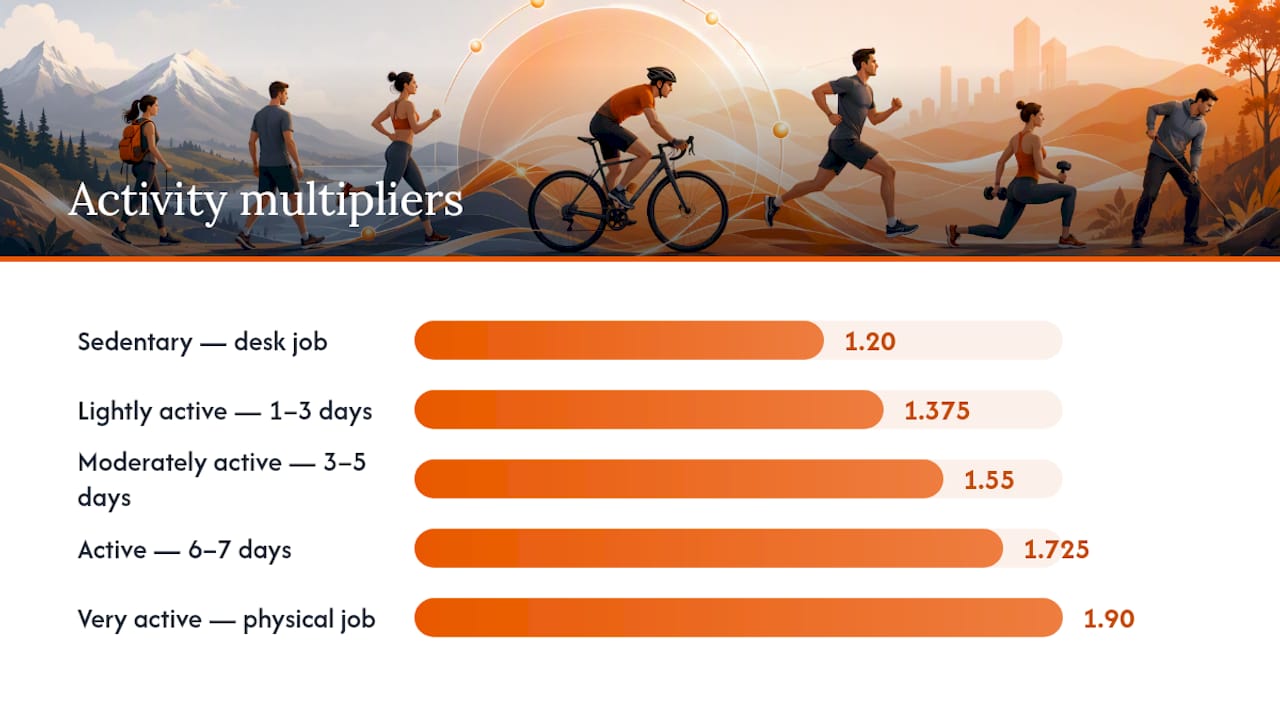
| Activity level | Multiplier | Typical description |
|---|---|---|
| Sedentary | 1.2 | Desk job, little to no exercise |
| Lightly active | 1.375 | Light exercise 1 to 3 days a week |
| Moderately active | 1.55 | Moderate exercise 3 to 5 days a week |
| Active | 1.725 | Hard exercise 6 to 7 days a week |
| Very active | 1.9 | Physical job plus daily hard training |

These values vary slightly across sources, but the ranges hold steady enough to use with confidence. The better question isn't which multiplier exists. It's which one actually matches your week.
A few ways to get a more honest answer:
- Check your job type first. Standing and walking all day pushes you toward moderately active even before you count workouts.
- Count actual training sessions, not intentions. Three planned gym visits that turn into two most weeks means lightly active, not moderately active.
- Use a wearable tracker for a week or two to see your real average step count and active minutes instead of guessing.
- Watch for the classic overestimate: someone who works a desk job and lifts weights three times a week is usually lightly to moderately active, not "active." Athletic self-image inflates this number constantly.
Worked Example: Calculating TDEE Step by Step
Here's a full calculation using Mifflin–St Jeor, walked through with a 34-year-old woman who weighs 154 pounds, stands 5 feet 6 inches tall, and works out four times a week.
- Convert units. 154 lbs ÷ 2.2 = 70 kg. 5'6" = 66 inches × 2.54 = 167.6 cm.
- Plug into Mifflin–St Jeor for women: (10 × 70) + (6.25 × 167.6) − (5 × 34) − 161.
- Calculate step by step: 700 + 1,047.5 − 170 − 161 = 1,416.5 calories. That's her estimated BMR.
- Select the multiplier. Training four days a week with a moderate-intensity routine puts her at moderately active, or 1.55.
- Multiply BMR by the multiplier: 1,416.5 × 1.55 = 2,195.6, rounded to roughly 2,196 calories per day.
Measure weight and height under consistent conditions. Weigh yourself first thing in the morning, before eating, with shoes off, and use the same scale each time. A pound of variance from inconsistent measuring can shift your BMR estimate by 10 calories or more, which then compounds through the multiplier.
How Accurate Is a TDEE Formula, Really?
That margin widens further for people with atypical body composition, active illness, or ages at the extremes of adulthood, where the population data the formulas were built on doesn't fit as well.
Resting metabolic rate accounts for roughly 60 to 75% of total daily burn, according to background research on energy expenditure, so even a small BMR miscalculation ripples through your entire TDEE number.
When precision actually matters, researchers turn to doubly labeled water (DLW), a method that tracks isotope elimination over 7 to 14 days of normal living to measure real-world energy expenditure directly. Combined with indirect calorimetry, which measures oxygen consumption and carbon dioxide production to estimate metabolic rate in a controlled setting, DLW lets scientists partition exactly how much energy goes toward resting metabolism versus activity, according to a review in Annual Reviews of Nutrition. These methods aren't practical for everyday tracking. They exist in research labs and specialized clinics.
Pro Tip: If you're a competitive athlete, pregnant, managing a metabolic condition, or simply not seeing expected results after weeks of consistent tracking, a registered dietitian or sports medicine practitioner can arrange indirect calorimetry testing. For everyone else, the formula plus real-world tracking gets you close enough to act on.
How Do You Use TDEE to Hit a Weight Goal?
Your TDEE number is a starting point for a calorie target, not a fixed destination. Once you have an estimate, the adjustment depends on your goal.
For steady, sustainable weight loss, most people do well with a 10 to 20% deficit below TDEE. Using the worked example above, that means eating somewhere between 1,756 and 1,976 calories instead of 2,196. A more aggressive deficit, up to 25%, can speed up loss but raises the risk of muscle loss and rebound hunger. For lean mass gain, a modest surplus of 5 to 15% above TDEE, paired with resistance training, tends to add muscle without excessive fat gain.
Protein matters as much as the calorie target itself. Higher protein intake helps preserve lean mass during a deficit and supports muscle growth during a surplus, which is part of why the Katch–McArdle formula exists in the first place. Body composition, not just body weight, is what most people actually care about.
Track weight and, if possible, body measurements or photos for two to four weeks before making changes. Daily weight fluctuates with water retention, sodium intake, and hormonal cycles, so a single day's number tells you almost nothing. A two-week average moving in the wrong direction is the signal to adjust your intake by roughly 100 to 200 calories, not to panic and slash 500 calories overnight.
What Mistakes Wreck a TDEE Calculation?
A handful of errors show up over and over, and most of them are fixable in five minutes.
- Confusing BMR with TDEE. BMR is what you'd burn doing nothing. TDEE includes everything else. Eating "at your BMR" instead of your TDEE creates a much larger deficit than intended.
- Overestimating activity level. Selecting "active" because you feel active, rather than because your actual training log supports it, inflates your calorie target and stalls progress.
- Using the wrong formula for your body type. A heavily muscled person using a weight-only formula like Mifflin–St Jeor will likely underestimate their true BMR; Katch–McArdle usually fits better.
- Ignoring protein and meal timing. Hitting your calorie number while eating almost no protein undermines lean mass retention, especially during a deficit.
- Treating the output as exact. Every TDEE number carries a real margin of error. Treat it as a smart starting estimate, not a locked-in truth.
Pro Tip: Recalculate and reassess every four to six weeks, especially after meaningful weight change. A 15-pound loss changes your BMR enough that your old TDEE number is no longer accurate for your new body.
What's the Smartest Way to Actually Use a TDEE Formula?
Most people treat their first TDEE number as gospel, and that's the mistake. Formula-first, tracking-second is the right order, but tracking-second is not optional.
Calculate your estimate with Mifflin–St Jeor unless you have a solid body fat percentage and unusually high muscle mass, in which case Katch–McArdle earns its extra input. Then eat at that number for two to three weeks while tracking weight trend, not daily fluctuation. If your actual results diverge from what the math predicted, trust your body's data over the equation. That's not a failure of the formula.
Special populations need extra caution here. Elderly adults often see resting metabolic rate decline with age in ways that generic formulas don't fully capture. Pregnant and breastfeeding women have elevated energy needs that standard TDEE multipliers weren't built to estimate. Elite athletes training at very high volumes sometimes hit a point where additional training doesn't proportionally raise expenditure, a pattern researchers call the constrained energy expenditure model. Any of these situations calls for guidance from a registered dietitian or physician rather than a pure formula-and-multiplier approach.
Try the Free TDEE Calculator Built for Real-World Use
Running these numbers by hand is a useful exercise once. Doing it every time your weight shifts or your training schedule changes gets old fast. Apexapro's calculator catalog includes a free, browser-based TDEE tool that runs both Mifflin–St Jeor and Katch–McArdle instantly, so you can compare results side by side without opening a spreadsheet.

There's no sign-up, no download, and no waiting. Enter your weight, height, age, and activity level, and get your BMR and TDEE in seconds. If you know your body fat percentage, switch to Katch–McArdle and see how much the estimate shifts. Since accurate inputs matter more than the formula itself, pair it with Apexapro's guide on collecting accurate body measurements before you run your numbers. Head to Apexapro now, calculate your TDEE, and save the result so you have a real baseline to track against over the next few weeks.
Sources
- Energy Expenditure in Humans: Principles, Methods, and Changes Throughout the Life Course | Annual Reviews
- TDEE Calculator: Total Daily Energy Expenditure – Forbes Health
- Mifflin–St Jeor equation calculator — Medscape Reference
- TDEE Calculator: Find Your Total Daily Energy Expenditure | Built With Science
- How to Calculate TDEE (Total Daily Energy Expenditure) | OPEX Fitness
This article is general information, not a substitute for advice from a qualified doctor. Consult a qualified healthcare professional about your own circumstances before acting on anything here.