The formula for a cubic yard calculation is straightforward: multiply length × width × depth (all in feet), then divide by 27. For a 10 ft × 10 ft area at 4 inches deep, convert 4 inches to feet first (4 ÷ 12 = 0.333 ft), then calculate: 10 × 10 × 0.333 ÷ 27 = approximately one and a quarter cubic yards. That single sequence handles most landscaping and construction projects. Run your own numbers instantly with the Apexa Pro cubic yard calculator — no signup, no download.
Key Takeaways
The cubic yard formula, (length × width × depth in feet) ÷ 27, is the single calculation that drives every material estimate in this guide, from a small flower bed to a concrete slab.
| Point | Details |
|---|---|
| The core formula | (Length × width × depth in feet) ÷ 27 = cubic yards; convert inches to feet first by dividing by 12. |
| Why divide by 27 | One cubic yard equals 27 cubic feet (3 ft × 3 ft × 3 ft), so dividing scales any cubic-foot volume to yards. |
| Coverage rule of thumb | One cubic yard covers roughly a 10 ft × 10 ft area at 3 inches deep, useful for mulch and stone estimates. |
| Always add overage | Order 10–15% extra on loose materials; compaction and spillage can reduce delivered volume by up to 15%. |
| Use Apexapro | The free Apexapro cubic yard calculator at apexapro.com handles unit conversions and overage automatically, no signup needed. |
Table of Contents
- How to use the cubic yard calculator for your project
- How to calculate cubic yards manually, step by step
- Why you divide by 27 when converting cubic feet to cubic yards
- How much area does 1 cubic yard cover at different depths?
- Worked examples for common projects and rounding guidance
- Measurement tips and common mistakes to avoid
- Why Apexapro's cubic yard calculator gives you reliable results
- An editorial note on getting the math right
- The Apexa Pro cubic yard calculator is free and ready to use
- Sources
How to use the cubic yard calculator for your project
The Apexa Pro calculator accepts length, width, and depth in feet or inches, so you never need to pre-convert your tape measure readings. Enter your dimensions, select your material if prompted, and the tool handles the rest, including the ÷ 27 conversion and an optional overage adjustment.
Three quick input examples:
- Patio (10 ft × 12 ft × 4 in): Enter 10, 12, and 4 inches. The calculator converts 4 in to 0.333 ft, multiplies to get 40 cubic feet, then divides by 27 to return about one and a half cubic yards.
- Flower bed (8 ft × 6 ft × 3 in): Enter 8, 6, and 3 inches. Result: 8 × 6 × 0.25 ÷ 27 = just under half a cubic yard.
- Gravel driveway (12 ft × 30 ft × 3 in): Enter 12, 30, and 3 inches. Result: 12 × 30 × 0.25 ÷ 27 = a bit more than three cubic yards.
How the calculator processes your inputs:
- Inches entered in the depth field are divided by 12 to produce a decimal foot value.
- The three foot values are multiplied together to produce cubic feet.
- That cubic-foot total is divided by 27 to return cubic yards.
- Overage controls, where available, add a configurable percentage on top of the raw result so you can order the right amount in one step. Vendor calculators commonly include this feature to reduce short orders on loose materials.
How to calculate cubic yards manually, step by step
To calculate cubic yards by hand, measure all three dimensions in feet, multiply them together, and divide by 27. Here is the full sequence:
Step 1: Measure length and width in feet. If your tape shows feet and inches, convert the inch portion: divide inches by 12 and add to the whole-foot number (e.g., 10 ft 6 in = 10.5 ft).
Step 2: Convert depth from inches to feet. Divide the inch measurement by 12. Four inches becomes 0.333 ft; three inches becomes 0.25 ft; six inches becomes 0.5 ft.
Step 3: Multiply length × width × depth (all in feet) to get cubic feet.
Step 4: Divide cubic feet by 27 to get cubic yards.
Worked example — 10 ft × 10 ft at 4 in deep:
- Depth: 4 ÷ 12 = 0.333 ft
- Cubic feet: 10 × 10 × 0.333 = about 33 cubic feet
- Cubic yards: 33.3 ÷ 27 = about one and a quarter cubic yards
Unit consistency is the most common source of errors. Every dimension must be in feet before you multiply. Mixing inches and feet in the same calculation without converting first produces a number that is off by a factor of 12 or more, which means a badly undersized order. The cubic-yard formula is (length × width × depth in feet) ÷ 27, and that "in feet" qualifier applies to all three inputs simultaneously.
Why you divide by 27 when converting cubic feet to cubic yards
One cubic yard is a cube measuring 3 ft × 3 ft × 3 ft, which equals exactly 27 cubic feet. Dividing any cubic-foot volume by 27 scales it to cubic yards. That single relationship is the entire basis of the cubic yard formula.
Quick unit references:
- 1 yd³ = 27 ft³
- 1 yd³ is approximately 202 US gallons
- 1 yd³ is approximately 0.765 cubic meters
Converting in both directions:
- Cubic feet → cubic yards: divide by 27 (e.g., 54 ft³ ÷ 27 = 2 yd³)
- Cubic meters → cubic yards: divide by 0.7646 (e.g., 2 m³ ÷ 0.7646 ≈ 2.62 yd³)
- Cubic yards → cubic feet: multiply by 27 (e.g., 3.5 yd³ × 27 = 94.5 ft³)
If your measurements are in inches throughout, convert each dimension to feet first (divide each by 12), then apply the formula. Alternatively, multiply all three inch values together and divide by 46,656 (which is 12³ × 27) to go directly from cubic inches to cubic yards.
How much area does 1 cubic yard cover at different depths?
One cubic yard covers roughly a 10 ft × 10 ft area at 3 inches deep, a practical heuristic that works for mulch, topsoil, and stone. The table below shows exact coverage at common depths.
Recommended depths by material:
- Mulch: 2–3 inches for established beds; 4 inches for new beds or weed suppression
- Topsoil: 4–6 inches for new lawn areas; 2–3 inches as a top-dress
- Gravel (driveway): 3–4 inches for a stable base layer
- Concrete slab: 4 inches is standard residential; 6 inches for driveways or heavy loads
Bags per cubic yard: A 2 cubic foot bag is one of the most common retail sizes. One cubic yard equals 27 cubic feet, so you need 13.5 bags of 2 cu ft each (round up to 14). A 0.5 cu ft bag requires 54 bags per cubic yard. For a flower bed needing 0.44 yd³, that is roughly 6 bags of 2 cu ft.
Most suppliers recommend ordering some extra material—typically around 10 to 15 percent—to account for settling, spillage, and uneven subgrades.
Pro Tip: *Loose materials like mulch and compost tend to compact significantly after delivery, so adding extra material is advised.
Worked examples for common projects and rounding guidance
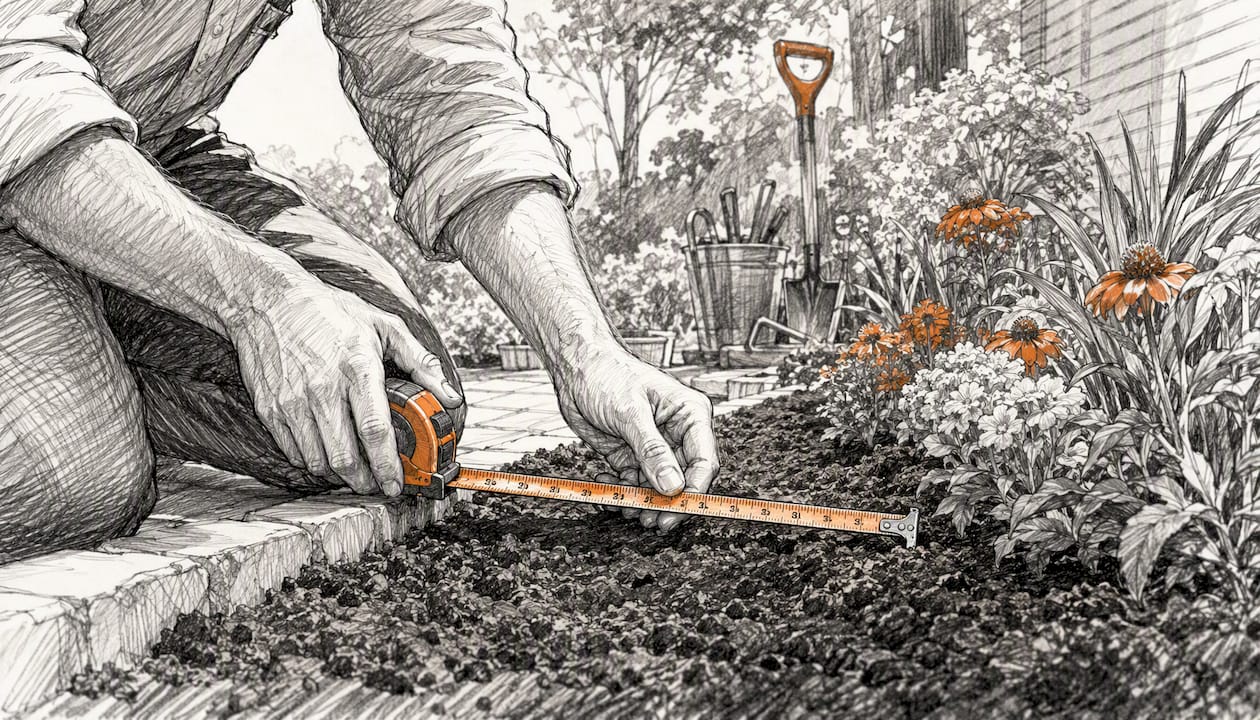
Flower bed (irregular shape, ~48 sq ft, 3 in deep): Break the area into rectangles. A bed that is roughly 8 ft × 6 ft = 48 sq ft.
For reference, poured concrete runs approximately 2.025 tons per cubic yard, which matters when checking truck load limits.
Rounding rule: Always round up to the next available increment, never down. A short load means a second delivery charge. When the overage calculation lands within 0.1 yd³ of a half-yard mark, round to that mark.
Measurement tips and common mistakes to avoid
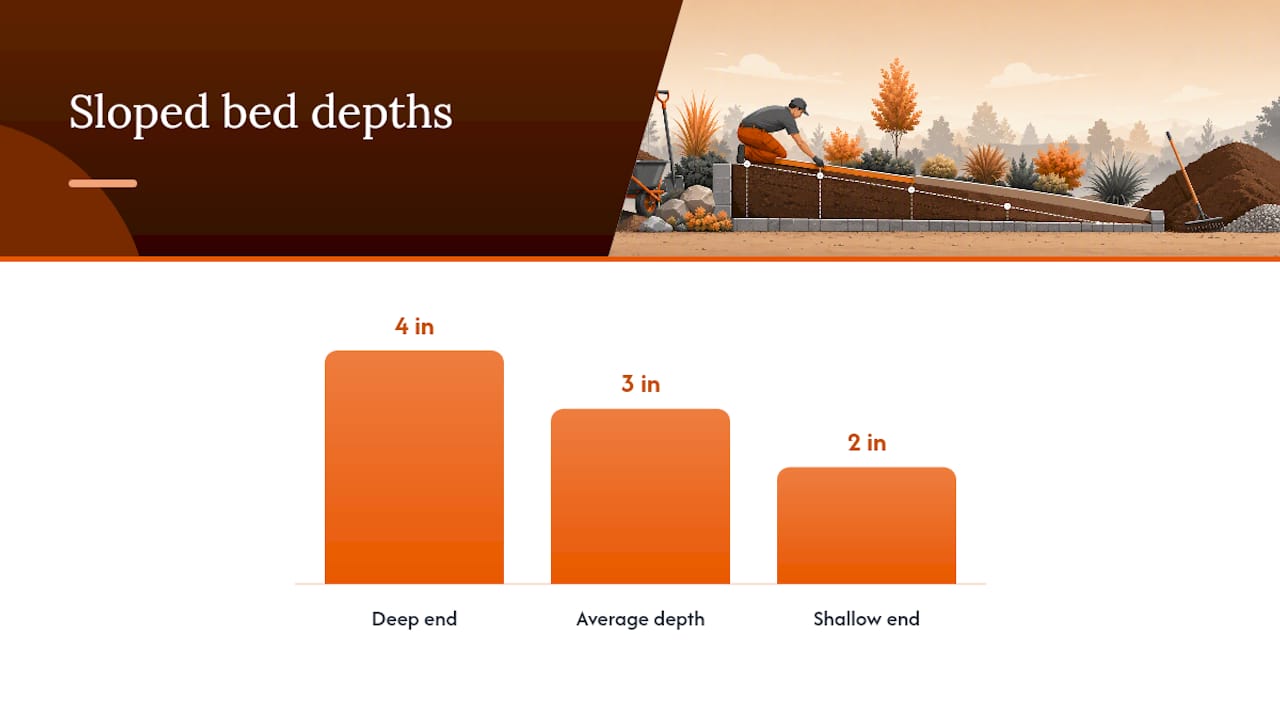
Measure depth at the deepest point and average it across the area before calculating. On a sloped or uneven surface, a single depth reading at one corner will understate the true volume.
Common pitfalls:
- Mixing feet and inches in the same multiplication without converting
- Forgetting to divide depth (in inches) by 12 before multiplying
- Skipping the 10–15% overage on loose materials
- Ignoring compaction, especially for mulch, compost, and topsoil
- Measuring a sloped area as flat and missing the extra depth at the low end
Measuring irregular shapes: Break the area into rectangles, triangles, or circles, calculate the volume of each piece separately, then add them together. For a triangular section, use ½ × base × height to get the area, then multiply by depth and divide by 27. Circular areas use π × radius² for the surface area. Geometric formulas for non-rectangular volumes follow the same pattern: get the area in square feet, multiply by depth in feet, divide by 27.
For uneven depth, take three or four depth readings across the area and average them. On a bed that slopes from 4 inches at one end to 2 inches at the other, the average depth is 3 inches.
Pro Tip: *To verify a contractor's estimate in the field, measure the area yourself, apply the formula, and compare.
Why Apexapro's cubic yard calculator gives you reliable results
Apexapro's free cubic yard calculator delivers instant results for feet and inches inputs without requiring any account creation or app download. The platform is built around real search demand, which means the calculator's fields and outputs reflect the questions actual DIYers and landscapers ask most.
Platform proof points:
- Completely free, browser-based, no signup or download required
- Accepts feet and inches directly, with automatic unit conversion built in
- Bilingual support (English and Spanish) for a broader range of users
- Tools are updated regularly based on real user demand, not a static feature list
- Covers construction, finance, health, cooking, and more, all in one catalog
The calculator's practical outputs, including auto-converted dimensions, suggested overage, and bag-count estimates, reduce the most common ordering mistakes. Apexapro publishes educational calculation guides alongside its tools, so the explanatory content and the calculator are built to work together.
An editorial note on getting the math right
Measurement errors in construction and landscaping projects are rarely about the formula itself. The formula is simple. The errors come from unit mismatches, skipped conversions, and the assumption that a single depth reading represents the whole area. After working through dozens of calculation guides and tools, the pattern is consistent: the projects that go wrong are the ones where someone measured in inches but calculated in feet, or ordered the raw cubic-yard number without adding overage.
The Apexa Pro calculator removes those friction points by handling the conversions automatically and surfacing the overage recommendation before you finalize your order. For anyone who wants to verify the math manually, the step-by-step method in this guide produces the same result. Both approaches work. The goal is to arrive at the supplier with a number you are confident in, so you order once and order right.
The Apexa Pro cubic yard calculator is free and ready to use
Calculating material volumes does not require a spreadsheet or a contractor's estimate. The Apexa Pro cubic yard calculator runs instantly in any browser, accepts feet and inches, and returns cubic yards with optional overage built in.

No signup. No download. Enter your length, width, and depth, and the tool handles the conversion and division automatically. It also supports common material selections so you can move from raw measurement to a confirmed order quantity in under a minute. Try it at Apexapro.
Sources
- Cubic Yards Calculator | Measure and Price Volume
- Cubic Yard Calculator for Mulch & Stone
- Yardage Calculator