
What is special relativity?
Special relativity is Albert Einstein's theory showing that space and time are not fixed backdrops — they shift depending on how fast you are moving relative to someone else. Published in 1905, the theory overturned centuries of Newtonian mechanics and revealed that measurements of distance, duration, and even mass depend entirely on the observer's state of motion.
Here are the core ideas, stripped to their essentials:
- Time dilation: A clock moving at high speed ticks more slowly than one at rest. The faster you travel, the slower your time runs compared to a stationary observer.
- Length contraction: Objects moving at high speed appear shorter along the direction of motion when measured by a stationary observer.
- Mass-energy equivalence: Mass and energy are two forms of the same thing, connected by the famous equation E=mc². A tiny amount of mass contains an enormous amount of energy.
- Relativity of simultaneity: Two events that appear simultaneous to one observer may not appear simultaneous to another observer moving at a different speed.
- The Lorentz factor (γ): The mathematical multiplier that quantifies how much time, length, and mass change at a given speed. At everyday speeds, γ is essentially 1, so the effects are invisible. Near the speed of light, γ grows dramatically.
The theory applies specifically to inertial frames — observers moving at constant velocity, with no acceleration. That scope is what makes it "special" rather than general. Einstein's later general relativity extended these ideas to include gravity and acceleration.
Table of Contents
- How Einstein developed the theory of special relativity
- The two postulates that the whole theory rests on
- How reference frames and relative motion work
- Lorentz transformations: the math connecting different frames
- Consequences and paradoxes that follow from special relativity
- Real-world applications of special relativity
- How to explain special relativity to a child or a beginner
- Try an interactive special relativity simulator
- Why two events are never simultaneous for everyone
- Energy and momentum in special relativity
- Key Takeaways
- Why special relativity rewards patience more than raw intelligence
How Einstein developed the theory of special relativity
The path to special relativity was not a single flash of genius. It was the product of decades of mounting experimental tension and theoretical dead ends that classical physics simply could not resolve.
-
1865 — Maxwell's equations: James Clerk Maxwell showed that light is an electromagnetic wave traveling at a fixed speed, approximately 186,000 miles per second. The problem: classical mechanics said speeds must add together. If light travels at that speed relative to what, exactly?
-
1887 — The Michelson–Morley experiment: Albert Michelson and Edward Morley designed a precise experiment to detect the "aether," the hypothetical medium through which light was supposed to travel. They found nothing. The Michelson–Morley, Kennedy–Thorndike, and Ives–Stilwell experiments collectively confirmed that the speed of light does not change regardless of Earth's motion through space. The aether did not exist.
-
1895–1904 — Lorentz and Poincaré: Hendrik Lorentz and Henri Poincaré developed transformation equations that could mathematically explain why the aether was undetectable. They were on the right track mathematically but still clung to the idea of absolute space and time.
-
1905 — Einstein's "miracle year" paper: Working as a patent clerk in Bern, Switzerland, Einstein published "On the Electrodynamics of Moving Bodies" in the journal Annalen der Physik. He did not simply patch the existing framework. He discarded the aether entirely and rebuilt physics from two clean postulates. The result was a complete paradigm shift: space and time are relative, not absolute.
-
1905 — E=mc²: In a follow-up paper the same year, Einstein derived the mass-energy equivalence relationship, showing that mass itself is a form of stored energy.
-
Early 20th century — Experimental confirmation: Subsequent experiments validated the theory's predictions with increasing precision, cementing special relativity as a cornerstone of modern physics.
The shift from Newton to Einstein was not just a refinement. Newton's mechanics assumed time flows at the same rate everywhere in the universe, for everyone. Einstein showed that assumption was wrong — and that the universe is far stranger, and more consistent, than anyone had imagined.
The two postulates that the whole theory rests on
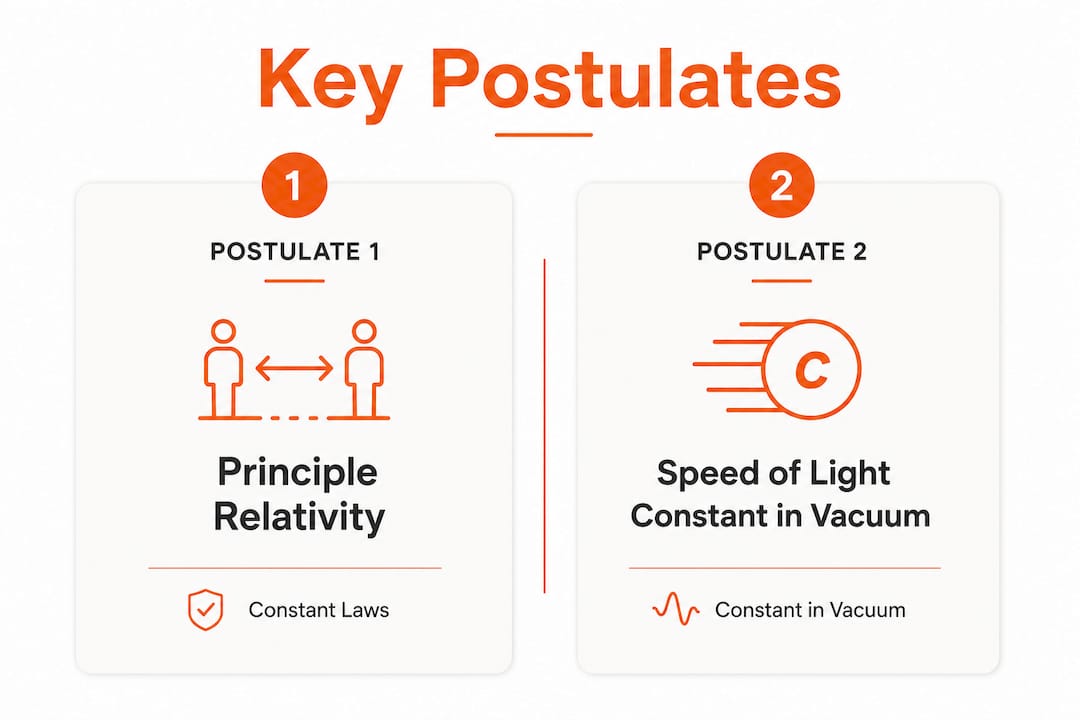
Einstein built special relativity on exactly two foundational principles. Everything else — time dilation, length contraction, E=mc² — follows logically from these two statements.
-
Postulate 1 — The principle of relativity: The laws of physics are identical in all inertial reference frames. Whether you are sitting still on a train platform or riding a train at constant speed, the same physical laws apply. No experiment you perform inside a sealed, smoothly moving vehicle can tell you whether you are moving or standing still.
-
Postulate 2 — The invariance of the speed of light: The speed of light in a vacuum is the same for all observers, regardless of their motion or the motion of the light source. It is always approximately 186,000 miles per second (299,792 kilometers per second). No exceptions.
These two postulates seem simple, but together they are explosive. Classical mechanics said that speeds add: if you throw a ball at 10 mph from a car moving at 60 mph, the ball travels at 70 mph relative to the road. Apply that logic to light, and a flashlight beam fired from a moving rocket should travel faster than one fired from a stationary source. But it does not. The speed of light stays constant no matter what.
The only way to reconcile both postulates is to accept that time and space themselves must flex. If the speed of light cannot change, then time and distance must adjust instead. That is the conceptual leap that makes special relativity so counterintuitive — and so powerful.
How reference frames and relative motion work
Understanding special relativity starts with understanding reference frames. A reference frame is simply the perspective from which you make measurements — your position, your clock, your ruler.
An inertial reference frame is one that moves at constant velocity, with no acceleration or rotation. Two observers in different inertial frames will measure the same physical laws, but they will not agree on the timing or length of events.
Key ideas about reference frames:
- There is no such thing as absolute rest. Before Einstein, physicists assumed the universe had a fixed backdrop — the aether — against which all motion could be measured. The Michelson–Morley experiment demolished that idea. Motion is always relative to something else.
- Two observers moving at different speeds will measure different elapsed times for the same event. This is not an illusion or a measurement error. It is a real physical difference.
- Two observers moving at different speeds will also measure different lengths for the same object. A spaceship moving past you at near-light speed appears shorter to you than it does to the pilot inside.
- Observers in different frames will disagree about whether two events happened at the same time. Simultaneity is not universal.
A simple analogy: Imagine you are on a train moving at 60 mph, and you toss a ball straight up. To you, the ball goes straight up and comes straight back down. To someone watching from the platform, the ball traces a diagonal arc, because it also has the train's horizontal velocity. Both observations are correct — they just reflect different reference frames. Special relativity extends this logic to light and time itself.
Pro Tip: When you feel confused by relativity, ask yourself: "Relative to whom?" Every measurement of time, length, or speed only makes sense when you specify the observer. That single habit clears up most beginner confusion.

Lorentz transformations: the math connecting different frames
When two observers in different inertial frames want to compare their measurements, they need a translation tool. That tool is the Lorentz transformation, and it replaces the simpler Galilean transformation that classical mechanics used.
Why Galilean transforms are not enough:
In classical mechanics, if you are moving at speed v relative to me, and you measure an event at position x and time t, I simply add your velocity to get the position in my frame: x' = x − vt. Time stays the same for both of us: t' = t. Clean and intuitive — but wrong at high speeds.
What Lorentz transformations do differently:
Special relativity replaces Newtonian mechanics at high speeds using Lorentz transformations, which modify both space and time coordinates simultaneously. The key equations look like this:
- x' = γ(x − vt)
- t' = γ(t − vx/c²)
Where γ (the Lorentz factor) equals 1 / √(1 − v²/c²), and c is the speed of light.
What this means in plain terms:
- At low speeds (everyday life), v is tiny compared to c, so v²/c² is nearly zero, γ is nearly 1, and the Lorentz transforms reduce to the familiar Galilean ones. Nothing weird happens.
- As speed approaches c, γ grows rapidly. As speed approaches the speed of light, the Lorentz factor γ grows dramatically, reaching values of a few units at high fractions of light speed and much larger values even closer to light speed.
- Time dilation follows directly: a moving clock runs slow by a factor of γ. A clock moving at 99% of light speed ticks roughly 7 times more slowly than a stationary one.
- Length contraction also follows: a moving object appears shorter by a factor of γ along the direction of motion.
Galilean vs. Lorentz: a quick comparison
| Feature | Galilean transformation | Lorentz transformation |
|---|---|---|
| Time between frames | Same for all observers | Depends on relative speed |
| Length between frames | Same for all observers | Contracts at high speed |
| Speed of light | Would vary with motion | Always constant |
| Valid range | Low speeds (everyday life) | All speeds up to c |
| Reduces to the other? | N/A | Yes, at low speeds |
The Lorentz transformation is not just a mathematical curiosity. It is the precise mechanism by which the two postulates of special relativity stay consistent. Without it, the constancy of light speed and the principle of relativity would flatly contradict each other.
Consequences and paradoxes that follow from special relativity
Once you accept the two postulates and the Lorentz transformation, a cascade of strange but logically necessary consequences follows.
Time dilation
Time passes more slowly for objects moving at high speeds compared to a stationary observer. This is not a clock malfunction — it is time itself running at a different rate. The effect is negligible at car or airplane speeds, but at a significant fraction of the speed of light, it becomes dramatic.
Length contraction
A spaceship traveling at 87% of the speed of light would appear, to a stationary observer, to be half its rest length along the direction of travel. The pilot inside measures the ship at its normal length. Both are correct.
Mass-energy equivalence
E=mc² is perhaps the most famous equation in science. It states that mass and energy are interchangeable. A small amount of mass corresponds to an enormous amount of energy, because c² is an astronomically large number. Nuclear reactors and atomic weapons both operate on this principle — a tiny loss of mass releases a vast amount of energy.
The cosmic speed limit
Nothing with mass can reach or exceed the speed of light. As an object accelerates, its effective mass increases, requiring more and more energy to push it further. As speed approaches c, the required energy approaches infinity. The speed of light is not just a practical barrier — it is a fundamental one built into the structure of the universe.
The twins paradox: a story before the math
Here is where special relativity gets genuinely dramatic. Imagine two identical twins, Alex and Jordan. On their 30th birthday, Jordan boards a spacecraft and blasts off toward a distant star at 99% of the speed of light. Alex stays home on Earth.
From Alex's perspective on Earth, Jordan's clock is running slow — about 7 times slower, given a Lorentz factor of roughly 7.1 at 99% of c. Years pass on Earth while only months pass for Jordan.

Jordan eventually turns around and comes home. When the twins reunite, Jordan is noticeably younger than Alex. Not by a little — by years, depending on how far Jordan traveled.
The natural question is: why can't Jordan say that Alex was the one moving, making Alex the younger twin? The answer is that the situation is not symmetric. The twins paradox resolves because the traveling twin changes inertial frames through acceleration — the turnaround point — while Alex never accelerates. That asymmetry breaks the apparent contradiction and is what produces the real, measurable age difference.
This is not science fiction. The effect has been confirmed experimentally with atomic clocks flown on aircraft and with subatomic particles in accelerators.
Real-world applications of special relativity
Special relativity is not just a thought experiment. It shapes technology that millions of people use every day.
GPS navigation
GPS satellites must apply relativistic time corrections to maintain accurate positioning. Satellites orbit at high speed, which causes their clocks to tick slightly slower than ground-based clocks due to time dilation. Without correcting for this effect, GPS coordinates would drift by several miles per day, making the system useless for navigation. The correction is applied continuously, and it works — because special relativity is correct.
Particle accelerators
Particle accelerators like those at CERN rely on special relativity because subatomic particles are accelerated to near-light speeds. At those velocities, the particles' effective mass increases dramatically, and the accelerator's magnets and energy inputs must account for relativistic effects. Without these corrections, the machines simply would not work as designed.
Nuclear energy
Every nuclear power plant on Earth operates on E=mc². When uranium atoms split in a fission reaction, the total mass of the products is slightly less than the original mass. That missing mass converts directly into energy — heat that drives turbines and generates electricity.
Cathode ray tubes and electron microscopes
Older television sets and early computer monitors used cathode ray tubes, where electrons are accelerated to significant fractions of the speed of light. Engineers had to account for relativistic mass increase to focus the electron beam correctly. Electron microscopes, which achieve far higher resolution than optical microscopes, face the same requirement.
Medical imaging
Positron emission tomography (PET) scans use antimatter — specifically positrons — that annihilate with electrons to produce gamma rays. The energy of those gamma rays is calculated directly from E=mc², and the imaging software depends on that calculation being accurate.
The thread connecting all of these is the same: modern technologies like GPS rely fundamentally on relativistic corrections to function. Special relativity is not abstract physics — it is embedded in the infrastructure of modern life.
How to explain special relativity to a child or a beginner
The biggest obstacle to understanding special relativity is not the math. It is the intuition. We live our entire lives at speeds far below 1% of the speed of light, so nothing in our daily experience hints that time or space could be flexible. The key is to build intuition through stories and analogies before touching any equations.
Analogies that actually work:
- The train and the flashlight: Imagine shining a flashlight forward from a moving train. Common sense says the light should travel faster relative to the ground than a flashlight fired from a stationary position. But it does not. The speed of light stays the same. The only way that can be true is if time itself runs differently for the person on the train. That is the seed of the whole theory.
- The moving clock: Picture a clock made of two mirrors with a light beam bouncing between them. When the clock moves sideways, the light beam has to travel a longer diagonal path to bounce between the mirrors. Since light speed cannot change, the bounces take longer — the clock runs slow. This is time dilation made visible, with no equations required.
- The twins story: Use the Jordan and Alex scenario from the paradoxes section. Tell it as a story first. Let the strangeness sink in before explaining why it happens. The emotional hook of "one twin ages faster than the other" is far more memorable than any formula.
Tips for teaching or learning the theory:
- Start with the two postulates and sit with them. Do not rush to consequences. Ask yourself: "If these two things are both true, what must follow?"
- Use the twins paradox as your anchor. Every major concept in special relativity — time dilation, length contraction, simultaneity, the Lorentz factor — shows up in that one story.
- Resist the urge to reconcile relativity with everyday intuition. It will not reconcile. The goal is to build a new intuition, one that lives alongside your everyday experience rather than replacing it.
- Explaining the twin paradox through storytelling is one of the most effective ways to make the concept stick for beginners, because it grounds abstract physics in a human narrative.
Pro Tip: Draw a simple spacetime diagram with a vertical time axis and a horizontal space axis. Plot Alex staying still as a vertical line and Jordan's journey as a diagonal path. The length of each path on that diagram represents elapsed time. Jordan's diagonal path is geometrically shorter — and that shorter path is exactly why Jordan ages less. No equations needed.
Try an interactive special relativity simulator
Reading about time dilation is one thing. Watching it happen in real time is something else entirely.
Apexapro's interactive special relativity simulator lets you adjust the speed of a traveler as a percentage of the speed of light and instantly see how much time passes for them compared to someone staying behind. Slide the speed up toward 99% of c and watch the age difference grow. It is the twins paradox made tangible, no equations required.
What you can explore with the simulator:
- Set any speed from 0% to near 100% of the speed of light and see the Lorentz factor update live.
- Compare elapsed time for the traveler versus the stationary observer across any journey distance.
- Observe how length contraction changes the apparent size of the traveling object.
- Experiment with the numbers that GPS engineers and particle physicists actually use.

The simulator runs entirely in your browser — no download, no sign-up. It is part of Apexapro's free collection of educational tools, built for students, curious adults, and anyone who wants to see physics in action rather than just read about it. Try it at apexapro.com and see how much younger Jordan would be when the spacecraft lands.
Why two events are never simultaneous for everyone
Simultaneity is one of the most disorienting ideas in all of special relativity, and it is often skipped in beginner explanations. That is a mistake, because it is central to how the theory holds together.
In everyday life, we assume that if two things happen at the same time, everyone agrees on that fact. Special relativity says otherwise. Whether two events are simultaneous depends entirely on the observer's state of motion.
The classic thought experiment: Imagine a train car with a light bulb at the exact center. The bulb flashes, and the light travels outward in both directions. To a passenger sitting in the middle of the car, the light reaches both ends simultaneously — the distances are equal and the speed of light is the same in both directions.
Now consider a person standing on the platform watching the train pass. From their perspective, the back of the train is rushing toward the light beam while the front is rushing away. The light hits the back wall before it hits the front wall. The two events are not simultaneous from the platform.
Both observers are correct. There is no universal "now." What counts as simultaneous depends on your reference frame, and that dependency is not a quirk or an approximation — it is a precise mathematical consequence of the Lorentz transformation.
This has a practical implication that goes beyond thought experiments. In GPS systems, the satellites and ground receivers are in different reference frames moving at different speeds. Synchronizing clocks across those frames requires accounting for the relativity of simultaneity, not just time dilation. The engineers who designed GPS had to get this right, and they did.
The relativity of simultaneity also resolves apparent contradictions in the twins paradox. When Jordan turns the spacecraft around, there is a dramatic shift in which events on Earth Jordan considers "simultaneous" with that moment. That shift accounts for a large chunk of the age difference between the twins — and it only makes sense once you accept that simultaneity is frame-dependent.
Energy and momentum in special relativity
Classical mechanics defines momentum as mass times velocity: p = mv. That formula works perfectly at low speeds. At high speeds, it breaks down, and special relativity provides the corrected version.
Relativistic momentum
In special relativity, momentum is p = γmv, where γ is the Lorentz factor. At everyday speeds, γ is essentially 1 and the formula reduces to the classical version. As speed approaches c, γ grows without bound, meaning momentum also grows without bound. This is one reason why accelerating a massive object to the speed of light would require infinite energy.
Relativistic energy
The total energy of a moving object in special relativity is E = γmc². This equation contains two important cases:
- When the object is at rest (v = 0), γ = 1, and the equation reduces to E = mc² — the famous rest energy. Even a stationary object contains energy by virtue of its mass alone.
- When the object is moving, the total energy is higher than the rest energy. The difference is the kinetic energy, and at high speeds it grows far faster than the classical formula ½mv² would predict.
Why this matters physically
The relationship between energy and momentum in special relativity is captured by the equation E² = (pc)² + (mc²)². For a photon, which has no mass, this reduces to E = pc — energy and momentum are directly proportional, linked by the speed of light. For a massive particle, the rest energy term adds a floor below which the total energy cannot fall.
This framework is the foundation of particle physics. When two protons collide at near-light speed inside the Large Hadron Collider at CERN, the kinetic energy of their collision converts into new particles via E = mc² run in reverse — energy becoming mass. The Higgs boson, detected in 2012, was produced exactly this way. Every calculation involved in designing that experiment, predicting what particles would appear, and interpreting the detector data depended on the relativistic energy-momentum relationship.
For a beginner, the key takeaway is this: mass is not a fixed, inert property. It is a form of energy. And energy, whether kinetic or stored as mass, follows precise rules that only special relativity gets right at high speeds.
Key Takeaways
Special relativity shows that space, time, mass, and energy are all interconnected and observer-dependent, with the speed of light as the one absolute constant anchoring the entire framework.
| Point | Details |
|---|---|
| Two postulates drive everything | The principle of relativity and the constancy of light speed together produce all relativistic effects. |
| Time dilation is real and measurable | Clocks moving at high speed run slower by the Lorentz factor γ, confirmed by GPS satellites and particle accelerators. |
| E=mc² links mass and energy | A small amount of mass holds enormous energy; nuclear power and particle physics both depend on this relationship. |
| The twins paradox resolves through asymmetry | The traveling twin ages less because acceleration breaks the symmetry between the two frames, not because motion is relative. |
| Simultaneity is frame-dependent | Two events simultaneous for one observer may not be simultaneous for another moving at a different speed. |
Why special relativity rewards patience more than raw intelligence
Special relativity has a reputation for being impenetrable, and that reputation is mostly undeserved. The math involved at the introductory level is algebra, not calculus. The real challenge is psychological: the theory asks you to abandon intuitions that have been reinforced every second of your life.
The counterintuitive nature of the theory is a direct consequence of the fact that everyday life occurs far below light speeds, so nothing in ordinary experience hints that time or space could flex. Our brains are calibrated for a world where Newtonian mechanics is accurate enough to be indistinguishable from the truth. Special relativity does not contradict that world — it extends beyond it.
What most beginner explanations get wrong is leading with equations. The Lorentz factor is not the entry point. The twins paradox is. The train-and-flashlight thought experiment is. The moment of genuine understanding usually comes not from solving a formula but from sitting with a story long enough that the strangeness starts to feel inevitable rather than arbitrary.
There is also a misconception worth addressing directly: the theory is not saying that everything is relative. The speed of light remains constant and absolute — that is the one thing that does not change between observers. The relativity is in space and time, not in physics itself. The laws of physics are the same for everyone. That is the whole point of the first postulate.
Interactive tools change this learning dynamic considerably. When you can drag a slider to 95% of the speed of light and watch the age difference between two travelers update in real time, the abstraction becomes concrete. The number stops being a symbol and starts being a fact. That shift from abstract to tangible is where real understanding begins — and it tends to happen faster than most beginners expect.