The periodic table is a chemical elements chart that organizes all known elements by atomic number, from hydrogen to oganesson, arranged so that elements with similar properties line up in the same column. You can use it to read an element's atomic mass, predict how it bonds, and figure out whether it will react violently or barely at all. Head to the Apexapro interactive periodic table to click any element and see its details instantly, no sign-up needed. When you open an element tile, look for three things first:
- Atomic number — the number of protons, which uniquely identifies the element
- Chemical symbol — the 1–2 letter shorthand (e.g., Na for sodium, Fe for iron)
- Atomic mass — the weighted average mass of all natural isotopes, in atomic mass units
Those three fields answer most homework questions before you even read the rest of the tile.
Table of Contents
- How the periodic table is laid out: periods, groups, and blocks
- Metals, nonmetals, metalloids, and the major named groups
- Key periodic trends and how to use them
- Electron configurations, valence electrons, and why they matter for bonding
- How to read an element tile: atomic number, symbol, mass, and more
- A brief history of the periodic table and how new elements get added today
- Real-world examples of common elements in action
- How to study the periodic table: techniques and practice activities
- Why the table's shape encodes chemical and physical trends
- Recommended interactive periodic tables and printable resources
- Key Takeaways
- The Apexapro interactive periodic table is free and ready to use
- Useful sources and further reading
How the periodic table is laid out: periods, groups, and blocks
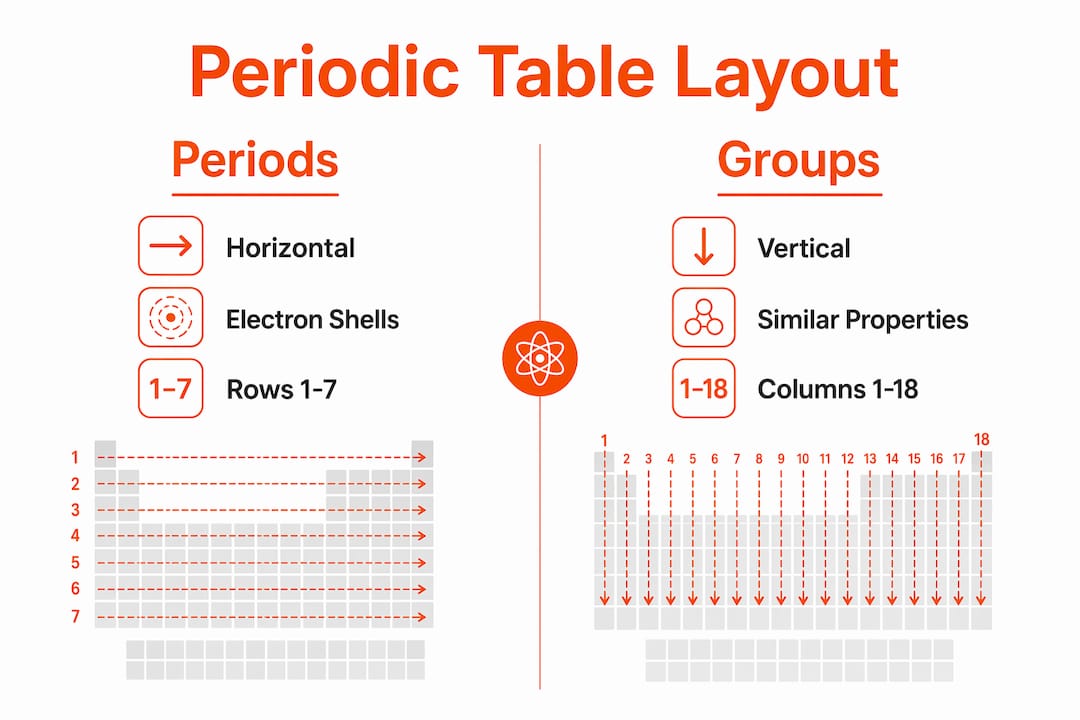
The table's organizing rule is simple: elements run left to right, top to bottom, in order of increasing atomic number. That single rule gives the whole chart its shape.
Periods are the horizontal rows. Each period corresponds to a principal electron shell. Period 1 has just hydrogen and helium (shell 1). Period 2 runs from lithium to neon (shell 2). By the time you reach period 4, elements are filling a third type of orbital, which is why the table suddenly gets wider.
Groups are the vertical columns, numbered 1 through 18. Elements in the same group share the same number of valence electrons, which is why they behave so similarly in reactions. Group 1 elements (the alkali metals) all have one valence electron and all react vigorously with water. Group 17 (the halogens) all have seven valence electrons and all want to grab one more. Group 18 (the noble gases) have full outer shells and mostly sit out reactions entirely.
The table is also divided into four blocks based on which orbital type is being filled:
- s-block (groups 1–2, plus helium): filling s orbitals
- p-block (groups 13–18): filling p orbitals
- d-block (groups 3–12): filling d orbitals — these are the transition metals
- f-block (lanthanides and actinides): filling f orbitals, pulled below the main table to keep it printable
The lanthanides and actinides appear as two separate rows at the bottom. They belong between groups 2 and 3 in periods 6 and 7, but placing them inline would make the table too wide for a standard page.
Pro Tip: If two elements are in the same group, they almost always form the same types of compounds. Sodium (Na) and potassium (K) are both in group 1, so both form +1 ions and both react with chlorine to make a white salt. Use that shortcut constantly on tests.
Metals, nonmetals, metalloids, and the major named groups
The most visible divide on any chemical elements chart is the staircase line that runs from boron (B) down to astatine (At). Everything to the left is a metal; everything to the right is a nonmetal; the elements touching the line are metalloids.
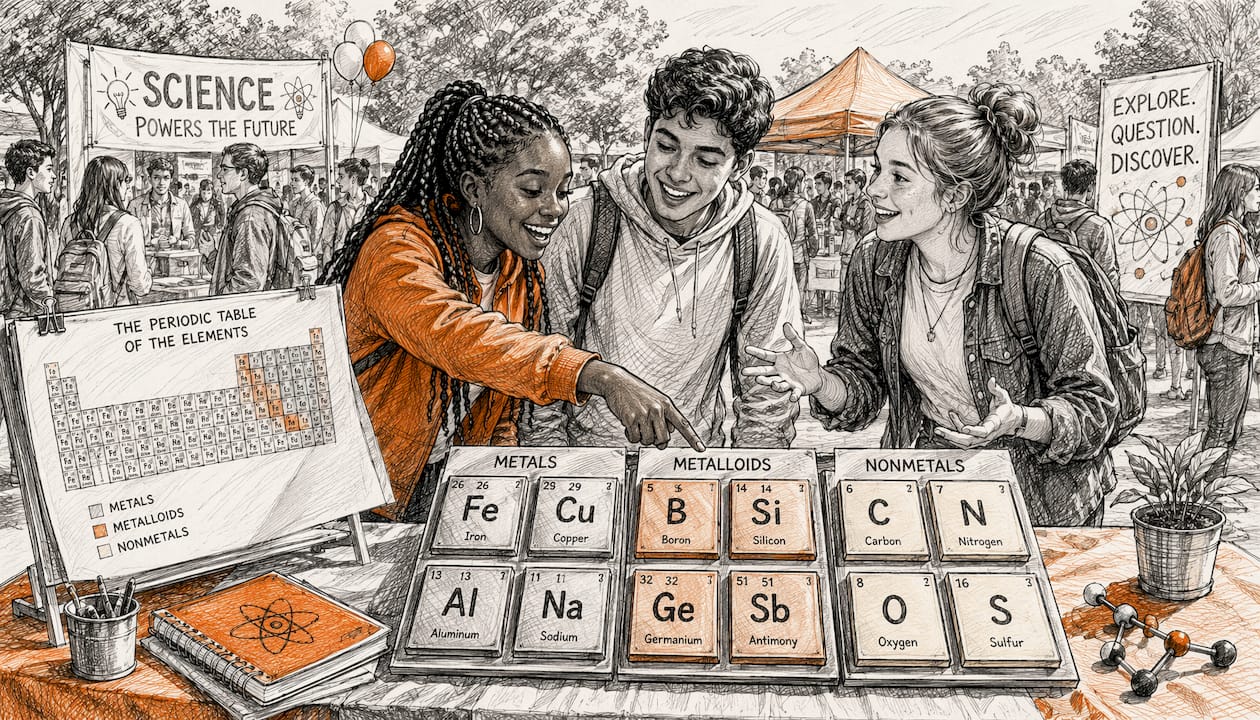
Metals are generally good conductors of heat and electricity, tend to be shiny and malleable, and make up roughly three-quarters of the table. Nonmetals are typically insulators, often brittle as solids, and cluster in the upper-right corner. Metalloids — silicon, germanium, arsenic, antimony, tellurium, and polonium — have intermediate properties that shift depending on conditions. Silicon conducts electricity far better than sulfur but far worse than copper, which is exactly why it works as a semiconductor.
The boundary is genuinely fuzzy. Some advanced courses treat aluminum as a metalloid in certain contexts, and some textbooks debate where to draw the line precisely. For high school purposes, the staircase is a reliable guide.
| Group / Region | Category | Key property |
|---|---|---|
| Group 1 | Alkali metals | One valence electron; highly reactive with water |
| Group 2 | Alkaline earth metals | Two valence electrons; reactive but less so than group 1 |
| Groups 3–12 | Transition metals | Variable oxidation states; high melting points; used as catalysts |
| Group 17 | Halogens | Seven valence electrons; form salts with metals |
| Group 18 | Noble gases | Full outer shells; largely unreactive under standard conditions |
| Periods 6–7, f-block | Lanthanides / Actinides | Rare-earth and radioactive elements; fill f orbitals |
Three real-world snapshots that tie categories to everyday life:
- Iron (Fe), group 8, transition metal — its d-block electrons allow multiple oxidation states, which is why iron forms both rust (Fe₂O₃) and the tough alloy steel used in construction.
- Sodium (Na), group 1, alkali metal — one valence electron makes it so reactive it must be stored in oil, yet that same reactivity is what drives nerve signals in your body when sodium ions cross cell membranes.
- Silicon (Si), group 14, metalloid — its intermediate conductivity is the foundation of every computer chip and solar panel; it also forms the silica in glass.
Noble gases deserve a special mention. Helium, neon, argon, and their group-18 neighbors are largely unreactive under standard conditions because their outer shells are already full. That stability is exactly why neon lights glow without chemically changing and why argon is used to blanket welding seams from oxygen.
Key periodic trends and how to use them
Four trends show up on almost every chemistry test. Learn the direction of each one and you can answer comparison questions without memorizing individual values.
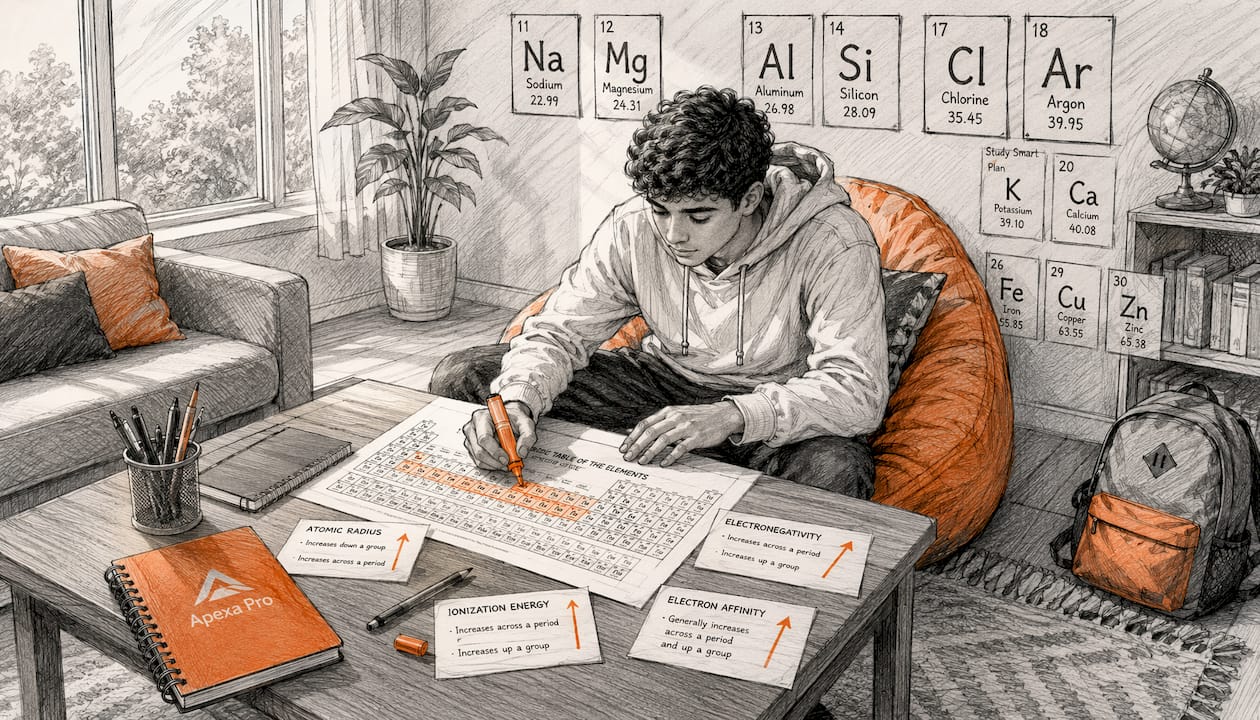
| Trend | Across a period (left → right) | Down a group (top → bottom) | Short cause |
|---|---|---|---|
| Atomic radius | Decreases | Increases | More protons pull electrons closer; more shells add distance |
| Ionization energy | Increases | Decreases | Harder to remove an electron from a smaller, more tightly held atom |
| Electronegativity | Increases | Decreases | Same logic as ionization energy; fluorine is the highest |
| Electron affinity | Generally increases | Generally decreases | Atoms with nearly full shells gain electrons readily |
The underlying driver for left-to-right trends is effective nuclear charge (often written Z_eff). As you move across a period, each new element adds one proton to the nucleus but the new electron goes into the same shell, so it barely adds any shielding. The nucleus pulls harder on all the electrons, shrinking the atom and making it harder to remove an electron.
Moving down a group, each new period adds a full electron shell between the nucleus and the outer electrons. That extra shielding reduces the pull, so atoms get larger and ionization energy drops.
Two quick predictions to practice:
- Which is larger, Na or Cl? Both are in period 3. Sodium is in group 1, chlorine in group 17. Moving right across the period, atomic radius decreases, so Na is larger.
- Which has higher ionization energy, He or Li? Helium is in period 1, group 18 — a full outer shell and high Z_eff. Lithium is in period 2, group 1 — one valence electron in a new, shielded shell. Helium wins by a wide margin.
The ACS notes that the table's layout reveals these repeating trends, which means you can predict element behavior without memorizing every value individually.
Electron configurations, valence electrons, and why they matter for bonding
Every element's position on the table is a shorthand for its electron configuration. The period number tells you the highest principal shell in use; the group number (for main-group elements) tells you the number of valence electrons.
Three simple examples:
- Hydrogen (H): 1s¹ — one electron, one valence electron, forms one covalent bond (as in H₂O)
- Oxygen (O): 1s² 2s² 2p⁴ — six valence electrons, needs two more, forms two bonds (or gains 2e⁻ to become O²⁻)
- Sodium (Na): 1s² 2s² 2p⁶ 3s¹ — one valence electron, loses it easily to form Na⁺ (ionic bonding with chlorine)
Electron configuration patterns/Unit_2%3A_Chemical_Bonding_and_Structure/8%3A_Bonding_in_Transition_Metal_Compounds_and_Coordination_Complexes/8.1%3A_Chemistry_of_the_Transition_Metals) explain block placement and account for many recurring chemical behaviors. The d-block transition metals are a good example: their partially filled d orbitals allow multiple oxidation states, which is why iron can be Fe²⁺ or Fe³⁺ and why copper compounds range from colorless to deep blue.
Quick valence rules for common ions:
- Group 1 → loses 1e⁻ → +1 ion (Na⁺, K⁺)
- Group 2 → loses 2e⁻ → +2 ion (Mg²⁺, Ca²⁺)
- Group 16 → gains 2e⁻ → −2 ion (O²⁻, S²⁻)
- Group 17 → gains 1e⁻ → −1 ion (F⁻, Cl⁻)
Pro Tip: To draw a quick Lewis dot structure for any main-group element, count its valence electrons (= group number for groups 1–2 and 13–18) and place one dot per electron around the symbol, pairing them up only after each side has one. That rule covers most of the Lewis structures you will see in a first-year chemistry course.
How to read an element tile: atomic number, symbol, mass, and more
Every square on the table packs several data points into a small space. Here is what a standard tile contains and what each field means:
| Field | What it tells you |
|---|---|
| Atomic number (top) | Number of protons; defines the element |
| Chemical symbol (center, large) | 1–2 letter abbreviation |
| Element name (below symbol) | Full name |
| Standard atomic mass (bottom) | Weighted average of all natural isotopes, in u (unified atomic mass units) |
| State at room temperature | Solid, liquid, or gas at room temperature |
| Common oxidation states | Typical charges the element takes in compounds |
Interactive tables like the one at Apexapro often add electron configuration, electronegativity, density, and melting point when you click an element — far more than a printed tile can show.
The atomic number and atomic mass are easy to mix up. The atomic number is always a whole number and never changes for a given element. The atomic mass is a decimal because it averages across isotopes weighted by natural abundance.
Watch out for this common mistake: The atomic mass on the tile is NOT the same as the mass number of a specific isotope. Carbon's atomic mass is ~12.011 u (the average), but carbon-14 has a mass number of exactly 14. When a problem asks for the mass number of a specific isotope, use the isotope's proton + neutron count, not the tile's decimal value.
A brief history of the periodic table and how new elements get added today
Dmitri Mendeleev published his arrangement of the elements in 1869, organizing them by atomic mass and leaving deliberate gaps where he predicted undiscovered elements would fit. When gallium, scandium, and germanium were found within years, matching his predictions almost exactly, the scientific community accepted the table as a genuine predictive tool, not just a sorting exercise.
Today, the table is ordered by atomic number rather than mass (a correction Henry Moseley established in 1913), and IUPAC is the international body that validates and officially names newly discovered elements before they are added.
A short timeline of key milestones:
- 1869 — Mendeleev publishes the first widely accepted periodic table, predicting gaps for undiscovered elements
- 1890s — Noble gases (helium, argon, neon, etc.) discovered and added as a new group, confirming the table could accommodate surprises
- 1913 — Moseley reorders by atomic number, resolving inconsistencies in Mendeleev's mass-based version
- 1940s–1970s — Actinides and synthetic transuranium elements fill out the f-block; the table reaches its modern 7-period shape
- 2016 — IUPAC officially names elements 113, 115, 117, and 118 (nihonium, moscovium, tennessine, oganesson), completing period 7
New elements beyond oganesson (118) are theoretically possible, but synthesizing them requires particle accelerators, and they exist for only fractions of a second before decaying.
Real-world examples of common elements in action
Abstract categories become memorable when you connect them to objects you already know.
- Iron (Fe) — The backbone of steel in bridges, skyscrapers, and car frames. Iron's transition-metal properties give it the strength and workability that pure metals like sodium could never offer. In class, you may see iron filings used to visualize magnetic field lines.
- Silicon (Si) — Every smartphone processor and solar cell depends on silicon's semiconducting behavior. In a lab setting, silicon dioxide (SiO₂) is the silica in sand, which students often use in filtration demonstrations.
- Sodium (Na) and chlorine (Cl) — Together they form sodium chloride (table salt), one of the most studied ionic compounds in introductory chemistry. Sodium's explosive reactivity with water and chlorine's toxic gas form are both neutralized when they combine — a vivid illustration of how bonding changes properties entirely.
- Helium (He) — Its noble-gas stability makes it safe for balloons and blimps, and its extremely low boiling point (−269 °C) makes it the coolant of choice in MRI machines and particle accelerators. Students encounter it in gas-law experiments because it behaves almost perfectly as an ideal gas.
Transition-metal compounds often show variable oxidation states and colorful coordination complexes, which is why the pigments in many paints and glazes are transition-metal salts — cobalt blue, chromium green, and iron-based ochres all trace back to d-block chemistry.
How to study the periodic table: techniques and practice activities
Memorizing all 118 elements is not the goal. The goal is knowing the groups, the trends, and how to read a tile quickly. Here is a short routine that works:
- Memorize group headings and a few anchor elements. Learn the group names (alkali metals, halogens, noble gases) and one or two representative elements per group. Sodium for group 1, chlorine for group 17, argon for group 18 — those anchors let you navigate the rest.
- Practice trend comparisons. Pick two elements and ask: which is larger? Which has higher electronegativity? Use the period-and-group rules from the trends section above, not a memorized list.
- Read element tiles for five minutes daily. Open an interactive table, click a random element, and identify its atomic number, mass, valence electrons, and one real-world use. Five minutes of active clicking beats thirty minutes of passive reading.
- Quiz yourself with the interactive table. Cover the element name, look at the symbol, and recall the group. Then check. Spaced repetition with immediate feedback is the fastest way to lock in symbols and positions.
For authoritative data lookup, PubChem's periodic table is a machine-readable database used by researchers worldwide — every measured property is sourced and up to date. The Royal Society of Chemistry's interactive table is excellent for classroom activities and includes curated element stories. For hands-on clicking practice, the Apexapro interactive table is free, browser-based, and works on any device.
Study insight: Trends are more useful than memorized values. Once you know that electronegativity increases across a period and decreases down a group, you can rank any pair of main-group elements without looking them up.
Pro Tip: Space your group-memorization sessions across three days rather than cramming in one sitting. On day one, learn groups 1, 2, and 18. On day two, add groups 17 and 16. On day three, review all five and add the transition metals as a block. That spacing lets each session reinforce the last.
Why the table's shape encodes chemical and physical trends
The layout of the periodic table is not aesthetic — it is a direct consequence of quantum mechanics and electron shell filling. As you move left to right across a period, each additional proton increases the effective nuclear charge pulling on the outer electrons, while the electrons added to the same shell provide almost no extra shielding. The result is a steady tightening: smaller atoms, higher ionization energies, greater electronegativity.
Moving down a group, each new period adds a complete inner shell. Those inner electrons shield the outer ones from the nucleus, reducing effective nuclear charge and allowing the atom to expand. That is why cesium (period 6, group 1) is far larger and far more reactive than lithium (period 2, group 1), even though both have just one valence electron.
To visualize this, sketch a simple 3×3 grid of the first three periods and draw an arrow pointing right labeled "Z_eff increases → smaller, higher IE" and an arrow pointing down labeled "more shielding → larger, lower IE." That two-arrow sketch captures the core logic of every trend question you will face.
The ACS states that the table's layout reveals repeating trends in atomic radius, electronegativity, and ionization energy, allowing scientists to predict element behavior without memorizing every individual value. PubChem describes the modern table as a machine-readable database used by researchers to access element property data — a reminder that the chart students study in class is the same framework professional chemists rely on.
The periodic table currently contains a full set of recognized elements from hydrogen to oganesson, each confirmed and named through experimental discovery and IUPAC validation.
That number has grown steadily since Mendeleev's original 63-element table, and the underlying logic of period-and-group placement has held up through every addition.
Recommended interactive periodic tables and printable resources
Not all periodic tables are equal. Here are the most reliable options for students:
- PubChem Periodic Table (NIH) — Best for data lookup; every element links to a full property page with sourced measurements. Ideal when you need exact values for a lab report.
- Royal Society of Chemistry Interactive Table — Strong for classroom activities; includes curated element stories and trend visualizations. Search "RSC periodic table" to find it directly.
- Wikipedia Periodic Table page — Good for quick overview and history; links to individual element articles for deeper reading.
- NIST Periodic Table of the Elements — NIST's critically evaluated atomic data, available as a high-resolution PDF suitable for printing as a desk or wall chart.
- Apexapro Interactive Periodic Table — Free, browser-based, no sign-up. Click any element to see its atomic number, mass, electron configuration, oxidation states, and usage notes. Fully bilingual (English/Spanish) and works on phones and desktops. Access it at apexapro.com.
For printables, NIST offers a PDF in two versions (with and without crop marks) that prints cleanly at poster size. Single-page cheat sheets and element-symbol flashcard sets are also widely available through school library databases and science department websites.
For a broader perspective on element discovery history, including the current count and how recent additions were confirmed, that resource offers a useful complementary view.
Key Takeaways
The periodic table's power comes from one rule: atomic number determines position, and position predicts behavior — learn the groups and trends, and you can answer most chemistry questions without memorizing individual element facts.
| Point | Details |
|---|---|
| Ordered by atomic number | Elements run left to right, top to bottom, from hydrogen (1) to oganesson (118). There are 118 recognized elements on the modern periodic table. |
| Same group, similar chemistry | Elements in the same column share valence electrons and form the same types of bonds and ions. |
| Trends follow two directions | Atomic radius increases down a group and decreases across a period; electronegativity does the opposite. |
| Read the tile correctly | Atomic number is a whole number (protons only); atomic mass is a decimal average across isotopes. |
| Apexapro for practice | The free Apexapro interactive table lets you click any element to see its full property data, no sign-up needed. |
The periodic table is worth exploring, not just memorizing
Most students treat the periodic table as a wall chart to stare at before a test. That approach misses the point entirely. The table is a prediction engine: once you understand why elements are placed where they are, you can reason about elements you have never studied. That shift from memorization to reasoning is what separates students who find chemistry manageable from those who find it overwhelming.
The patterns here — effective nuclear charge, valence electrons, group behavior — are not arbitrary rules. They reflect how electrons actually occupy space around a nucleus. Spend time with an interactive table, click unfamiliar elements, and test your predictions against the data. The table will start to feel less like a chart and more like a map.
The Apexapro interactive periodic table is free and ready to use
If you want to move from reading about the periodic table to actually using it, Apexapro's free interactive table is the fastest way to start. No account, no download, no waiting — open it in any browser and start clicking.
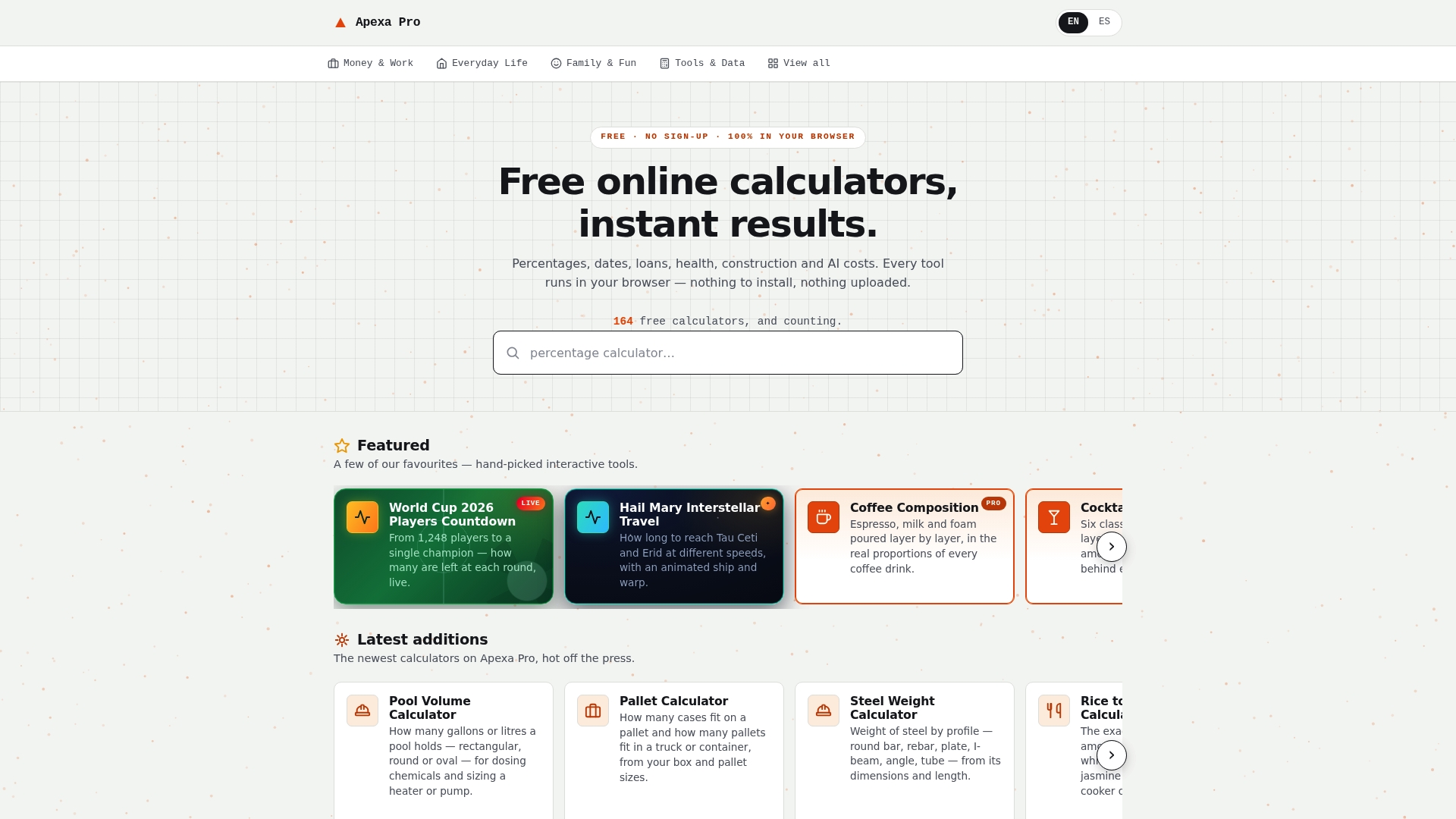
Every element tile on Apexapro expands to show atomic number, atomic mass, electron configuration, common oxidation states, and a short note on real-world uses. The tool is fully bilingual in English and Spanish, works on phones and desktops, and is designed specifically for students doing homework or preparing for tests. It is the same kind of data-rich, interactive reference that researchers use through PubChem, built into a clean interface that a high school student can navigate in seconds. Open it, pick an element from a group you are studying, and check whether its properties match what the trends predict. That one habit will do more for your chemistry grade than any flashcard set.
Useful sources and further reading
Authoritative references for students who want to verify facts, explore data, or cite sources in assignments:
- NIST Periodic Table of the Elements — The U.S. National Institute of Standards and Technology's critically evaluated atomic data; available as a printable high-resolution PDF. Use this when you need verified physical constants.
- PubChem Periodic Table — NIH — A data-rich interactive table maintained by the National Institutes of Health; every element links to a full property database. Best for lab reports and data lookup.
- ACS Periodic Table Resource — The American Chemical Society's educational page explaining trends and the table's structure. Strong for understanding why the layout works.
- Transition Metals — Britannica — Deeper reading on d-block chemistry, variable oxidation states, and industrial uses. Good for students writing reports on transition metals.
- Transition Metal — Wikipedia — Overview of transition-metal properties with links to individual element articles; useful for quick reference and history.
- INL Interactive Periodic Table — Idaho National Laboratory's interactive table, another solid free resource for classroom and homework use.
IUPAC (the International Union of Pure and Applied Chemistry) is the authority that validates and officially names every new element before it appears on the table. When you cite element names or atomic weights in a school assignment, IUPAC-sourced data is the standard your teacher expects.